


 SPARK Website
What Is the Growth Forecast for Latin America Telecom Tower Market by 2034?
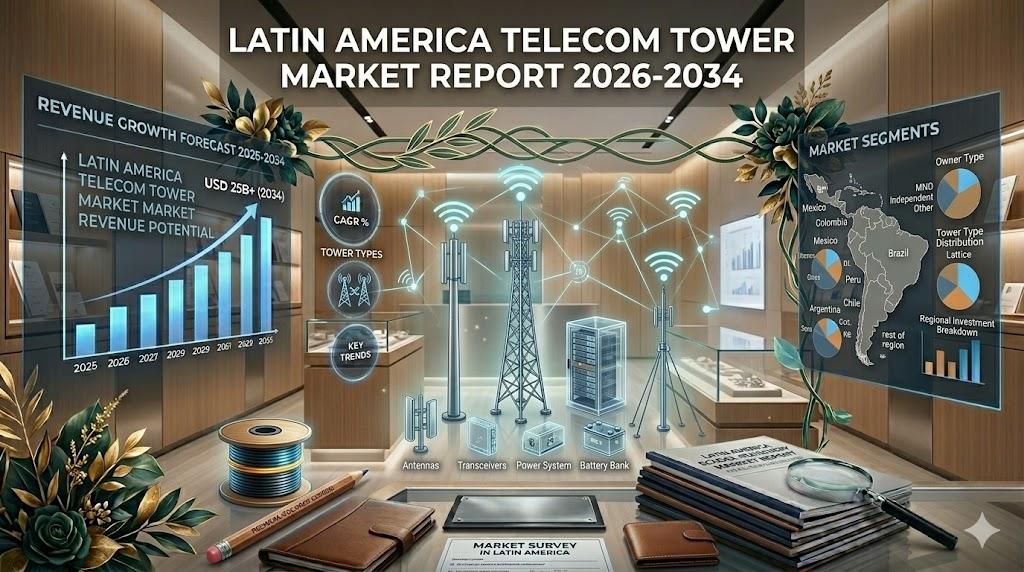
According to the latest industry insights from IMARC Group, the Latin America telecom tower market size reached 231.7 Thousand Units in 2025. Looking forward, the market is projected to reach 314.5 Thousand Units by 2034, exhibiting a compound annual growth rate (CAGR) of 3.28% during the forecast period of 2026-2034.
How Big is the Latin America Telecom Tower Market and What is its Growth Forecast?
The Latin America telecom tower market is witnessing a period of steady expansion as the region prioritizes digital infrastructure to support a modern economy. Valued at 231.7 Thousand Units in 2025, the market serves as the physical foundation for all wireless communication across Central and South America.
The forecast for the next decade remains highly positive. By 2034, the total number of tower units is expected to hit 314.5 Thousand Units. This growth is supported by a CAGR of 3.28%, propelled by the rapid rollout of 5G networks, a surge in mobile data consumption, and proactive government initiatives aimed at enhancing connectivity in underserved rural regions.
Why is the Deployment of 5G Networks Transforming Regional Infrastructure?
The rollout of 5G technology is the single most significant catalyst for the Latin America telecom tower market. As of early 2023, eight countries in the region have already commercially deployed 5G services, with many others following suit.
- Denser Networks: Unlike previous generations, 5G utilizes higher frequency bands. While these bands offer blazing-fast speeds, they have a shorter transmission range, requiring a much higher concentration of towers and small cells to maintain a seamless signal.
- Subscription Growth: Estimates suggest that by late 2026, 5G subscriptions could account for up to 43% of the mobile market in Latin America.
- Financial Impact: The market value is expected to rise significantly to meet these needs, growing from USD 28.48 Billion in 2024 to USD 32.76 Billion by 2029.
How is Escalating Demand for High-Speed Internet Driving Tower Construction?
The digital revolution in Latin America has shifted from a luxury to a necessity. The rise of work-from-home models, online education, and the massive popularity of streaming services have created an insatiable demand for reliable, high-speed connectivity.
- Mobile Subscriber Growth: According to the GSMA, the region is expected to reach 485 million mobile subscribers, covering 72% of the population. This influx of users requires a robust network of towers to handle increased data traffic.
- Streaming Services (SVOD): The region is estimated to reach 165 million SVOD subscribers by 2029, with Brazil leading the penetration. In 2023 alone, there were 110 million subscribers. This "streaming strain" necessitates constant upgrades to existing telecom infrastructure to deliver consistent quality.
Sample Request For Your Business
What are the Main Ownership Models in the Latin America Telecom Tower Industry?
To manage the high costs of infrastructure, the Latin America telecom tower market is divided into three primary ownership segments:
Market Segmentation by Ownership
|
Ownership Type |
Description |
|
MNOs (Mobile Network Operators) |
Towers owned and operated directly by telecom providers like Vivo, Claro, or Movistar. |
|
MNO Owned TowerCo |
Separate tower companies established as subsidiaries of major mobile network operators. |
|
Independent TowerCo |
Third-party companies (e.g., American Tower) that lease space on their towers to multiple MNOs. |
There is a growing trend toward consolidation and the "TowerCo" model, where MNOs sell their assets to independent companies to free up capital for 5G spectrum auctions and network equipment.
Which Installation Types are Dominating the Regional Landscape?
The physical placement of towers depends heavily on the environment - whether it is a dense urban center or a sprawling rural landscape.
- Ground-Based Towers: These are standalone structures typically found in rural or suburban areas where space is abundant. They offer high capacity and are essential for providing broad coverage across vast distances.
- Rooftop Towers: Increasingly popular in crowded cities like São Paulo or Mexico City. These installations utilize existing building heights to provide localized "small cell" coverage, which is vital for the short-range requirements of 5G signals in urban canyons.
Which Countries are the Primary Hubs for Telecom Tower Growth?
While the need for connectivity is universal, certain countries lead the Latin America telecom tower market share due to their population size and economic focus on digital infrastructure:
- Brazil: The undisputed leader. Recent deals, such as Oi transferring assets to American Tower Brazil for USD 7.5 Million, highlight the ongoing consolidation. American Tower now manages over 17,000 towers in the country.
- Mexico: A major hub for investment, focusing on expanding 5G reach across its industrial corridors.
- Colombia: Seeing significant movement, such as Tigo Colombia selling 1,100 towers to KKR affiliates in early 2024 to streamline operations.
- Argentina, Chile, and Peru: These nations are witnessing rapid upgrades as they compete to modernize their digital economies and enhance rural connectivity.
What are the Latest Strategic Developments and Market News?
The competitive landscape of the Latin America telecom tower market is defined by strategic divestments and acquisitions.
- Consolidation (October 2024): The transfer of Oi’s property and tower assets to American Tower Brazil for USD 7.5 Million underscores the shift toward independent tower management.
- Infrastructure Investment (January 2024): Millicom's subsidiary, Tigo Colombia, sold 1,100 wireless communication towers to KKR affiliates, illustrating the influx of private equity into the regional telecom space.
- Rural Initiatives: Governments across the region are offering incentives for operators to expand towers into remote areas to ensure more equitable access to digital services.
What is the Future Outlook for Telecom Towers in Latin America Through 2034?
The future of the Latin America telecom tower market is intrinsically linked to the 5G revolution. With a projected growth to 314.5 Thousand Units by 2034, the region is building the necessary physical framework to support autonomous vehicles, the Internet of Things (IoT), and high-definition mobile content.
The convergence of Independent TowerCo expansion, increased SVOD consumption, and government-led digital inclusion ensures that telecom towers will remain a high-value asset class. As MNOs continue to offload physical assets to focus on service delivery, the market will likely see further professionalization and technological upgrades to existing towers.

 English