


 SPARK Website
Unidirectional Tape Market to Reach USD 7.93 Billion by 2035 | Driven by Aerospace and Automotive Lightweighting Demand
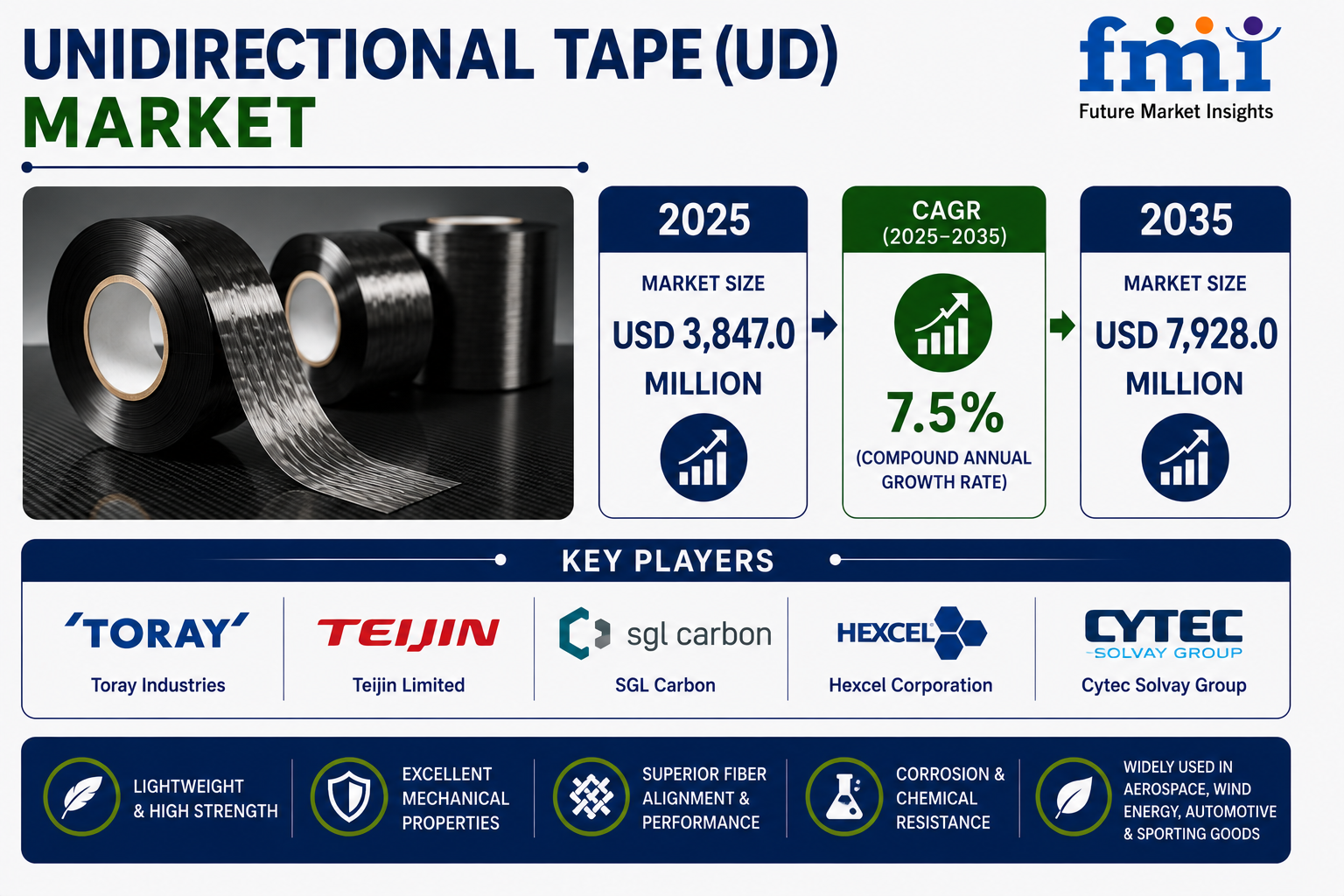
According to Future Market Insights (FMI), The global unidirectional tape (UD) market is entering a decisive growth cycle as manufacturers across aerospace, automotive, wind energy, and industrial engineering intensify their shift toward lightweight, high-strength composite materials. What was once considered a specialized reinforcement solution for niche aerospace programs is increasingly becoming a mainstream structural material platform integrated into next-generation manufacturing infrastructure.
The global unidirectional tape market is projected to expand from USD 3.85 billion in 2025 to USD 7.93 billion by 2035, registering a CAGR of 7.5%. The market’s trajectory reflects broader industrial transformations centered on lightweighting, automation, energy efficiency, and advanced materials engineering.
The next decade is expected to move UD tapes from premium-performance applications into wider industrial deployment, supported by improvements in automated fiber placement, resin systems, manufacturing throughput, and cost optimization.
Quick Stats: Unidirectional Tape (UD) Market
- Market Value (2025): USD 3.85 billion
- Projected Market Value (2035): USD 7.93 billion
- Forecast CAGR (2025–2035): 7.5%
- Leading Fiber Type: Carbon Fiber (56%)
- Largest Application Segment: Aerospace (48%)
- Key Growth Regions: Asia Pacific, North America, Europe
- Leading Companies: Toray Industries, Teijin Limited, SGL Carbon, Hexcel Corporation, Solvay
Get Detailed Market Forecasts, Competitive Benchmarking, and Pricing Trends: https://www.futuremarketinsights.com/reports/sample/rep-gb-3573
Advanced Composites Are Becoming Industrial Infrastructure
The growth of the unidirectional tape market reflects a much larger structural shift underway in global manufacturing.
Industries are increasingly prioritizing:
- Weight reduction
- Structural efficiency
- Fuel savings
- Carbon-emissions reduction
- Automation compatibility
- High-performance materials integration
UD tapes fiber-reinforced composite tapes with aligned continuous fibers — directly support these priorities by delivering exceptional strength-to-weight ratios while enabling precision-controlled manufacturing processes.
Their adoption is accelerating because traditional materials such as steel and aluminum increasingly struggle to meet modern engineering demands around:
- EV range optimization
- Aerospace fuel efficiency
- Wind turbine scaling
- High-pressure vessel durability
- Automated manufacturing precision
As a result, UD tapes are transitioning from “advanced material options” into core engineering materials across multiple industries.
Market Growth Is Expected to Accelerate After 2030
The market’s expansion is expected to occur in two distinct phases.
Phase One: Industrial Adoption (2025–2030)
The first phase will see the market rise from USD 3.85 billion to approximately USD 5.28 billion.
Growth during this stage will be driven by:
- Wider aerospace deployment
- EV lightweighting initiatives
- Increased automated fiber placement adoption
- Higher investment in composite manufacturing capacity
Manufacturers will focus heavily on:
- Standardization
- Material qualification
- Production scalability
- Cost reduction
Phase Two: Mainstream Structural Integration (2030–2035)
The second half of the decade is expected to generate the majority of the market’s value creation.
Between 2030 and 2035, the market is projected to add USD 2.64 billion in additional value — nearly 65% of total decade growth.
This stage will likely be characterized by:
- Multi-sector deployment
- Integration into mass manufacturing systems
- Advanced automation compatibility
- Broader industrial penetration
UD tapes are expected to become embedded into mainstream manufacturing platforms rather than remaining specialized engineering materials.
Aerospace Continues to Define the Market’s Strategic Direction
Aerospace Holds 48% Market Share
The aerospace industry remains the largest and most influential application segment because aircraft manufacturers continue pursuing aggressive lightweighting targets.
UD tapes are increasingly used in:
- Aircraft fuselage structures
- Wing assemblies
- Engine components
- Interior panels
- Control surfaces
Their appeal comes from combining:
- High stiffness
- Fatigue resistance
- Structural integrity
- Weight reduction
In commercial aviation, reducing aircraft weight directly improves:
- Fuel efficiency
- Emissions performance
- Payload optimization
- Operating economics
Defense aerospace programs are also accelerating demand for advanced composite systems that deliver both structural performance and operational durability.
Carbon Fiber Dominates the Competitive Landscape
Carbon Fiber Accounts for 56% Share
Carbon fiber remains the dominant reinforcement material because it provides:
- Exceptional stiffness-to-weight ratios
- Superior fatigue resistance
- High tensile strength
- Dimensional stability
Its dominance is especially strong in:
- Aerospace
- High-performance automotive
- Pressure vessels
- Wind energy systems
Manufacturers continue investing in:
- Improved fiber alignment systems
- Faster curing technologies
- Automated processing compatibility
- Lower-cost carbon fiber production
As production volumes increase, carbon fiber systems are expected to become more commercially viable for broader industrial applications.
Electric Vehicles Are Expanding the Market Beyond Aerospace
One of the most important structural changes underway is the growing role of the automotive industry — particularly electric vehicles.
EV manufacturers are increasingly adopting UD tapes for:
- Battery enclosures
- Structural reinforcements
- Body panels
- Crash-management systems
The logic is straightforward:
lighter vehicles improve battery efficiency and driving range.
As EV competition intensifies globally, manufacturers are under pressure to optimize:
- Weight
- Energy efficiency
- Safety performance
- Structural rigidity
This is creating substantial growth opportunities for composite-material suppliers.
Speak to Analyst: Customize insights for your Business Strategy: https://www.futuremarketinsights.com/customization-available/rep-gb-3573
For Automotive Manufacturers
- UD tapes could become critical for next-generation EV architectures
- Lightweighting increasingly influences range competitiveness
For Material Suppliers
- Processing efficiency and automation compatibility are becoming as important as material performance
- Scale manufacturing capabilities will increasingly define competitive advantage
For Investors
- The market represents long-term exposure to:
- Aerospace growth
- EV expansion
- Renewable energy infrastructure
- Industrial automation
Future Outlook: Composite Manufacturing Enters a Scaling Phase
The next decade is unlikely to be defined solely by material innovation. Instead, the market’s evolution will depend on how effectively manufacturers industrialize advanced composites at scale.
The industry is moving toward:
- Faster composite manufacturing
- Automated production ecosystems
- Lower-cost carbon fiber systems
- Integrated structural materials platforms
As these transitions accelerate, unidirectional tapes are expected to move from premium engineering applications into broader industrial infrastructure.
Executive-Level Takeaways
- The global unidirectional tape market is projected to reach USD 7.93 billion by 2035
- Aerospace remains the dominant application segment
- Carbon fiber continues leading material demand with 56% market share
- EV lightweighting is creating major new commercial opportunities
- Wind energy expansion is increasing demand for structural composite systems
- Automation compatibility is becoming a core competitive requirement
- Asia-Pacific especially China and Japan represents the strongest growth engine
- Cost reduction and manufacturing scalability will shape long-term market penetration

 English