


 SPARK Website
Japan Agriculture Equipment Market Size, Growth, Trends and Demand Outlook 2026–2034
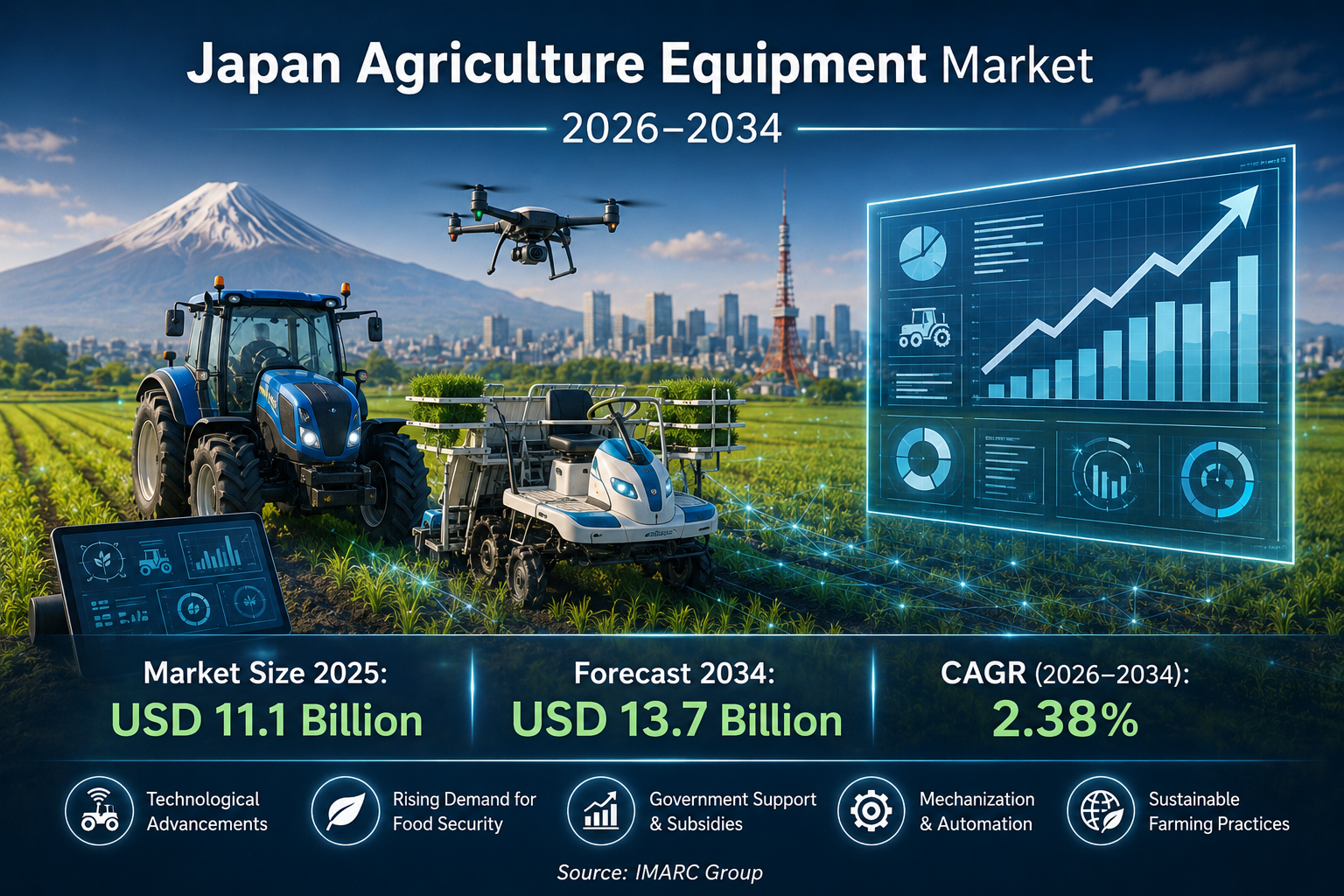
Japan Agriculture Equipment Market Report 2026
Market Size in 2025: USD 11.1 Billion
Market Forecast in 2034: USD 13.7 Billion
Market Growth Rate: 2.38% (2026–2034)
According to the latest report by IMARC Group, titled "Japan Agriculture Equipment Market: Industry Trends, Share, Size, Growth, Opportunity and Forecast 2026-2034," the Japan Agriculture Equipment market was valued at USD 11.1 Billion in 2025. Looking forward, IMARC Group estimates the market to reach USD 13.7 Billion by 2034, exhibiting a CAGR of 2.38% during 2026-2034.
Download a Sample PDF of This Report: https://www.imarcgroup.com/japan-agriculture-equipment-market/requestsample
Japan Agriculture Equipment Industry Trends and Demands in 2026:
The Japan agriculture equipment market is growing steadily with the increase in the penetration of smart agriculture technology, government supported agricultural development in the form of Agriculture 3.0 and Society 5.0, growing demand for autonomous and semi-autonomous farming machinery to overcome farming labor shortage, precision agriculture on rice, vegetable and fruit production system, and an increase in the replacement rate of ageing agricultural machinery in Japan. It covers tractors for agriculture, tilling, and harvesting, irrigation and crop processing equipment, agricultural spraying and handling equipment, soil cultivating and preparation equipment and others for land development, threshing and harvesting, plant protection and post-agro processing applications.
Service channels include OEM and aftermarket. An aging and shrinking rural population means Japan has a desperately tight agricultural workforce, which is now the principal structural driver for growing demand for agricultural machinery automation. Government support for the purchase of smart farming equipment is promoting the adoption of autonomous tractors and drone sprayers. Mechanisation of rice paddy fields still drives demand for tractors and harvesting machinery. Adoption of precision irrigation systems enhances efficiency of water use in vegetables and fruits. Export market opportunities are expanding the international revenue base of Japanese agricultural machinery manufacturers.
The market embodies Japan’s strategic response to the intensifying agricultural labor shortage – a combination of rapidly advancing machinery technology and farm scale consolidation to take advantage of the economies of scale of larger equipment. Farmers and agricultural cooperatives are now moving away from traditional hands-on machinery to GPS- enabled uncrewed and remotely operated machinery. Tractor automation and auto-steering, precision positioning, and IoT data integration are now expected features on most new high-end equipment. The precision machinery for the harvesting of specialized Japanese rice, tea and vegetable crops is in continual development. Spraying equipment related UAV drones are quickly taking over the traditional boom spraying for both paddy and upland field works. OEM channel relationships of Japanese manufacturers such as Kubota, Iseki, Yanmar with domestic agriculture cooperatives maintain a stable institutional procurement volume, and aftermarket channel expansion is driven by an extensive domestically established cycle of replacing/upgrading machinery in Japan.
How AI is Reshaping the Future of the Japan Agriculture Equipment Market:
Autonomous Farming Machinery Navigation and Operation: AI processes GPS positioning, LiDAR sensing, and field mapping data to enable autonomous tractor operation, precision row following, headland turning, and implement depth control without continuous operator supervision. Machine learning models adapt navigation parameters to field topography, soil condition, and crop row variability improving operational accuracy across diverse Japanese paddy and upland field environments. These capabilities directly address Japan's agricultural labor shortage enabling individual farmers to supervise multiple simultaneously operating autonomous equipment units and dramatically extending effective farming hours per available labor unit.
Precision Crop Monitoring and Yield Prediction: AI analyzes satellite imagery, drone-captured field data, soil sensor readings, and historical yield records to generate field-level crop health maps, nutrient deficiency alerts, pest and disease risk assessments, and harvest timing recommendations. Machine learning models predict yield outcomes enabling farmers and agricultural cooperatives to optimize harvest scheduling, procurement planning, and market supply management. These technologies improve crop quality consistency, reduce input waste through targeted treatment application, and support Japanese agricultural producers in maintaining premium product quality standards demanded by domestic retail and food processing customers.
Predictive Maintenance for Agricultural Machinery Fleets: AI monitors tractor, harvester, and sprayer operational data including engine parameters, hydraulic pressure, transmission load, and component vibration signatures to predict maintenance requirements before breakdowns occur during critical planting and harvesting periods. Machine learning algorithms trained on fleet operational data identify early failure precursors enabling preventive parts replacement minimizing costly unplanned downtime. These capabilities are particularly valuable in Japan's time-sensitive rice planting and harvesting windows where equipment downtime directly impacts yield quality and annual revenue outcomes for farm operators and agricultural cooperatives.
Japan Agriculture Equipment Market Segmentation:
The market report offers a comprehensive analysis of the segments, highlighting those with the largest Japan Agriculture Equipment market share. It includes forecasts for the period 2026-2034 and historical data from 2020-2025 for the following segments.
Analysis by Equipment Type:
- Agriculture Tractor
- Harvesting Equipment
- Irrigation and Crop Processing Equipment
- Agriculture Spraying and Handling Equipment
- Soil Preparation and Cultivation Equipment
- Others
Analysis by Application:
- Land Development
- Threshing and Harvesting
- Plant Protection
- After Agro Processing
Analysis by Sales Channel:
- Original Equipment Manufacturers (OEM)
- Aftermarket
Regional Insights:
- Kanto Region
- Kinki Region
- Central/Chubu Region
- Kyushu-Okinawa Region
- Tohoku Region
- Chugoku Region
- Hokkaido Region
- Shikoku Region
Competitive Landscape:
The report offers an in-depth examination of the competitive landscape encompassing market structure, key player positioning, leading strategies for success, a competitive dashboard, and a company evaluation quadrant. Additionally, the report features detailed profiles of all major companies in the Japan Agriculture Equipment industry.
- Kubota Corporation
- Iseki & Co., Ltd.
- Yanmar Holdings Co., Ltd.
- Mitsubishi Mahindra Agricultural Machinery Co., Ltd.
- Claas KGaA mbH (Japan)
Recent News and Developments in Japan Agriculture Equipment Market
April 2026: Kubota Corporation announced the commercial launch of its next-generation autonomous tractor platform featuring AI-powered field navigation, real-time crop monitoring integration, and remote fleet management capabilities targeting Japan's accelerating smart agriculture adoption driven by rural labor shortage structural pressures.
March 2026: Japan's Ministry of Agriculture, Forestry and Fisheries announced expanded subsidies for smart agriculture equipment purchases including autonomous tractors, drone sprayers, and precision irrigation systems, with the program targeting acceleration of technology adoption across small-to-medium scale farm operators and agricultural cooperative networks.
Ongoing: Increasing investments in autonomous machinery development, drone spraying system adoption, precision irrigation technology, AI-powered crop monitoring integration, and government smart agriculture support program funding continue to reshape the Japan Agriculture Equipment market.
Frequently Asked Questions (FAQs)
Q1. What is the size of the Japan Agriculture Equipment market?
The Japan Agriculture Equipment market was valued at USD 11.1 Billion in 2025 and is projected to reach USD 13.7 Billion by 2034, exhibiting a CAGR of 2.38% during 2026-2034.
Q2. What factors are driving the growth of the Japan Agriculture Equipment market?
Key growth drivers include Japan's critical agricultural labor shortage driving autonomous machinery adoption, government smart agriculture subsidy programs under Society 5.0 and Agriculture 3.0 initiatives, rising precision agriculture technology implementation, aftermarket replacement demand from Japan's large aging machinery fleet, growing drone sprayer adoption for plant protection, and Japanese OEM export market expansion opportunities.
Q3. Which equipment types dominate the Japan Agriculture Equipment market?
Agriculture tractors represent the foundational equipment category underpinned by Japan's extensive rice paddy cultivation requiring powered tillage and transport, alongside harvesting equipment for mechanized rice, tea, and vegetable crop collection, and growing demand for agriculture spraying equipment incorporating drone UAV technology for plant protection applications.
Q4. Which sales channel leads the Japan Agriculture Equipment market?
The OEM channel leads through established partnerships between major Japanese manufacturers including Kubota, Iseki, and Yanmar and domestic agricultural cooperatives providing institutional procurement volumes, while the aftermarket channel represents a significant and stable revenue stream driven by Japan's large installed machinery fleet requiring ongoing parts, service, and equipment upgrade investment.
Note: If you need specific information that is not currently within the scope of the report, we will provide it to you as a part of the customization.
About Us:
IMARC Group is a global management consulting firm that helps the world's most ambitious changemakers to create a lasting impact. The company provides a comprehensive suite of market entry and expansion services including thorough market assessment, feasibility studies, company incorporation assistance, factory setup support, regulatory approvals and licensing navigation, branding, marketing and sales strategies, competitive landscape and benchmarking analyses, pricing and cost research, and procurement research.
Contact Us:
Street: 563-13 Kamien
Area: Iwata
Country: Tokyo, Japan
Postal Code: 4380111
Email: sales@imarcgroup.com

 عربي
عربي