


 SPARK Website
Operationalizing Revenue AI Agents with Databricks and Unified Data Platforms
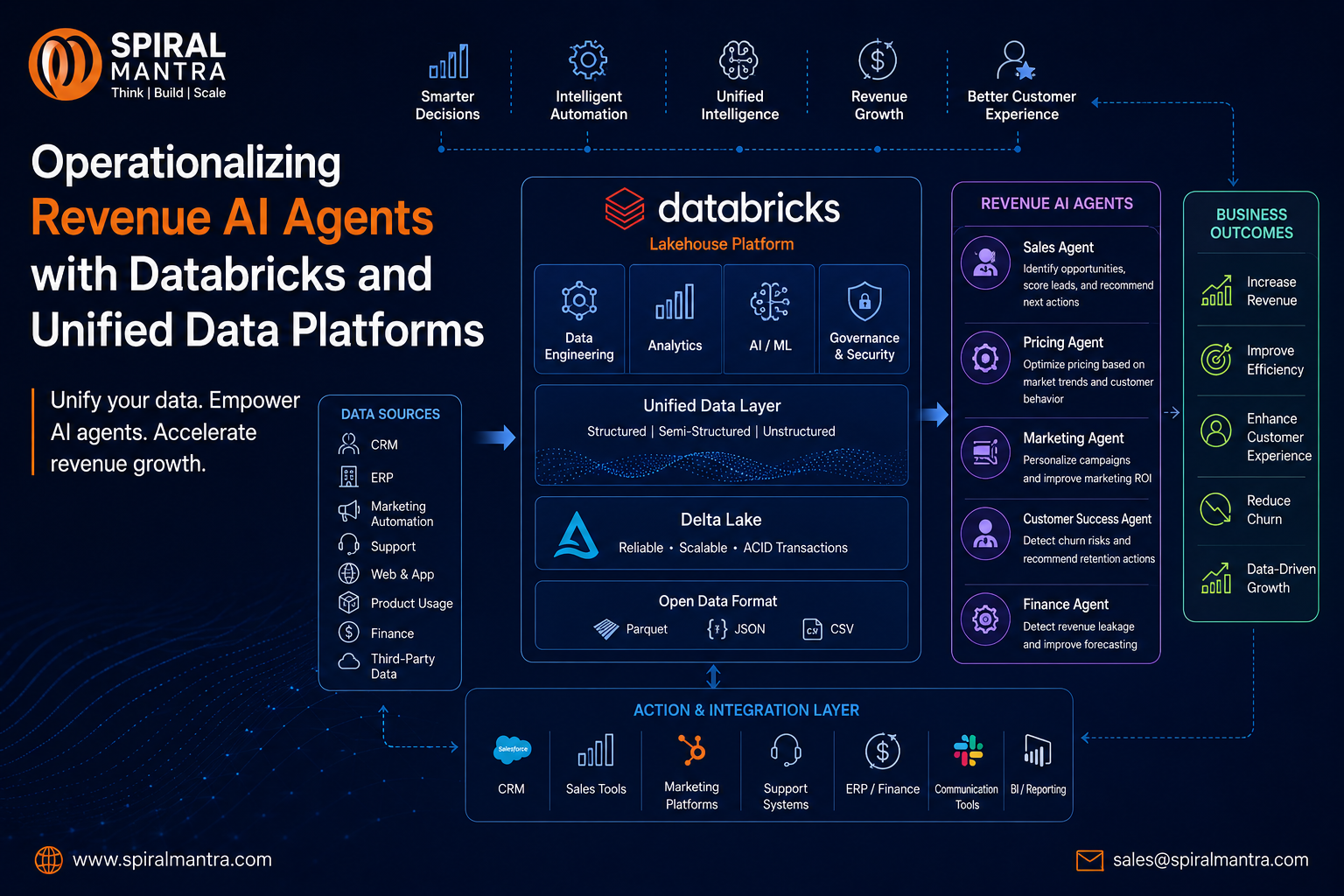
In today’s hyper-competitive digital economy, enterprises are under constant pressure to accelerate revenue growth, improve customer engagement, and make faster business decisions. Traditional dashboards and static reporting systems are no longer enough. Organizations now require intelligent systems that can analyze data in real time, generate insights automatically, and even recommend or execute actions autonomously.
This shift has fueled the rise of Revenue AI Agents — intelligent, AI-powered systems designed to optimize sales, marketing, customer success, and financial operations. By combining unified data platforms like Databricks with modern AI technologies, enterprises can operationalize these agents at scale and transform how revenue teams operate.
As businesses continue investing in advanced AI solutions, the role of modern data engineering services and scalable architecture becomes increasingly critical for enterprise success.
What Are Revenue AI Agents?
Revenue AI Agents are autonomous or semi-autonomous AI systems that continuously analyze enterprise data, identify opportunities, and assist revenue teams with intelligent decision-making.
These agents can:
- Predict customer churn
- Optimize pricing strategies
- Generate sales recommendations
- Personalize customer outreach
- Forecast revenue trends
- Automate lead qualification
- Detect revenue leakage
- Recommend next-best actions
Unlike traditional analytics platforms that rely heavily on manual interpretation, AI agents actively interact with business systems and workflows to improve outcomes.
For example, an AI agent can analyze customer behavior, CRM interactions, product usage data, and marketing engagement in real time to recommend high-conversion upsell opportunities to sales teams automatically.
Why Unified Data Platforms Matter
AI agents are only as effective as the data they consume. Many organizations still struggle with fragmented systems, siloed data warehouses, disconnected applications, and inconsistent governance frameworks.
Unified data platforms solve this challenge by centralizing structured and unstructured data into a single scalable environment.
Platforms like Databricks provide:
- Unified analytics and AI infrastructure
- Real-time data processing
- Scalable machine learning capabilities
- Centralized governance
- Lakehouse architecture
- Support for GenAI and LLM workflows
- Seamless integration with enterprise ecosystems
This unified approach enables organizations to operationalize AI agents more efficiently while maintaining governance, scalability, and performance.
Modern data engineering services play a foundational role in building these integrated environments that support enterprise AI adoption.
The Role of Databricks in Revenue AI Transformation
Databricks has emerged as one of the leading platforms for enterprise AI and advanced analytics. Its Lakehouse architecture combines the flexibility of data lakes with the performance of data warehouses, enabling businesses to unify analytics, machine learning, and AI operations.
Key Capabilities Driving Revenue AI Agents
1. Unified Lakehouse Architecture
Revenue AI agents require access to massive amounts of data across multiple business functions. Databricks enables organizations to consolidate data from:
- CRM systems
- ERP platforms
- Marketing automation tools
- Customer support systems
- Financial applications
- Product analytics platforms
By eliminating silos, organizations gain a complete revenue intelligence layer.
2. Real-Time Data Processing
Modern revenue operations depend on real-time decision-making.
Databricks supports streaming and real-time analytics that allow AI agents to:
- Detect customer behavior instantly
- Trigger automated recommendations
- Monitor revenue anomalies
- Optimize campaigns dynamically
This real-time capability helps businesses respond faster to changing customer and market conditions.
3. AI and Machine Learning Integration
Databricks simplifies the deployment of machine learning and Generative AI models using tools like:
- MLflow
- Mosaic AI
- Delta Lake
- Feature Store
- Vector Search
These capabilities allow organizations to build AI agents that continuously learn from enterprise data and improve performance over time.
Many enterprises partner with a trusted software development company to design, integrate, and operationalize these advanced AI workflows efficiently.
Operationalizing Revenue AI Agents: Key Components
Successfully deploying Revenue AI Agents requires more than just machine learning models. Organizations need a robust operational framework.
Data Engineering Foundation
Strong data pipelines are essential for delivering clean, accurate, and real-time data to AI systems.
Modern data engineering services help organizations:
- Build scalable ETL/ELT pipelines
- Enable data governance
- Ensure data quality
- Integrate multi-source enterprise systems
- Optimize real-time data flows
Without reliable data engineering, AI agents cannot deliver accurate recommendations or automation.
AI Model Development and Governance
Operational AI requires:
- Continuous model training
- Monitoring and observability
- Bias detection
- Explainability
- Version control
- Compliance management
Databricks provides MLOps capabilities that simplify AI lifecycle management while ensuring enterprise-grade governance.
Workflow Automation
Revenue AI Agents become significantly more powerful when integrated with enterprise workflows.
Examples include:
- Triggering automated CRM updates
- Sending personalized outreach campaigns
- Creating sales alerts
- Recommending pricing adjustments
- Automating support escalations
This level of automation enhances productivity while reducing manual effort across teams.
Use Cases of Revenue AI Agents
Intelligent Sales Forecasting
AI agents analyze historical sales data, pipeline activity, customer engagement, and market trends to improve forecasting accuracy.
This helps leadership teams make smarter investment and resource allocation decisions.
Dynamic Pricing Optimization
AI-powered pricing engines continuously analyze demand, competition, customer behavior, and profitability metrics to recommend optimal pricing strategies.
Customer Churn Prevention
Revenue AI agents identify churn signals early by analyzing:
- Product usage
- Support interactions
- Engagement patterns
- Contract activity
Organizations can proactively engage at-risk customers before revenue loss occurs.
Personalized Revenue Growth Strategies
AI agents help marketing and sales teams personalize recommendations for customers based on real-time behavioral intelligence.
This drives:
- Higher conversion rates
- Increased customer retention
- Better customer experiences
- Improved lifetime value
The Importance of AI Solutions in Modern Enterprises
Enterprises are increasingly investing in scalable AI solutions to improve operational efficiency and drive business innovation.
However, implementing AI successfully requires:
- Scalable infrastructure
- Strong governance
- Reliable data pipelines
- Cross-functional integration
- Domain expertise
Organizations that operationalize AI effectively gain competitive advantages through faster decision-making, intelligent automation, and improved customer engagement.
This is why businesses often collaborate with an experienced software development company that specializes in AI modernization and enterprise data platforms.
Challenges in Operationalizing Revenue AI Agents
Despite the opportunities, organizations still face several challenges:
Data Silos
Disconnected systems limit AI visibility and reduce model effectiveness.
Governance and Security
Enterprises must ensure compliance, privacy, and secure AI operations.
Scalability
AI systems must handle growing data volumes and real-time workloads efficiently.
Integration Complexity
Revenue AI Agents often require integration across multiple enterprise platforms.
Talent Gaps
Building enterprise AI systems requires expertise in:
- AI engineering
- Data engineering
- MLOps
- Cloud architecture
- Enterprise integration
This makes specialized data engineering services increasingly valuable for organizations pursuing enterprise AI transformation.
The Future of Revenue Operations
Revenue operations are evolving from reactive reporting toward autonomous intelligence systems.
Future-ready enterprises will increasingly rely on:
- AI-powered decision intelligence
- Agentic AI systems
- Unified data ecosystems
- Real-time predictive analytics
- Intelligent workflow automation
Platforms like Databricks are becoming central to this transformation by enabling organizations to operationalize AI at enterprise scale.
Businesses that invest early in unified data strategies and AI solutions will be better positioned to accelerate growth, improve customer experiences, and adapt to rapidly changing market conditions.
Conclusion
Operationalizing Revenue AI Agents with Databricks and unified data platforms is redefining how modern enterprises approach revenue growth and business intelligence.
By combining scalable infrastructure, advanced AI capabilities, and modern data engineering services, organizations can move beyond static dashboards toward intelligent, autonomous revenue systems.
As enterprise AI adoption accelerates, businesses need robust AI solutions and strategic technology partnerships to successfully deploy and scale these intelligent systems.
Partnering with an experienced software development company can help enterprises build future-ready architectures that unlock the full potential of Revenue AI Agents and unified data platforms.

 عربي
عربي