


 SPARK Website
Challenges in Teaching Machines to Understand Context
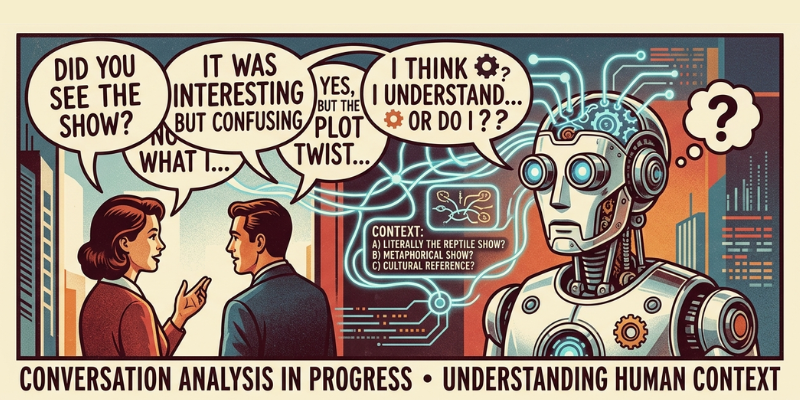
Artificial Intelligence has made great progress recently. However, understanding context is still a big challenge. Context helps humans interpret meaning beyond words, tone, and situations, but machines often struggle with this layer of understanding. This gap affects how accurately AI systems respond to real-world inputs. If you want to build a strong foundation in these concepts, consider enrolling in the Artificial Intelligence Course in Bangalore at FITA Academy to deepen your practical understanding.
What Context Means in AI
The term "context" in AI pertains to a system's capability to understand meaning by utilizing adjacent information. Humans use prior knowledge, emotions, and environment to understand conversations naturally. Machines rely on patterns in data, which may not always capture deeper meaning. This makes context a complex concept to model in algorithms.
For example, a simple sentence can have multiple meanings depending on tone or situation. AI systems often focus on word patterns rather than intent. This limitation can lead to misunderstandings, especially in conversations that involve sarcasm or ambiguity.
Ambiguity in Language
One of the biggest challenges is dealing with ambiguous language. Terms and expressions can carry various interpretations depending on the context. Humans easily resolve this ambiguity using experience, but machines depend on training data. If the data lacks variety, the system may misinterpret the meaning.
This issue becomes more visible in natural language processing tasks like chatbots or translation systems. A small misunderstanding can change the entire message. Developers need to design models that can consider multiple interpretations before giving an output.
Lack of Real World Understanding
AI systems do not truly understand the world the way humans do. They process information based on patterns rather than real experiences. This makes it difficult for machines to connect language with real-world knowledge. As a result, AI may generate responses that sound correct but lack practical sense.
Improving this requires better training data and more advanced learning techniques. If you are interested in learning how such systems are trained and improved, you can explore an Artificial Intelligence Course in Hyderabad to gain hands-on insights into these concepts.
Data Limitations and Bias
Another challenge lies in the quality of data used to train AI models. Context depends heavily on diverse and accurate data. When the data is biased or lacking, the AI system will have difficulty accurately interpreting meaning. This can lead to unfair or incorrect outcomes.
Data diversity plays a key role in improving contextual understanding. Developers must carefully select and preprocess data to reduce bias. This process is time-consuming but essential for building reliable AI systems.
Difficulty in Handling Long Conversations
Understanding context becomes even harder in long conversations. AI systems often lose track of earlier information as the interaction continues. Humans can remember previous points and connect them easily, but machines may treat each sentence independently.
Advanced models try to maintain context over multiple steps, but this is still an evolving area. Improving memory and sequence handling is a key focus in modern AI research.
Teaching machines to understand context is a complex task that involves language, data, and real-world knowledge. While progress has been made, there are still many limitations that researchers are working to overcome. As artificial intelligence progresses, improved comprehension of context will result in more precise and human-like interactions. If you are eager to explore these concepts further, consider enrolling in an AI Course in Ahmedabad to build your expertise and practical skills in this field.
Also check: How AI Differs from Traditional Programming

 English