


 SPARK Website
How POS Systems Improve Kitchen Efficiency in Busy Pakistani Restaurants
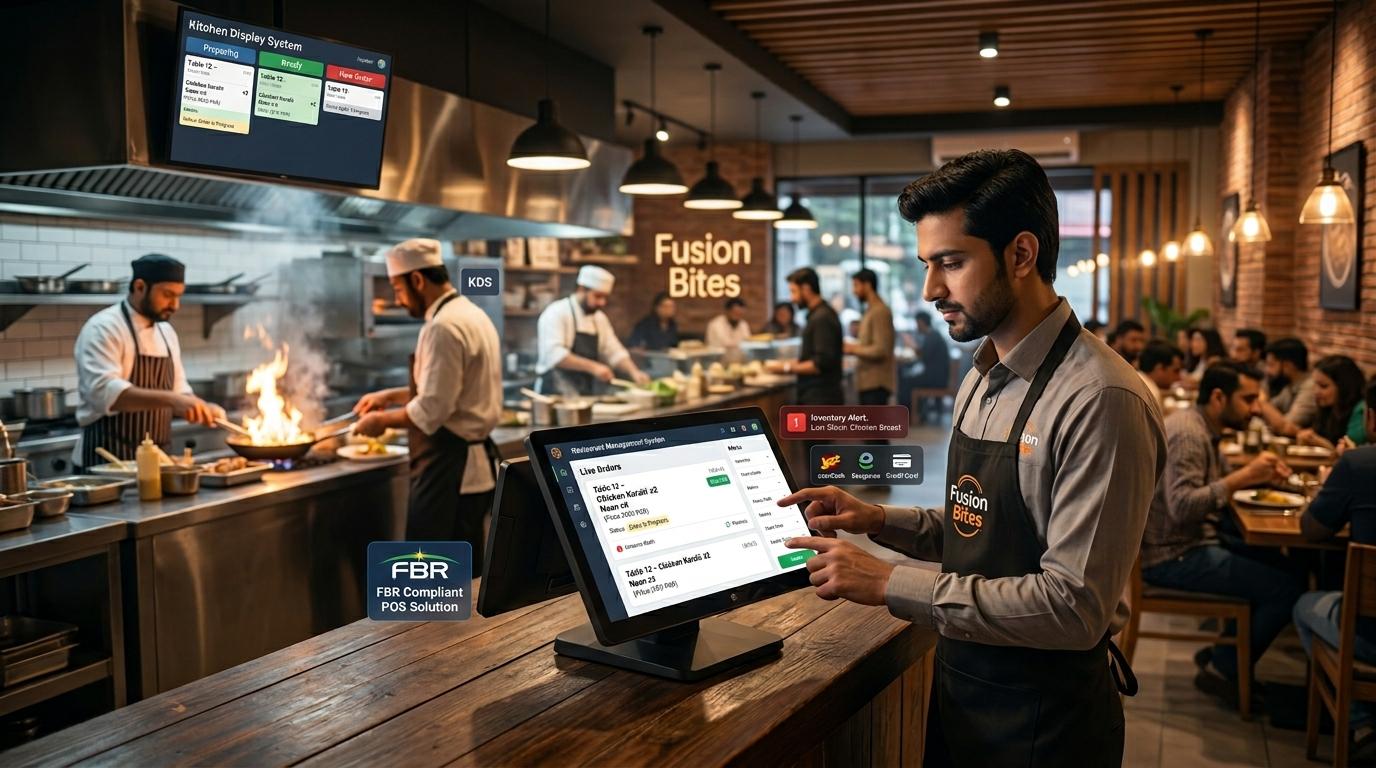
Running a busy restaurant in Pakistan means managing a storm of simultaneous demands: dine-in tables filling up, online delivery orders pouring in, kitchen staff shouting for clarity, and cashiers juggling bills during the evening rush. For food business owners who still rely on handwritten order slips and manual billing, the result is predictable: delayed food, wrong orders, unhappy customers, and a kitchen team working harder than it should. A modern restaurant POS system changes all of that, and its impact on kitchen efficiency is far greater than most owners realize.
The Real Cost of Kitchen Chaos
Before diving into solutions, it is important to understand what inefficiency actually costs a Pakistani restaurant. A missed order during a Friday dinner rush can mean losing a table of eight customers permanently. A billing error costs not just money but trust. Slow ticket times during peak hours directly reduce table turnover, which is one of the most important metrics for any dine-in restaurant.
The root cause of most kitchen problems is poor communication between the front of house and the back of house. Waitstaff write orders by hand, rush them to the kitchen, and the chef deciphers hurried handwriting under pressure. This system was never designed for the scale that modern Pakistani restaurants operate at.
How Restaurant POS Software Bridges the Communication Gap
A restaurant POS software solution eliminates the handwritten order slip entirely. When a waiter takes an order on a tablet or terminal, it is transmitted instantly to the kitchen through a Kitchen Display System (KDS). The chef sees the order on a screen the moment it is placed, with complete details including special instructions like "no spice" or "extra raita."
This real-time order management does several things at once. It removes the physical trip between the front and back of house. It eliminates handwriting errors. And it creates a digital record of every order that can be reviewed later for training or dispute resolution.
For restaurants running multiple stations, such as a grill section, a dessert station, and a drinks counter, a good restaurant management software can route each item to the correct station automatically. The biryani goes to the rice section while the seekh kebab goes to the grill, all from a single customer order.
Inventory Management in Real Time
One of the most overlooked features of a modern point of sale system is its inventory management capability. In Pakistani food business kitchens, ingredient wastage and over-ordering are silent profit killers. A cloud-based POS solution tracks ingredient usage in real time as orders are placed. When a specific dish is ordered, the system automatically deducts the relevant ingredients from your stock counts.
This means a kitchen manager knows at any given moment exactly how much chicken is left, whether the stock of ghee is running low, or if it is time to reorder bread for the morning. Restaurant billing software that is integrated with inventory removes the guesswork and prevents the embarrassing situation of telling a table that your most popular dish is unavailable.
Faster Billing and Table Turnover
In a busy Pakistani restaurant, the time between a customer finishing their meal and leaving the table is critical. Every extra minute a paid table sits idle is lost revenue. With a digital POS system, the billing process is dramatically faster. A waiter can generate and print a bill in seconds, accept payment through cash or card, and mark the table as available, all without walking to a central counter.
This speed directly improves table turnover rates. For Lahori dhabas, Karachi seafood restaurants, and Islamabad cafes alike, faster table turnover during peak hours can mean serving significantly more covers in a single evening without adding a single seat.
Data-Driven Decisions for Kitchen Staff Management
A restaurant POS solution does not just process orders. It records them. Over time, this data becomes incredibly valuable. Your point of sale software can show you which dishes sell the most on which days, what peak ordering hours look like, and which menu items consistently generate the highest revenue.
With this information, kitchen managers can plan prep schedules far more accurately. If the data shows that karahi orders spike between 8 PM and 10 PM on weekends, you can ensure that marinated chicken is prepped and mise en place is ready before the rush hits. This kind of data-driven kitchen management turns reactive firefighting into proactive planning.
Managing Multiple Channels from One System
Pakistani food businesses today operate across multiple order channels simultaneously. There are dine-in customers, takeaway orders, phone orders, and orders coming through food delivery platforms. Managing all of these through separate systems is a recipe for confusion.
A robust restaurant POS software centralizes all order channels into a single dashboard. Delivery orders appear in the same kitchen queue as dine-in orders, each flagged clearly by channel and priority. Kitchen staff no longer need to monitor multiple screens or answer phones to confirm orders. The POS handles the routing, and the kitchen focuses on what it does best: cooking.
The Local Advantage for Pakistani Restaurants
Not all point of sale solutions are built with local operations in mind. When evaluating restaurant POS software in Pakistan, owners should look for systems that support Urdu menu inputs, handle split billing for large family tables, integrate with local payment methods, and offer reliable customer support in the same time zone. Scalability also matters. A system that works for a single outlet should be able to grow with you as you expand to multiple branches.
Some local providers like myPOS have started addressing these gaps by building solutions tailored to the realities of the Pakistani food service industry, from small dhabas to multi-location chains. The key is choosing software that your kitchen staff can actually adopt quickly, because the best POS system is the one your team uses consistently, not the one with the longest feature list.
Conclusion
The difference between a chaotic kitchen and a smooth one is rarely about how hard the team works. It is almost always about the systems they work with. A modern POS software solution transforms kitchen communication, tightens inventory control, speeds up billing, and equips managers with the data they need to make smarter decisions. For busy Pakistani restaurants competing in an increasingly demanding market, investing in the right restaurant point of sale system is not a luxury. It is the foundation of a kitchen that can actually keep up.

 عربي
عربي