


 SPARK Website
Shoulder Replacement Market Size to Reach USD 4.69 Billion by 2033, Driven by Rising Orthopedic Disorders and Advancements in Surgical Techniques
Market Overview
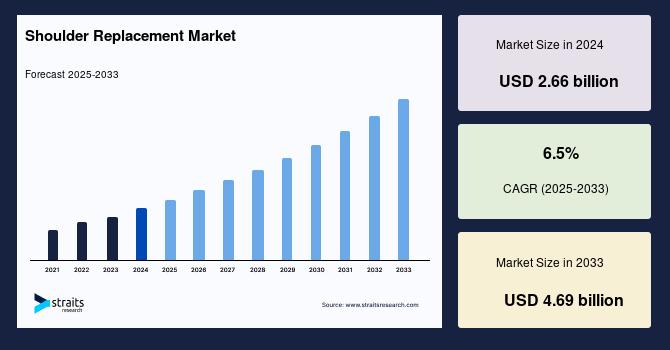
The global Shoulder Replacement Market is witnessing steady growth, driven by the increasing prevalence of orthopedic disorders, aging populations, and advancements in surgical procedures. According to the latest report by Straits Research, the market was valued at USD 2.66 billion in 2024 and is projected to reach USD 4.69 billion by 2033, growing at a CAGR of 6.5% during the forecast period.
Explore comprehensive insights, detailed forecasts, and competitive analysis:
https://straitsresearch.com/report/shoulder-replacement-market
Shoulder replacement procedures involve the surgical replacement of damaged joint components with prosthetic implants to restore function and relieve pain. These procedures are commonly performed in patients suffering from conditions such as osteoarthritis, rheumatoid arthritis, and severe fractures.
Market Dynamics
The growth of the shoulder replacement market is primarily driven by the rising incidence of musculoskeletal disorders and joint-related conditions. An aging global population is particularly susceptible to degenerative joint diseases, leading to increased demand for joint replacement procedures.
Additionally, advancements in medical technology and surgical techniques are significantly contributing to market growth. Minimally invasive procedures, improved implant designs, and enhanced surgical precision are resulting in better patient outcomes and faster recovery times.
The growing awareness of orthopedic treatments and increasing access to healthcare services are also supporting market expansion. Patients are becoming more informed about available treatment options, leading to higher adoption of shoulder replacement procedures.
Furthermore, the increasing participation in sports and physical activities is contributing to the rising number of shoulder injuries, further driving demand for surgical interventions.
Technological innovations such as 3D printing, robotic-assisted surgery, and customized implants are transforming the landscape of shoulder replacement procedures. These advancements are improving implant fit, durability, and overall surgical success rates.
However, high costs associated with surgical procedures and potential complications may pose challenges to market growth. Despite these constraints, ongoing innovation and increasing healthcare investments are expected to create new opportunities.
Market Segmentation
The shoulder replacement market is segmented based on type, procedure, and end-users.
By Type
- Anatomical Shoulder Prosthesis
- Reverse Shoulder Prosthesis
Reverse shoulder prosthesis is gaining traction due to its effectiveness in treating complex shoulder conditions and rotator cuff deficiencies.
By Procedure
- Resurfacing Hemiarthroplasty
- Reverse Total Replacement
- Stemmed Hemiarthroplasty
- Total Shoulder Replacement
Total shoulder replacement holds a significant share due to its widespread use in treating severe joint damage.
By End-Users
- Hospitals
- Orthopaedic Centres
- Others
Hospitals dominate the market due to the availability of advanced surgical facilities and skilled healthcare professionals.
Regional Insights
Geographically, the market is segmented into North America, Europe, Asia-Pacific, Latin America, and the Middle East & Africa.
North America holds a dominant position in the shoulder replacement market, supported by advanced healthcare infrastructure, high adoption of innovative technologies, and strong presence of leading medical device companies. Europe follows closely, driven by increasing healthcare investments and growing awareness of orthopedic treatments.
Asia-Pacific is expected to witness significant growth during the forecast period due to expanding healthcare infrastructure, rising medical tourism, and increasing prevalence of orthopedic conditions in countries such as China and India.
Latin America and the Middle East & Africa are projected to experience steady growth, supported by improving healthcare access and rising investments in medical technologies.
Competitive Landscape
The shoulder replacement market is highly competitive, with key players focusing on innovation, product development, and strategic collaborations.
Leading companies operating in the market include:
- Johnson & Johnson
- Stryker Corporation
- Zimmer Biomet
- Exactech Inc.
- Waldemar Link GmbH & Co. KG
- Arthrex, Inc.
- Aesculap AG
- DJO Global, Inc.
- Osteonics Corporation
These companies are investing in advanced implant technologies, robotic-assisted surgical systems, and innovative solutions to improve patient outcomes and expand their market presence.
Gain deeper insights including segment-level forecasts, company benchmarking, and strategic recommendations tailored to your business needs:
https://straitsresearch.com/report/shoulder-replacement-market/request-sample
Conclusion
The global shoulder replacement market is poised for steady growth, driven by increasing prevalence of orthopedic disorders, advancements in surgical technologies, and rising healthcare investments. As the demand for effective and minimally invasive treatment options continues to grow, market players are expected to focus on innovation and strategic expansion to maintain a competitive edge.

 عربي
عربي