


 SPARK Website
Smart Concrete Calculator Guide for Perfect Construction Planning
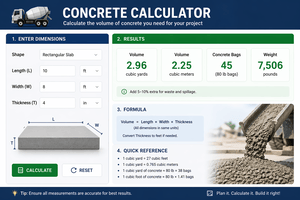
Building anything with concrete—whether it is a small patio, a driveway, or a large foundation—requires careful planning. One of the biggest challenges people face is knowing how much concrete they actually need. Ordering too little can delay your project, while ordering too much wastes money. This is where a Concrete Calculator becomes very useful.
A Concrete Calculator is a simple tool that helps you estimate the exact amount of concrete required for your project. It works by using measurements like length, width, and depth. With just a few inputs, it gives you an accurate result. This saves time, reduces waste, and helps you stay within budget.
In this article, we will explore everything about a Concrete Calculator in very simple language. You will learn how it works, why it is important, and how you can use it step by step. We will also discuss tips, mistakes to avoid, and real-life examples to make things easy to understand.
Understanding Concrete Calculator Basic Working
A Concrete Calculator works on a simple idea. It calculates the volume of the space where you want to pour concrete. Volume is the total space that needs to be filled.
To use a Concrete Calculator, you usually need three basic measurements:
- Length
- Width
- Depth (or thickness)
The formula behind it is very simple:
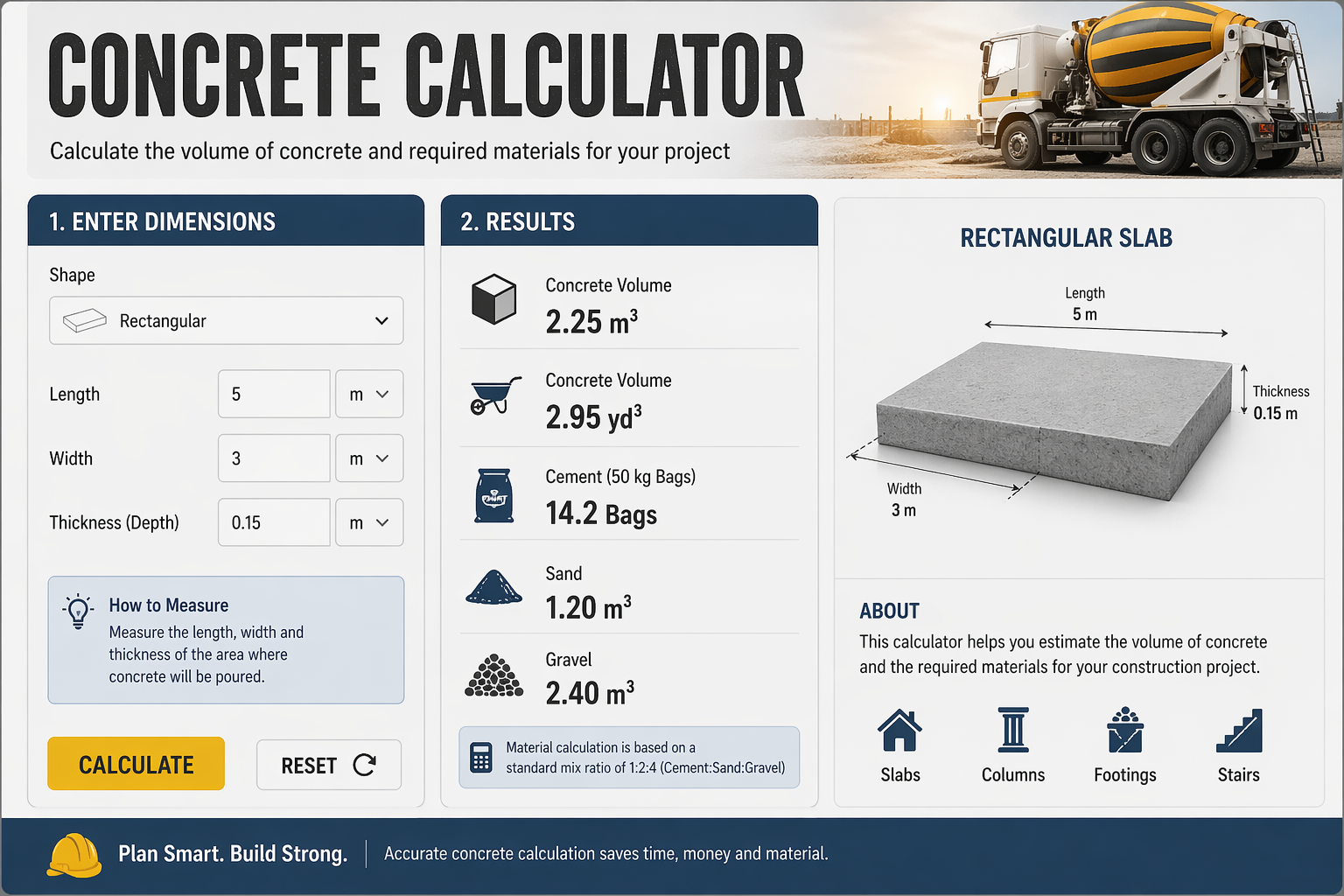
Volume = Length × Width × Depth
Let’s say you want to build a small concrete slab. If the length is 10 feet, width is 5 feet, and depth is 0.5 feet, the calculator multiplies these numbers to give you the volume. This volume tells you how much concrete is required.
Most calculators also convert this volume into cubic meters, cubic feet, or even bags of concrete. This makes it easier to order materials.
The best part is that you do not need to do any complex math yourself. A Concrete Calculator does everything for you in seconds. You just need to enter the correct measurements.
Another important thing is that some calculators allow different shapes like:
- Rectangular slabs
- Circular areas
- Columns
- Footings
This makes the tool flexible and useful for all types of construction projects.
In simple words, a Concrete Calculator saves effort and gives quick, reliable results. Even beginners can use it without any technical knowledge.
Why Concrete Calculator Is Very Important
Using a Concrete Calculator is not just helpful—it is essential for any construction work. Without it, you are just guessing, and guessing often leads to problems.
First, it helps you save money. Concrete is not cheap, and ordering too much can increase your project cost. On the other hand, ordering too little means you will have to buy more later, which can be expensive and inconvenient.
Second, it saves time. Construction projects often run on tight schedules. If you run out of concrete in the middle of work, everything stops. A Concrete Calculator helps you avoid such delays by giving accurate estimates.
Third, it reduces waste. Wasting materials is not good for your budget or the environment. When you know the exact amount needed, you only use what is required.
Another important reason is accuracy. Manual calculations can lead to mistakes, especially if you are not experienced. A Concrete Calculator reduces human error and gives precise results.
It also helps in planning. When you know how much concrete you need, you can plan transportation, labor, and mixing properly. This makes the entire process smooth.
For large projects, even a small mistake in calculation can lead to big losses. That is why professionals always use a Concrete Calculator before starting any work.
In short, using a Concrete Calculator makes your project:
- More accurate
- More efficient
- More cost-effective
Steps To Use Concrete Calculator Easily
Using a Concrete Calculator is very simple, even if you are new to construction work. You just need to follow a few easy steps.
First, measure the area where you want to pour concrete. Use a measuring tape to find the length and width. Make sure your measurements are correct because even small mistakes can affect the result.
Next, measure the depth or thickness. This depends on your project. For example, a driveway may need more thickness than a walkway.
After that, enter these values into the Concrete Calculator. Most tools allow you to choose units like feet, meters, or inches. Make sure you use the same unit for all measurements.
Once you enter the values, the calculator will instantly show the volume of concrete required. Some tools also show how many bags of concrete you need.
Many calculators also include a waste factor. This means they add a little extra concrete to cover spillage or uneven surfaces. This is very useful because it ensures you do not run short.
If your project has multiple sections, calculate each section separately and then add the results. This gives a more accurate estimate.
It is also a good idea to double-check your inputs before calculating. This helps avoid errors.
In simple terms, the steps are:
- Measure the area
- Enter the values
- Get the result
With these steps, anyone can use a Concrete Calculator easily and confidently.
Common Mistakes While Calculating Concrete Needs
Even though a Concrete Calculator is simple to use, people still make some common mistakes. These mistakes can lead to wrong results and cause problems during construction.
One common mistake is incorrect measurements. If your length, width, or depth is wrong, the final calculation will also be wrong. Always measure carefully and double-check your values.
Another mistake is ignoring units. Sometimes people mix units like feet and inches, which leads to incorrect results. Always use the same unit for all measurements.
Not considering depth properly is another issue. Some people guess the thickness instead of measuring it. This can lead to ordering too much or too little concrete.
Many people also forget to include extra material for waste. In real projects, some concrete is always lost due to spillage or uneven ground. A Concrete Calculator often allows you to add extra percentage, so always use that option.
Another mistake is not dividing complex shapes into simple parts. If your area is not a perfect rectangle or circle, break it into smaller sections and calculate each one separately.
Rushing the process is also a problem. People often enter values quickly without checking, which increases the chances of errors.
Lastly, relying only on guesswork instead of using a Concrete Calculator is the biggest mistake. Guessing may work for very small projects, but it is risky for anything bigger.
Avoiding these mistakes will help you get accurate results and complete your project smoothly.
Different Types Of Concrete Calculations Explained
A Concrete Calculator can handle different types of calculations depending on the shape of your project. Understanding these types helps you use the tool more effectively.
The most common type is the rectangular slab calculation. This is used for floors, patios, and driveways. You just need length, width, and depth.
Another type is circular calculation. This is used for round areas like columns or circular patios. Instead of length and width, you use the diameter or radius.
There are also calculations for footings. Footings are the base of a structure and usually have different shapes. A Concrete Calculator helps estimate the volume needed for strong support.
Column calculations are also common. Columns are vertical structures, and their volume is calculated using height and radius or diameter.
Some advanced calculators also allow you to calculate stairs, walls, and irregular shapes. These tools are very helpful for complex projects.
Each type of calculation uses a slightly different formula, but the basic idea is always the same—finding the volume.
Using the right type of calculation ensures accuracy. If you use a rectangular formula for a circular area, the result will be wrong.
So always choose the correct shape in the Concrete Calculator before entering your measurements.
Tips For Accurate Concrete Estimation Results
Getting accurate results from a Concrete Calculator is very important. Here are some simple tips that can help you improve accuracy.
Always measure carefully. Use proper tools like measuring tape and level. Do not rely on rough estimates.
Double-check your values before entering them into the calculator. A small mistake can lead to a big difference in results.
Use the correct units. If you start with feet, stick to feet. Do not mix units like inches and meters.
Add a small extra percentage for waste. Most professionals add around 5% to 10% extra concrete to avoid shortages.
Break complex areas into smaller sections. This makes calculations easier and more accurate.
Use a reliable Concrete Calculator. Not all tools are the same. Choose one that is simple and accurate.
If possible, compare results from two calculators. This gives you more confidence in your estimate.
Also, consider the ground condition. Uneven surfaces may require more concrete.
Lastly, take your time. Do not rush the process. Careful calculation leads to better results.
Following these tips will help you get the most accurate estimate and complete your project without any issues.
Conclusion
A Concrete Calculator is one of the most useful tools in construction. It helps you calculate the exact amount of concrete needed for your project in a quick and simple way. Whether you are a beginner or a professional, this tool can save you time, money, and effort.
By understanding how it works and using it correctly, you can avoid common mistakes and ensure smooth project completion. Accurate estimation not only reduces waste but also improves planning and efficiency.
Always remember to measure carefully, choose the right calculation type, and add a little extra for safety. With these simple steps, your construction work will become much easier and more reliable.
Frequently Asked Questions (FAQs)
1. What is a Concrete Calculator?
A Concrete Calculator is a tool that helps you estimate how much concrete you need for a project based on measurements like length, width, and depth.
2. Why should I use a Concrete Calculator?
It saves time, reduces waste, and gives accurate results, helping you avoid extra costs and delays.

 عربي
عربي