


 SPARK Website
The Secret to a Tight Armbar: It’s All in the Hips
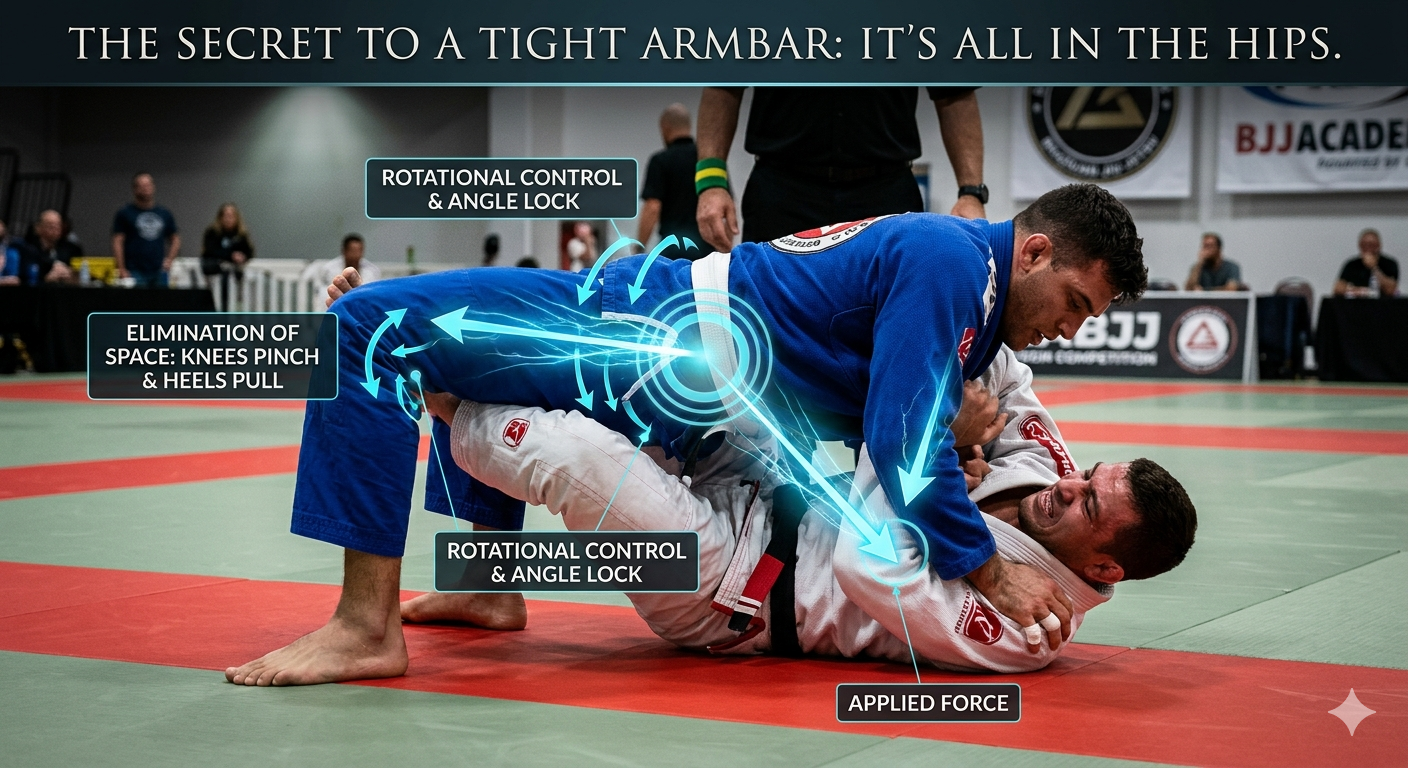
In the world of Brazilian Jiu Jitsu, the armbar stands as a quintessential submission. It is often the first joint lock a practitioner learns, yet it remains one of the most difficult to master at a world-class level. While the name suggests the focus is on the opponent's arm, the mechanical reality is quite different. The secret to a tight, inescapable armbar lies almost entirely in the positioning and movement of the hips. Without the proper application of the pelvis as a fulcrum, the submission becomes a battle of strength; with it, the technique becomes an unstoppable force of physics.
The Biomechanics of the Fulcrum
To understand the armbar, one must first understand the basic principles of leverage. According to Wikipedia, an armlock is a joint lock that hyperextends, hyperflexes, or hyperrotates the elbow joint or shoulder joint. The standard "straight armbar" relies on a Class 1 lever system. In this system, your hips act as the fulcrum, your legs act as the stabilizer, and the opponent's arm is the lever.
The effectiveness of this lever is determined by the distance between the fulcrum and the force applied. If your hips are far away from the opponent’s shoulder, the lever is weak. Many beginners make the mistake of falling backward and pulling the arm with their biceps. This approach is inefficient because it pits the practitioner's arm strength against the opponent's entire upper body. By keeping the hips glued to the shoulder, you ensure that the fulcrum is placed exactly where it needs to be to maximize pressure on the elbow joint.
Furthermore, the "tightness" of an armbar is defined by the absence of space. In a professional and analytical context, we look at this as a matter of mechanical tolerance. Any gap between your pelvis and the opponent’s triceps allows for rotational movement. If the opponent can rotate their elbow even a few degrees, they can begin to "hitchhike" or slip their arm out. Therefore, the primary goal during the transition to the armlock is to achieve a flush connection between the pelvic bone and the posterior side of the opponent's humerus.
Hip Placement and Rotational Control
Achieving the perfect armbar requires more than just sitting back; it requires a precise "cutting of the angle." When attacking from the closed guard, for example, the practitioner must use their hips to pivot until they are perpendicular to the opponent. This shift is not merely for aesthetics; it changes the vector of the force. By rotating the hips, you isolate the shoulder, making it impossible for the opponent to "stack" you or drive their weight forward to clear the legs.
Once the angle is established, the role of the hips transitions from a pivot point to a clamping mechanism. The adductor muscles of the legs must work in tandem with the hips to pinch the opponent's shoulder. This "knees-together" pressure is what prevents the arm from sliding out. If the knees are flared, the hips lose their connection to the lever. Analytical observation of high-level matches shows that the most successful grapplers keep their heels pulled tight toward their own glutes, which effectively locks the opponent's shoulder into the "hip pocket."
Another critical element is the orientation of the opponent's thumb. For the armbar to work, the elbow must be pointed directly against the fulcrum (the hips). If the opponent turns their thumb down, the elbow shifts, and the pressure is dissipated. To counter this, the practitioner must use their hips to "follow" the elbow. A slight bridge of the hips, combined with a subtle lateral shift, can realign the fulcrum with the joint even if the opponent attempts to rotate. This level of hip dexterity is what separates a blue belt from a black belt.
Common Pitfalls and the "Limp Arm" Escape Prevention
The most common reason an armbar fails is the creation of a "pocket of air" between the attacker's hips and the defender's shoulder. This usually happens during the transition from a dominant position, such as mount or side control, to the finishing position. As the practitioner swings their leg over the head, they often lose the downward pressure of their weight.
To prevent this, one must maintain a "heavy hip" philosophy. Even as you move, your weight should be concentrated through the pelvis onto the opponent’s chest or ribs. This creates a sensation of crushing pressure that limits the opponent's ability to breathe and move, making them more concerned with the weight than the impending arm attack. Research into athletic performance and combat sports, as highlighted in Google News, often points to the importance of core stability and hip mobility in preventing injury and increasing the efficacy of such movements.
When an opponent attempts the "limp arm" escape, they are essentially trying to create enough space to pull their elbow past your hip line. If your hips are high and your legs are loose, they will succeed. However, if you keep your hips low and "curled" into the arm, the elbow remains trapped. Think of your hips as a heavy wedge that is being driven into the space between the opponent's arm and their torso. As long as that wedge is deep, the arm cannot be retracted.
Implementing the Systemic Approach
Mastering the hip-centric armbar is not just about understanding the theory; it is about consistent, high-quality practice. Finding the right environment is crucial for this development. Many aspiring grapplers find themselves searching for the best jiu jitsu gym near me to find coaches who specialize in the biomechanics of the sport. A professional academy will emphasize drills that build "active hips," such as shrimp-to-armbar sequences and hip-heisting exercises.
The business of martial arts has grown significantly, and even publications like Forbes have noted how the discipline and analytical mindset required for BJJ can translate to professional success. The same focus on incremental improvement and technical precision used in the boardroom is required on the mats. When you view the armbar as a problem of engineering rather than a feat of strength, your success rate will skyrocket.
In practice, you should focus on the following checklist:
-
Is my pelvis in direct contact with their triceps?
-
Are my heels pulled tight toward my glutes?
-
Is there any light visible between my legs and their body?
-
Am I using my core to bridge, or am I just pulling with my hands?
By answering these questions during every rolling session, you refine the "hip-first" mentality. Eventually, the movement becomes second nature; your hips will move to the correct position before your brain even registers the opening.
Conclusion
The armbar is a masterpiece of human movement and physics. While the hands and legs play their roles, the hips are the engine that drives the submission home. By focusing on the fulcrum, eliminating space, and maintaining rotational control, you transform a basic move into a high-percentage finish. Remember, a tight armbar is not the result of strong arms; it is the result of intelligent hips.

 English