


 SPARK Website
Natural Food Colors Industry Expected to Grow to USD 4.4 Billion by 2036
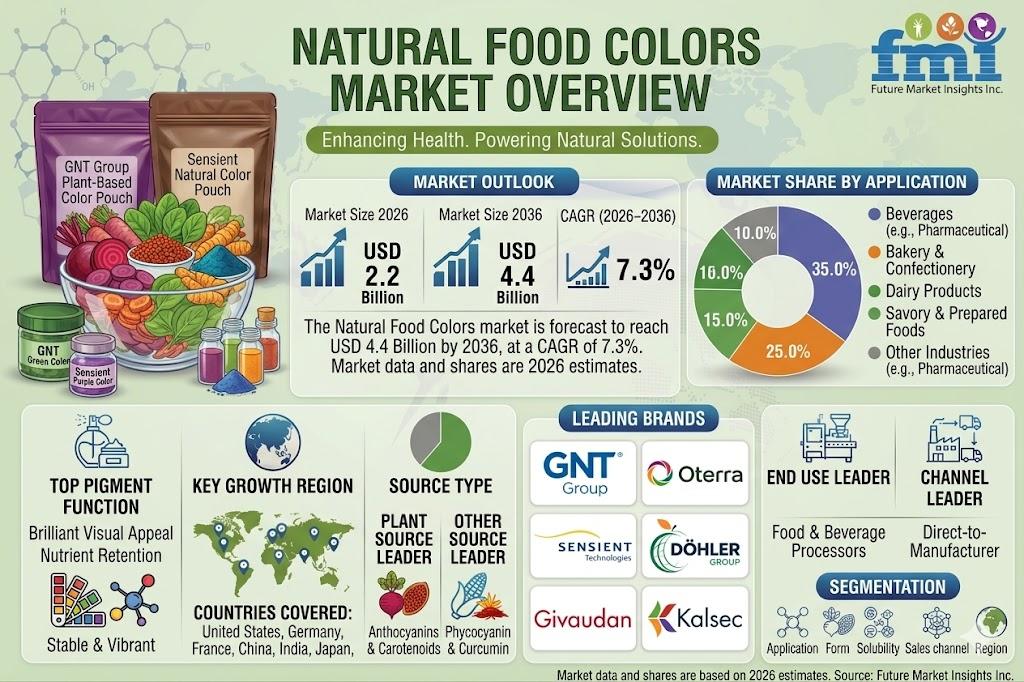
NEWARK, Del., USA | April 21, 2026 — According to the latest analysis by Future Market Insights (FMI), the global natural food colors market is poised for robust expansion as food and beverage manufacturers accelerate the shift away from synthetic dyes. The market, valued at USD 2.0 billion in 2025, is estimated to reach USD 2.2 billion in 2026 and is projected to grow to USD 4.4 billion by 2036, registering a CAGR of 7.3% during the forecast period.
This growth reflects a structural transformation in the food industry, where regulatory pressures, retailer mandates, and evolving consumer preferences are making natural colorants a core formulation requirement rather than a niche alternative. The market is expected to generate an incremental opportunity of USD 2.2 billion between 2026 and 2036.
Detailed insights, segmentation breakdown, and competitive intelligence @ https://www.futuremarketinsights.com/reports/sample/rep-gb-35
Quick Stats of Natural Food Colors Market Outlook
- Market Size (2025): USD 2.0 billion
- Market Size (2026): USD 2.2 billion
- Forecast (2036): USD 4.4 billion
- CAGR (2026–2036): 7.3%
- Incremental Opportunity: USD 2.2 billion
- Leading Application: Beverages (39%)
- Leading Source: Plant-Based (68%)
- Leading Pigment: Carotenoids (34%)
- Leading Form: Liquid Formats (46%)
- Leading Solubility: Water-Soluble Systems (52%)
Market Overview: Transition Toward Clean-Label Formulations
Natural food colors are derived from plant, algae, and fermentation-based sources and are increasingly replacing petroleum-based synthetic dyes across food and beverage applications. The market is expanding rapidly due to:
- Strict retailer and regulatory restrictions on artificial dyes
- Growing demand for “no artificial colors” labeling
- Rising clean-label and transparency expectations among consumers
Manufacturers are investing heavily in botanical extraction, fermentation technologies, and encapsulation techniques to improve pigment stability and scalability.
Key Growth Drivers
- Regulatory Push and Retailer Mandates
Global regulatory frameworks and retailer policies are accelerating the elimination of synthetic dyes, making natural colors a necessity for market access. - Expansion of Packaged Food and Beverage Industry
Increasing consumption of processed and convenience foods is driving demand for stable and visually appealing natural color solutions. - Advancements in Extraction and Fermentation Technologies
Innovations in bioprocessing and encapsulation are improving heat, light, and pH stability of natural pigments.
Market Trends Shaping the Industry
- Clean Label Movement: Strong shift toward plant-based and minimally processed ingredients
- Fermentation-Based Colors: Precision fermentation enabling consistent pigment production
- Encapsulation Technology: Enhanced stability for sensitive pigments
- Cross-Category Applications: Growing use in dairy, bakery, and functional beverages
Segment Insights
Pigment Leadership: Carotenoids (34%)
Carotenoids dominate due to their superior heat stability, making them ideal for baked and processed foods.
Application Leadership: Beverages (39%)
Beverages remain the largest segment, driven by demand for visually appealing and stable liquid formulations.
Source Leadership: Plant-Based (68%)
Plant-derived colors lead due to regulatory acceptance and reliable agricultural supply chains.
Form Leadership: Liquid Formats (46%)
Liquid formats are preferred for seamless integration into automated processing systems.
Regional Insights
Top Growth Markets (CAGR 2026–2036):
- India: 8.5% – Strong growth in clean-label packaged foods
- China: 8.3% – Rapid expansion of domestic food processing
- United States: 8.1% – Reformulation of legacy products
- Germany: 7.7% – Strict regulatory compliance standards
- Brazil: 7.6% – Strong agricultural base supporting pigment production
Regional Outlook:
- Asia-Pacific: Fastest-growing region due to urbanization and rising packaged food demand
- Europe: Regulatory-driven adoption of natural colorants
- North America: High reformulation activity across major brands
Speak to Analyst: Customize insights for your business strategy@ https://www.futuremarketinsights.com/customization-available/rep-gb-35
Competitive Landscape
The natural food colors market is moderately consolidated, with key players focusing on innovation, regulatory compliance, and supply chain control.
Key Players:
- GNT Group
- Oterra
- Sensient Technologies
- DSM-Firmenich
- Döhler Group
- Givaudan
- Kalsec
Competitive Differentiation Factors
- Strong regulatory and documentation capabilities
- Advanced extraction and fermentation technologies
- Control over raw material sourcing
- Dedicated application labs and technical support
Recent Developments
- Expansion of natural color production capacities globally
- Increased investment in fermentation-derived pigments
- Launch of new application centers to support regional markets
- Regulatory approvals for new natural color additives
Expert Insights
The natural food colors market is entering a high-growth phase as regulatory enforcement and consumer demand converge. Companies that can deliver stable, scalable, and compliant color solutions while managing agricultural variability will gain a significant competitive advantage.
FAQs
- What is the future outlook for the natural food colors market?
The market is projected to reach USD 4.4 billion by 2036, growing at a CAGR of 7.3%. - Which segment dominates the market?
Carotenoids lead the pigment segment with a 34% share. - Why are natural food colors gaining popularity?
They help manufacturers meet regulatory requirements and consumer demand for clean-label products. - What are the major challenges?
- Stability under heat, light, and pH conditions
- Raw material variability
- Regulatory compliance complexity
- Which regions offer the highest growth potential?
India, China, and the United States are the fastest-growing markets.
Conclusion
The global natural food colors market is set for strong growth, driven by the rapid elimination of synthetic dyes and the rise of clean-label standards. While technical and supply challenges remain, advancements in fermentation and encapsulation technologies are unlocking new opportunities for manufacturers. Companies that invest in innovation, compliance, and supply chain resilience will be best positioned to capitalize on this expanding market.
About Future Market Insights (FMI)
Future Market Insights (FMI) is a leading provider of market intelligence and consulting services, serving clients in over 150 countries. Headquartered in Delaware, USA, with a global delivery center in India and offices in the UK and UAE, FMI delivers actionable insights to businesses across industries including automotive, technology, consumer products, manufacturing, energy, and chemicals.
An ESOMAR-certified research organization, FMI provides custom and syndicated market reports and consulting services, supporting both Fortune 1,000 companies and SMEs. Its team of 300+ experienced analysts ensures credible, data-driven insights to help clients navigate global markets and identify growth opportunities.
Contact Us
Future Market Insights Inc.
Christiana Corporate, 200 Continental Drive,
Suite 401, Newark, Delaware - 19713, USA
T: +1-347-918-3531
For Sales Enquiries: sales@futuremarketinsights.com

 عربي
عربي