


 SPARK Website
Latin America Green Hydrogen Market Size, Share, and Forecast 2026–2034
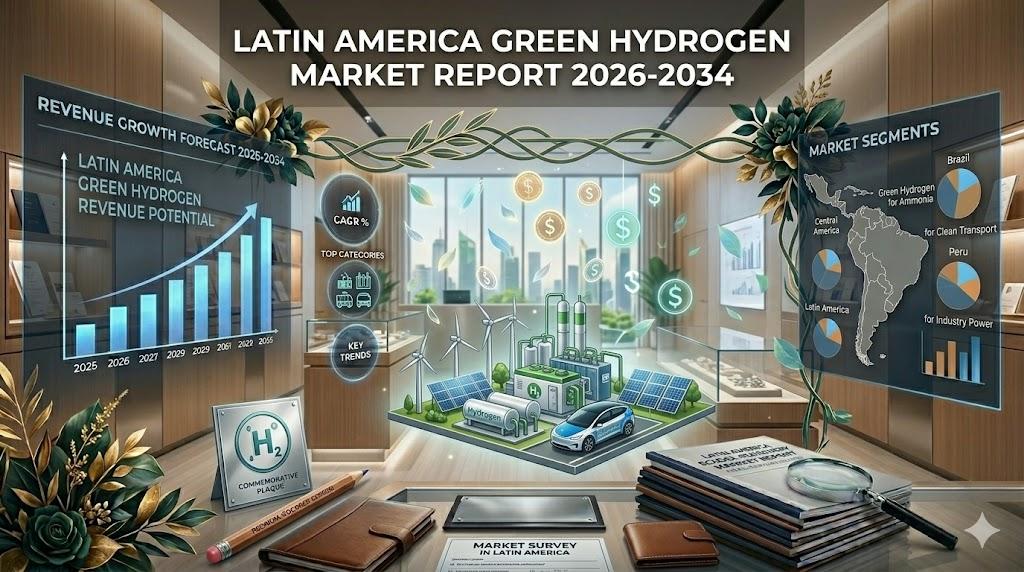
The Latin America green hydrogen market is defined as the regional sector focused on the production, distribution, and utilization of hydrogen generated through the process of electrolysis powered by renewable energy sources, such as wind and solar. Unlike "grey" or "blue" hydrogen, green hydrogen emits zero carbon dioxide during production, making it a cornerstone of the global transition toward clean energy. In 2025, the market reached a valuation of USD 148.9 Million, and it is projected to skyrocket to USD 4,241.7 Million by 2034, expanding at an extraordinary CAGR of 45.09% during the forecast period of 2026-2034.
What is the Current Size and Forecasted Growth of the Latin America Green Hydrogen Market?
The Latin America green hydrogen market size is currently undergoing an unprecedented acceleration. While the market started from a relatively small base of USD 148.9 Million in 2025, it is positioned to become one of the fastest-growing energy sectors in the world. Analysts expect the market to reach a staggering USD 4,241.7 Million by 2034.
This growth represents a Compound Annual Growth Rate (CAGR) of 45.09%. This rapid expansion is fueled by the region's unique geographical advantages, which allow for low-cost renewable energy generation, making green hydrogen production economically viable on a massive scale.
Which Key Drivers are Propelling the Green Hydrogen Revolution in Latin America?
Several critical factors are converging to make Latin America a global powerhouse for green hydrogen production:
- Abundant Renewable Resources: The region boasts world-class solar irradiation in the Atacama Desert (Chile) and exceptional wind speeds in Patagonia and Northeastern Brazil.
- Decarbonization Goals: Major economies in the region are committed to achieving carbon neutrality by 2050, viewing green hydrogen as the primary tool to decarbonize "hard-to-abate" sectors like heavy industry and shipping.
- Government Incentives: Favorable policies, such as Chile's "Green Hydrogen Action Plan 2023-2030," provide the regulatory framework and financial support needed to scale industrial operations.
- Export Potential: Due to low production costs, Latin American countries are positioning themselves as major exporters of green ammonia and hydrogen to energy-hungry markets in Europe and Asia.
What are the Primary Technologies Used in Latin America Green Hydrogen Production?
The market relies on advanced electrolysis technologies to split water into hydrogen and oxygen. The choice of technology impacts efficiency, cost, and scalability:
- Proton Exchange Membrane (PEM) Electrolyzer: Known for its ability to handle the variable power supply typical of wind and solar energy.
- Alkaline Electrolyzer: A more established and cost-effective technology, recently used in large-scale projects like Linde’s new 5-megawatt plant in São Paulo, Brazil.
- Solid Oxide Electrolyzer (and Others): Emerging technologies that offer higher efficiency at high temperatures, often integrated with industrial heat sources.
Sample Request For Your Business
Market Quick-Reference: Key Growth Statistics
|
Market Attribute |
Statistics (2025-2034) |
|
Market Size (2025) |
USD 148.9 Million |
|
Market Forecast (2034) |
USD 4,241.7 Million |
|
Growth Rate (CAGR) |
45.09% |
|
Base Year |
2025 |
|
Forecast Period |
2026-2034 |
How is the Green Hydrogen Market Segmented by Application and Distribution?
The versatility of green hydrogen allows it to serve multiple high-impact industries across the region:
By Application:
- Power Generation: Hydrogen serves as a storage medium for excess renewable energy, which can then be converted back into electricity to stabilize the grid.
- Transport: Fuel cell technology for heavy-duty trucking, shipping, and aviation is a primary focus for regional decarbonization.
- Industrial Feedstock: Used in the production of green steel, fertilizers (via green ammonia), and chemical processing.
By Distribution Channel:
- Pipeline: Ideal for local industrial clusters and regional transport.
- Cargo: Essential for the international export of hydrogen derivatives like ammonia or methanol via sea freight.
Which Countries are Leading the Green Hydrogen Market in Latin America?
The competitive landscape is dominated by countries with the most aggressive renewable energy agendas:
|
Country |
Competitive Advantage |
|
Brazil |
Massive wind/solar capacity; recent partnerships between Vale and Green Energy Park for green hydrogen production. |
|
Chile |
Atacama Desert solar resources and the "Green Hydrogen Action Plan 2023-2030" targeting global leadership. |
|
Mexico |
Strategic proximity to North American markets and a strong industrial manufacturing base. |
|
Argentina |
Exceptional wind energy potential in the southern Patagonia region. |
|
Colombia & Peru |
Emerging hubs focusing on domestic industrial decarbonization and mineral processing. |
What Recent News and Innovations are Shaping the Regional Landscape?
Innovation and corporate partnerships are moving at lightning speed in the Latin America green hydrogen market:
- Brazilian Expansion: In April 2024, Linde (White Martins) announced the construction of a second 5-megawatt alkaline electrolyzer in Jacareí, São Paulo, to supply the Southeast Brazilian market with independently verified green hydrogen.
- Strategic Partnerships: In October 2024, Vale and Green Energy Park (GEP) entered an agreement to explore large-scale green hydrogen production in Brazil, specifically for the mining and metals sector.
- Policy Milestones: The Chilean government's 2024 unveiling of the "Green Hydrogen Action Plan" seeks to replace polluting industries with sustainable ones, aiming for carbon neutrality by 2050.
Conclusion:
The Latin America green hydrogen market is standing on the brink of a monumental transformation, projected to grow from USD 148.9 Million in 2025 to over USD 4.2 Billion by 2034. With a staggering 45.09% CAGR, the region is effectively leveraging its abundant solar and wind resources to become a global hub for clean energy. Driven by favorable government policies in Chile and Brazil and multi-million dollar investments from global leaders like Linde and Vale, Latin America is not just participating in the energy transition—it is leading it.

 English