


 SPARK Website
Humanoid Robots in Construction Industry
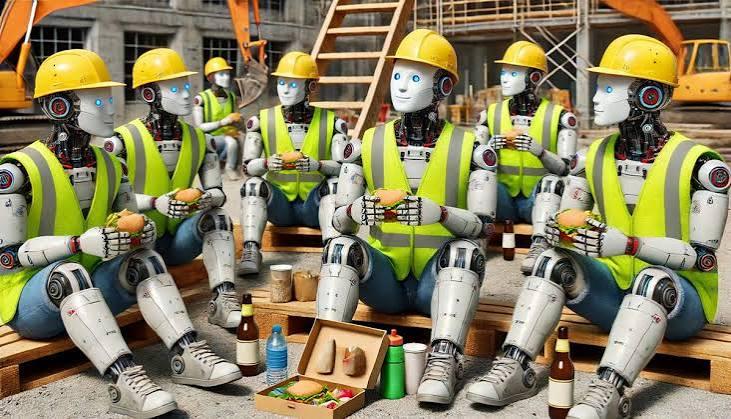
Overview of the Market
The global market for humanoid robots in construction is gaining momentum as the construction industry seeks solutions to labor shortages, rising project costs, and productivity challenges. Advances in artificial intelligence (AI), computer vision, autonomous navigation, and robotic dexterity are enabling humanoid robots to perform tasks such as material handling, welding, drilling, inspection, surveying, and equipment operation. While commercial deployment remains in its early stages, increasing investment in embodied AI and robotics is expected to accelerate adoption throughout the forecast period.
The global humanoid robots in construction marekt was valued at USD 0.48 billion in 2025 and is estimated to reach USD 0.67 billion in 2026, reflecting a growth rate of 39.6%. The industry dedicated to creating, developing, and implementing human-like robotic systems to carry out construction jobs, improving and productivity, safety, accuracy, automation across building and infrastructure projects, is known as the "humanoid robots in construction marke.
Access the Full Report PDF Here:
Key Market Trends
- Rising adoption of AI-powered humanoid robots on construction sites
- Growing demand for automation to address skilled labor shortages
- Increasing investment in embodied AI and autonomous robotics
- Integration of Building Information Modeling (BIM) with robotics
- Advances in machine vision and sensor technologies
- Growing focus on worker safety and hazardous task automation
- Development of robots capable of material handling, welding, and inspection
- Strategic partnerships between robotics companies and construction firms
Analytical Tool
- Porter's Five Forces Analysis
- SWOT Analysis
- PESTEL Analysis
- Value Chain Analysis
- Market Attractiveness Analysis
- Competitive Benchmarking
- Investment Analysis
Regional Analysis
- North America
- Europe
- Asia-Pacific
- Latin America
- Middle East & Africa
SWOT Analysis
Strengths
- Improves productivity and operational efficiency
- Reduces workplace injuries and safety risks
- Performs repetitive and hazardous construction tasks
Weaknesses
- High acquisition and deployment costs
- Limited real-world construction site experience
- Dependence on advanced AI and connectivity
Opportunities
- Increasing infrastructure development worldwide
- Growing demand for smart construction technologies
- Expansion of AI-enabled autonomous construction equipment
Threats
- Regulatory and safety compliance challenges
- Slow industry adoption
- High maintenance and integration costs
PESTEL Analysis
Political: Government initiatives supporting construction technology and automation
Economic: Rising infrastructure investments and labor cost pressures
Social: Increasing emphasis on worker safety and addressing skilled labor shortages
Technological: Advancements in AI, machine learning, robotics, sensors, and computer vision
Environmental: Sustainable construction practices and efficient resource utilization
Legal: Workplace safety regulations, robotics standards, and construction compliance requirements
Market Share and Key Players
Major companies operating in the humanoid robots in construction ecosystem include:
- Tesla
- Figure AI
- Apptronik
- Agility Robotics
- Boston Dynamics
- UBTECH Robotics
- Fourier Intelligence
- Unitree Robotics
- Sanctuary AI
- Persona AI
Challenges and Future Opportunities
Challenges
- High capital investment requirements
- Complex and unstructured construction environments
- Limited battery life and operational endurance
- Safety certification and regulatory compliance
- Integration with existing construction workflows
Future Opportunities
- Autonomous building construction
- AI-powered site monitoring and inspection
- Digital twin integration with humanoid robots
- Growth in smart cities and mega infrastructure projects
- Expansion of robotics-as-a-service (RaaS) business models
- Collaborative human-robot construction teams
Browse Trending Report:
- Humanoid Robot Industry Outlook, 2026–2036
- Geothermal Power Generation Industry Outlook, 2026–2036
- Power Purchase Agreement (PPA) Industry Outlook, 2026–2036
- Gas Turbine MRO Industry Outlook, 2026–2036
- Portable Generators Industry Outlook, 2026–2036

 English