


 SPARK Website
Weather Radar Market Growth Outlook and Industry Trends Through 2034
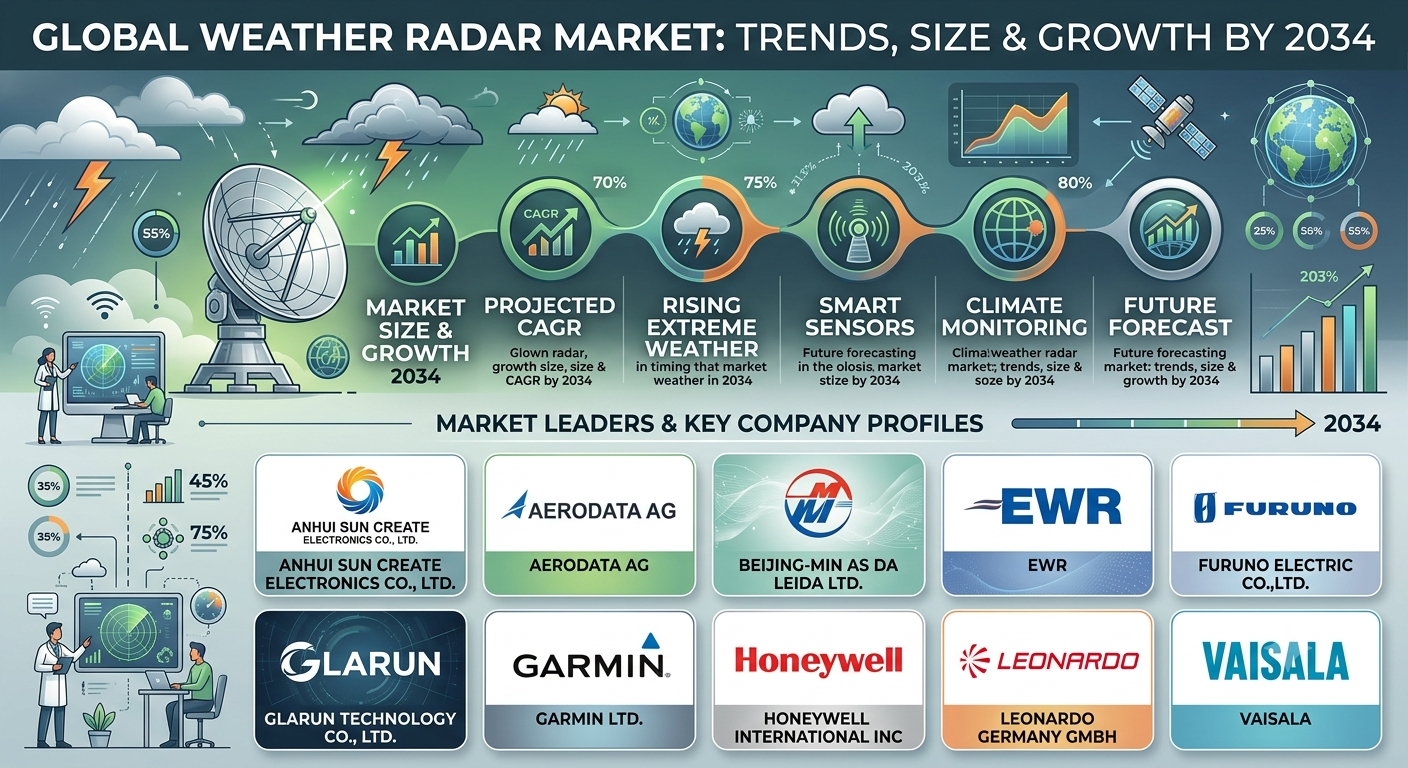
The global weather radar industry is witnessing significant progress as governments, meteorological agencies, airports, defense organizations, and private enterprises continue to invest in advanced weather monitoring infrastructure. The growing need for accurate forecasting, disaster preparedness, and climate monitoring is accelerating the adoption of next-generation radar technologies across developed and emerging economies. Increasing occurrences of extreme weather events, rising concerns regarding public safety, and technological advancements in Doppler and dual-polarization radar systems are further contributing to industry expansion. Continuous investments in weather intelligence solutions are helping organizations improve operational efficiency while reducing risks associated with severe weather conditions.
According to the latest study by The Insight Partners, the Weather Radar Market Share is expected to grow from US$ 338.25 million in 2025 to US$ 492.5 million by 2034, registering a CAGR of 4.26% during the forecast period (2026–2034). Growing investments in weather observation infrastructure, modernization of national meteorological networks, and increasing adoption of high-performance radar systems across aviation, agriculture, marine, and defense sectors are supporting long-term industry expansion. The report highlights emerging opportunities created by digital weather forecasting, AI-enabled data analytics, and expanding smart infrastructure projects worldwide.
Download Sample PDF: https://www.theinsightpartners.com/sample/TIPRE00021949
Rising Demand for Accurate Weather Forecasting Drives Industry Growth
One of the primary factors supporting industry growth is the increasing frequency of severe weather events, including hurricanes, cyclones, floods, thunderstorms, and heavy rainfall. Governments across the globe are strengthening weather monitoring capabilities to improve disaster preparedness and minimize economic losses. Modern radar systems provide real-time precipitation tracking, storm movement analysis, and early warning capabilities, allowing authorities to make informed decisions before extreme weather conditions occur.
Furthermore, rapid urbanization and expanding infrastructure projects have increased the importance of reliable weather intelligence for construction planning, transportation management, and emergency response operations.
Technological Advancements Accelerating Radar Adoption
Continuous innovations in weather radar technology are transforming forecasting accuracy and operational efficiency. The development of dual-polarization radar, phased-array radar, solid-state transmitters, and Doppler radar systems has significantly improved precipitation detection and storm analysis.
Artificial intelligence, machine learning, cloud computing, and advanced data analytics are further enhancing radar performance by enabling faster processing of meteorological data. These technologies allow meteorologists to generate more accurate forecasts while improving prediction capabilities for severe weather events.
Additionally, integrated weather observation systems combining radar, satellite imagery, and IoT-based environmental sensors are creating comprehensive forecasting solutions for government agencies and commercial organizations.
Aviation Sector Remains a Major Growth Driver
The aviation industry continues to represent one of the largest users of advanced weather radar systems. Accurate weather monitoring plays a critical role in ensuring flight safety, optimizing air traffic management, and minimizing operational disruptions caused by adverse weather conditions.
Airports worldwide are investing in next-generation radar infrastructure capable of detecting wind shear, thunderstorms, heavy rainfall, icing conditions, and turbulence. These capabilities help airlines improve scheduling efficiency while enhancing passenger safety and reducing fuel consumption through optimized flight routing.
The expansion of global air travel and modernization of airport infrastructure are expected to sustain demand throughout the forecast period.
Growing Importance in Agriculture and Water Resource Management
Agriculture has become another important application area for weather radar technologies. Farmers increasingly rely on accurate rainfall forecasting and weather monitoring to improve irrigation planning, crop management, and resource utilization.
Governments are also using advanced radar systems for flood prediction, watershed monitoring, reservoir management, and drought assessment. The availability of real-time weather intelligence supports better agricultural productivity while reducing financial losses caused by unpredictable climate conditions.
As climate variability continues to impact food production worldwide, investments in precision agriculture and weather monitoring technologies are expected to increase steadily.
Defense and Public Safety Investments Continue to Expand
National defense organizations are strengthening weather surveillance capabilities to support military planning and operational readiness. Weather radar systems provide valuable meteorological intelligence that assists military aviation, naval operations, and ground missions operating under changing environmental conditions.
Similarly, emergency management agencies utilize weather radar networks to issue timely warnings during severe storms, flash floods, tornadoes, and other natural disasters. Improved forecasting accuracy helps protect lives, critical infrastructure, and public assets.
Increasing government spending on disaster resilience programs is expected to remain a major growth catalyst through 2034.
Regional Growth Opportunities
North America continues to maintain a leading position due to the presence of advanced meteorological infrastructure, ongoing modernization of weather observation systems, and significant investments by government agencies. The United States remains one of the largest adopters of weather radar technologies across aviation, defense, research, and emergency management sectors.
Europe also demonstrates strong adoption driven by climate monitoring initiatives and investments in environmental observation systems.
Meanwhile, Asia Pacific is projected to experience substantial growth owing to increasing urbanization, expanding airport infrastructure, rising climate-related disasters, and government initiatives to strengthen weather forecasting capabilities in countries such as China, India, Japan, and Australia.
Key Players
The Weather Radar Market features the presence of several global companies actively investing in product innovation, strategic partnerships, and technological advancements. Major players include:
- Enterprise Electronics Corporation
- Baron Weather Inc.
- Leonardo S.p.A.
- Vaisala Oyj
- Furuno Electric Co., Ltd.
- GAMIC MBH
- EWR Weather Radar
- Honeywell International Inc.
- Raytheon Technologies
- Selex ES
These companies continue to focus on developing advanced radar technologies that offer higher accuracy, enhanced reliability, and improved operational performance across diverse applications.
Future Outlook
The outlook for the Weather Radar Market remains positive through 2034 as governments and commercial organizations continue prioritizing weather intelligence and disaster resilience. Increasing deployment of AI-powered forecasting platforms, cloud-connected radar networks, and integrated meteorological systems will further enhance forecasting precision and operational efficiency.
Growing investments in smart cities, climate adaptation programs, renewable energy projects, aviation modernization, and precision agriculture are expected to create new growth opportunities. As technological innovation continues to reshape weather monitoring capabilities, advanced radar systems will remain essential for improving public safety, protecting infrastructure, and supporting sustainable economic development worldwide.
About Us
The Insight Partners is a global market research and consulting firm delivering actionable industry intelligence across technology, healthcare, manufacturing, automotive, aerospace, electronics, energy, chemicals, and several other sectors. Our in-depth research reports provide reliable market forecasts, competitive analysis, emerging trends, and strategic recommendations that help organizations make informed business decisions and identify new growth opportunities.
Contact Us
The Insight Partners
Email: sales@theinsightpartners.com
Phone: +1-646-491-9876
Website: https://www.theinsightpartners.com
Related Reports -
Satellite Data Services Market Analysis, Share, Trend, and Growth
Embedded Computing Market Analysis, Share, Trend, and Growth
Wire Harness Market Analysis, Share, Trend, and Growth

 عربي
عربي