


 SPARK Website
Mushroom Packaging Market Industry Insights 2026–2034
Mushroom Packaging Market: Sustainable Packaging Solutions Driving Industry Growth
The Mushroom Packaging Market is experiencing significant growth as industries increasingly adopt environmentally responsible packaging alternatives. Mushroom packaging, also known as mycelium packaging, is manufactured by combining agricultural waste with fungal mycelium, creating biodegradable, compostable, and lightweight packaging materials. Rising environmental concerns, stricter regulations on plastic waste, and growing consumer preference for sustainable products are accelerating market adoption across industries such as electronics, food and beverage, personal care, and consumer goods.
The increasing emphasis on circular economy principles and sustainable supply chains is encouraging organizations to replace traditional plastic and foam packaging with innovative biodegradable alternatives. Mushroom packaging offers excellent protective properties while minimizing environmental impact, making it an attractive solution for modern packaging requirements.
Request Sample Link:
https://packagingmarketinsights.com/report/mushroom-packaging-market/request-sample
Market Overview
The mushroom packaging market is witnessing steady expansion due to the growing demand for sustainable packaging materials worldwide. Mushroom-based packaging solutions are increasingly being adopted as substitutes for petroleum-based packaging materials, particularly expanded polystyrene and plastic foams.
Governments across various regions are implementing regulations aimed at reducing plastic waste, while businesses are setting ambitious sustainability targets. These developments are creating favorable conditions for mushroom packaging manufacturers. In addition, consumer awareness regarding environmentally friendly packaging is rising, further supporting market growth.
Industries such as consumer electronics, food and beverage, and personal care are increasingly utilizing mushroom packaging because of its biodegradable nature and ability to provide effective product protection during transportation and storage.
Market Size and Forecast
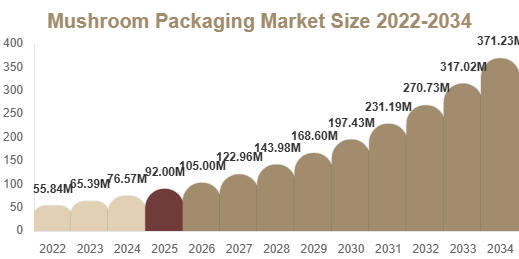
The global mushroom packaging market size is estimated to reach approximately USD 92 million in 2025 and is expected to increase to nearly USD 105 million in 2026. Over the forecast period from 2025 to 2034, the market is projected to reach approximately USD 410 million, registering a CAGR of 17.1%.
The robust growth trajectory reflects increasing commercialization of biodegradable packaging materials, expanding adoption across end-use industries, and ongoing innovation in sustainable packaging technologies. The market's expansion also highlights the growing importance of circular economy practices and environmentally responsible manufacturing processes.
Key market highlights include:
- Global market estimated at USD 92 million in 2025.
- Market projected to reach USD 410 million by 2034.
- CAGR expected at 17.1% during 2025–2034.
- Strong adoption across electronics, food, and consumer goods sectors.
Market Drivers
Rising Environmental Regulations on Plastic Packaging
Stringent government regulations targeting plastic waste are among the major drivers of the mushroom packaging market. Numerous countries have imposed restrictions on single-use plastics and expanded polystyrene packaging due to increasing concerns regarding pollution and landfill accumulation.
Mushroom packaging offers a compelling alternative because it is manufactured using natural materials and decomposes rapidly under composting conditions. As environmental policies continue to evolve globally, manufacturers are increasingly transitioning toward bio-based packaging materials to comply with regulations and improve sustainability performance.
Growing Consumer Preference for Eco-Friendly Products
Consumer demand for sustainable products continues to increase worldwide. Modern consumers increasingly evaluate brands based on their environmental practices, including the sustainability of packaging materials.
Mushroom packaging aligns closely with these expectations by providing renewable and compostable packaging solutions. Companies adopting mushroom-based packaging often use sustainability initiatives as part of their marketing strategies, enhancing customer loyalty and strengthening brand image.
Market Challenges
High Production Costs Compared to Conventional Materials
Despite offering substantial environmental benefits, mushroom packaging faces challenges related to production costs. Manufacturing mycelium-based packaging requires specialized cultivation facilities and carefully controlled environmental conditions, resulting in higher operational expenses than conventional foam production methods.
Additionally, mushroom packaging production cycles are naturally longer because the material must grow before processing into finished packaging products. This can limit scalability and manufacturing speed compared to petroleum-based alternatives.
Cost considerations remain particularly significant for small and medium-sized enterprises operating under tight budget constraints. Many manufacturers continue to rely on conventional packaging materials because they are more cost-effective and readily available.
However, advancements in biofabrication technologies and expanding production capacities are expected to gradually reduce manufacturing costs over time.
Market Opportunities
Integration of Circular Economy Packaging Models
The growing adoption of circular economy models presents a significant opportunity for the mushroom packaging market. Organizations worldwide are transitioning from linear production systems toward sustainable frameworks focused on reuse, recycling, and compostability.
Mushroom packaging perfectly supports circular economy objectives because it can be composted and safely returned to the environment after use. Companies involved in logistics, retail, and e-commerce are increasingly exploring compostable packaging programs to reduce landfill waste and improve sustainability performance.
Expansion in Food and Beverage Packaging Applications
The food and beverage industry offers considerable growth potential for mushroom packaging manufacturers. Food companies face increasing pressure to minimize plastic waste and comply with environmental regulations.
Mushroom-based materials provide biodegradable alternatives for trays, containers, and protective packaging applications. Additionally, consumers often associate natural packaging materials with healthier and environmentally responsible products, enhancing brand differentiation and customer perception.
As sustainability continues to gain importance across the food sector, demand for mushroom packaging solutions tailored for food applications is expected to rise substantially.
Market Segmentation
By Type
- Protective Packaging
- Insulated Packaging
- Customized Molded Packaging
Protective packaging dominated the market in 2024, accounting for approximately 62% of global market share. These solutions are widely used in consumer electronics and home appliance packaging due to their excellent cushioning capabilities.
The insulated packaging segment is projected to register the fastest growth, expanding at a CAGR of approximately 18.6% between 2025 and 2034, supported by growing demand from food delivery, pharmaceutical, and cosmetics applications.
By Application
- Electronics Packaging
- Food Packaging
- Personal Care Packaging
- Furniture Packaging
Electronics packaging represented approximately 46% of total market revenue in 2024, making it the leading application segment. The food packaging segment is anticipated to record the highest CAGR of approximately 18.2% during the forecast period.
By End-Use Industry
- Consumer Goods
- Food & Beverage
- E-commerce
- Electronics
Consumer goods accounted for approximately 41% of global demand in 2024. Meanwhile, the e-commerce segment is projected to grow at the fastest pace, registering a CAGR of around 19.1% through 2034 due to expanding online retail activities.
Regional Analysis
North America
North America accounted for approximately 34% of the global mushroom packaging market in 2025 and is expected to grow at a CAGR of around 16.4% through 2034. The United States leads regional growth, driven by strong demand from technology and consumer electronics companies.
Europe
Europe represented nearly 29% of global market share in 2025 and is projected to expand at a CAGR of approximately 17.3% during the forecast period. Strong environmental regulations and circular economy initiatives are major growth contributors, with Germany playing a leading role in regional adoption.
Asia Pacific
Asia Pacific accounted for around 21% of global revenue in 2025 and is expected to record the fastest CAGR of approximately 18.5% through 2034. Rapid industrialization, growing environmental awareness, and expanding electronics manufacturing activities in China, Japan, South Korea, and India are driving market growth.
Middle East & Africa
The Middle East & Africa region held approximately 8% of global market share in 2025 and is forecast to grow at a CAGR of around 15.2%. Sustainability initiatives and environmentally friendly logistics programs are supporting regional expansion.
Latin America
Latin America accounted for nearly 8% of the global market in 2025 and is projected to grow at a CAGR of approximately 16.1% through 2034. Brazil remains the leading regional market, supported by abundant agricultural waste resources suitable for mycelium cultivation.
Key Players
- Ecovative Design
- Mushroom Packaging (Ecovative brand)
- Grown Bio
- Magical Mushroom Company
- BioFab
- MycoWorks
- Mushroom Material
- Paradise Packaging Company
Other notable participants include MadeRight, Mycelium Packaging Solutions, Greener Packaging, Sustainable Bioproducts, MycoComposite Technologies, Mycelium Packaging Ltd, and Biohm.
Conclusion
The Mushroom Packaging Market is poised for substantial growth during the forecast period, supported by increasing environmental regulations, growing consumer demand for sustainable products, and expanding adoption across multiple industries. The market's strong projected CAGR of 17.1% highlights the increasing importance of biodegradable packaging solutions in achieving sustainability objectives.
Organizations adopting circular economy practices and investing in environmentally friendly packaging alternatives are expected to create significant opportunities for market participants. Despite challenges related to production costs, continuous innovation and expanding manufacturing capabilities are expected to strengthen long-term market prospects.
As industries continue prioritizing sustainability and reducing plastic waste, mushroom packaging is expected to emerge as a critical component of future packaging ecosystems worldwide.
Report Link:
https://packagingmarketinsights.com/report/mushroom-packaging-market

 English