Cosmetic Packaging Market: Industry Growth, Size, Share, Trends, and Forecast 2025–2034
The Cosmetic Packaging Market is experiencing steady growth as beauty and personal care manufacturers continue to invest in innovative, functional, and sustainable packaging solutions. Packaging plays an essential role in preserving product quality, strengthening brand identity, and enhancing consumer engagement across skincare, haircare, fragrances, and color cosmetics. Increasing consumer expectations regarding aesthetics, convenience, and environmentally responsible packaging continue to support market expansion throughout the forecast period.
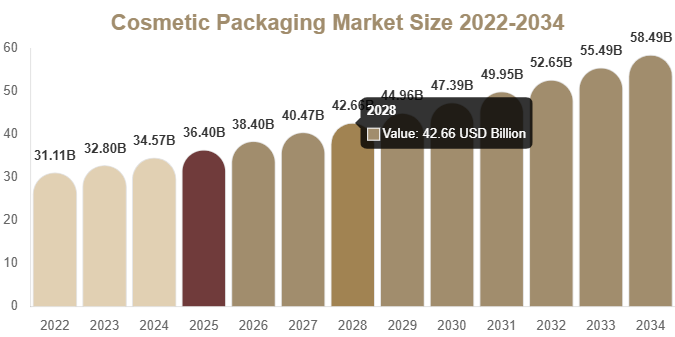
The global Cosmetic Packaging Market size was valued at USD 36.4 billion in 2025 and is projected to reach USD 58.7 billion by 2034, expanding at a CAGR of 5.4% during the forecast period (2025–2034). The market growth is supported by increasing global demand for beauty and personal care products, coupled with evolving consumer expectations regarding packaging functionality, aesthetics, and sustainability.
Cosmetic packaging serves a critical function in product preservation, brand positioning, and customer engagement. Packaging formats including bottles, tubes, jars, pumps, dispensers, and compacts are widely used across multiple cosmetic applications. Manufacturers continue to focus on lightweight materials, refillable solutions, recyclable packaging formats, airless dispensing systems, and smart labeling technologies to strengthen product performance while supporting sustainability objectives.
Market Size and Forecast
The Cosmetic Packaging Market is expected to witness consistent growth during the forecast period. Rising product launches across skincare, haircare, fragrance, and color cosmetics continue to generate demand for innovative packaging solutions.
Asia Pacific accounted for the largest market share of 38.2% in 2025, while Latin America is expected to register the fastest regional CAGR of 6.1% through 2034. Within product categories, bottles represented the largest type segment with a 29.4% share, while airless pumps are projected to expand at a CAGR of 6.6%.
Plastic remained the leading material segment with a 46.8% market share in 2025, whereas paper-based packaging is anticipated to grow at a CAGR of 6.9%. Among applications, skincare dominated with a 41.3% share, while color cosmetics are expected to record a CAGR of 6.4% during the forecast period.
China remained the leading country market with a value of USD 7.2 billion in 2025 and is estimated to reach USD 7.7 billion in 2026.
Market Drivers
Rising Global Demand for Beauty and Personal Care Products
Growing consumer spending on beauty and personal care products across both developed and emerging economies is a major factor supporting the Cosmetic Packaging Market. Rising disposable incomes, urbanization, and increasing awareness regarding personal grooming continue to drive demand for skincare, haircare, and makeup products.
The introduction of diverse cosmetic formulations also increases the need for specialized packaging formats. Liquid foundations require pump bottles, creams commonly utilize jars, while premium skincare formulations increasingly adopt airless packaging systems designed to preserve sensitive ingredients.
Growth of E-Commerce Beauty Retail
The rapid expansion of online beauty retail has strengthened demand for durable cosmetic packaging capable of protecting products throughout transportation and handling.
Manufacturers are introducing shock-resistant containers, tamper-evident closures, and packaging designed to reduce transit damage. Digital-first cosmetic brands also prioritize visually distinctive packaging that supports social media promotion and influencer marketing.
Market Challenges
Environmental concerns associated with conventional plastic packaging remain one of the primary challenges affecting the Cosmetic Packaging Market. Although plastic packaging offers durability and cost efficiency, increasing global concerns regarding plastic waste continue to encourage regulatory changes.
Many countries are implementing measures that promote recycling initiatives and restrict single-use plastics. As manufacturers transition toward biodegradable polymers and recycled plastics, production costs may increase. In addition, sourcing sustainable raw materials may create supply chain challenges that could influence market expansion in certain regions.
Market Opportunities
Expansion of Recyclable Paper-Based Packaging
Paperboard containers, molded pulp packaging, and fiber-based tubes are creating new opportunities within the Cosmetic Packaging Market. These materials provide lightweight, recyclable packaging solutions while maintaining attractive product presentation.
Advancements in coating technologies are improving moisture resistance and durability without reducing recyclability, encouraging wider adoption among cosmetic brands.
Smart Packaging Integration
Smart packaging represents another emerging opportunity across the market. QR codes, digital labeling, and NFC-enabled packaging provide consumers with product authentication and additional product information.
Technology-enabled packaging also allows brands to strengthen customer engagement through mobile applications and loyalty programs, supporting the growing importance of digital interaction within the cosmetics industry.
Market Segmentation
By Type
The bottles segment accounted for the largest market share of 29.4% in 2025 due to its extensive use in lotions, shampoos, serums, and other liquid cosmetic products.
Airless pumps are expected to register the fastest CAGR of 6.6% during the forecast period as they minimize product exposure to air while preserving formulation effectiveness.
Type segmentation includes:
Bottles
Tubes
Jars
Pumps & Dispensers
Compacts & Cases
By Material
Plastic dominated the material segment with a 46.8% market share owing to its lightweight nature, durability, and cost efficiency.
Paper & Paperboard packaging is projected to expand at a CAGR of 6.9% through 2034 as sustainable packaging alternatives continue to gain attention.
Material segmentation includes:
Plastic
Glass
Metal
Paper & Paperboard
By Application
Skincare represented the largest application segment with a 41.3% share in 2025 because products such as moisturizers, serums, and face masks require specialized packaging that protects sensitive formulations.
Color cosmetics are projected to grow at a CAGR of 6.4% throughout the forecast period.
Application segmentation includes:
Skincare
Haircare
Fragrances
Color Cosmetics
Distribution channels covered include Direct Sales, Packaging Distributors, Online B2B Platforms, and Contract Manufacturing Partnerships.
Regional Analysis
Asia Pacific led the Cosmetic Packaging Market with a 38.2% share in 2025 and is projected to grow at a CAGR of 5.8% through 2034. China remained the leading country market, supported by expanding domestic beauty brands and investments in automation and advanced molding technologies.
North America accounted for 24.7% of the global market and is expected to expand at a CAGR of 4.8%. The United States remains the dominant country, supported by established cosmetic brands, advanced packaging technologies, and increasing demand for customized packaging.
Europe represented 22.9% of the market in 2025 and is forecast to grow at a CAGR of 4.6%. Germany leads the region with strong manufacturing capabilities and ongoing development of recyclable and refillable cosmetic packaging.
The Middle East & Africa accounted for 7.3% of the market and is projected to grow at a CAGR of 5.2%. The United Arab Emirates remains the leading country market due to strong retail infrastructure and demand for premium beauty packaging.
Latin America held a 6.9% share in 2025 and is anticipated to register the fastest regional CAGR of 6.1% through 2034. Brazil continues to lead regional growth with expanding domestic manufacturing capabilities and increasing demand for cosmetic containers and closures.
Key Players
The Cosmetic Packaging Market is characterized by the presence of international packaging manufacturers and regional suppliers focused on innovation, sustainable materials, and strategic collaborations with cosmetic brands.
Key market participants include:
Amcor plc
AptarGroup Inc.
Albea Group
Berry Global Inc.
Silgan Holdings Inc.
Gerresheimer AG
HCP Packaging
Quadpack Industries
Conclusion
The Cosmetic Packaging Market is expected to maintain steady growth through 2034, supported by increasing demand for beauty and personal care products, continued packaging innovation, sustainability initiatives, and expanding e-commerce distribution. Growth opportunities are expected to emerge through recyclable paper-based packaging, refillable solutions, and smart packaging technologies, while manufacturers continue to address environmental concerns associated with conventional plastic packaging.
With a projected market value of USD 58.7 billion by 2034 at a CAGR of 5.4%, the Cosmetic Packaging Market is expected to remain an important segment of the global packaging industry. Continued investments in sustainable materials, premium packaging designs, and advanced dispensing technologies are anticipated to support long-term market development during the forecast period.



 SPARK Website

 English