


 SPARK Website
Smart Airport Utilities: Consolidating Runway and Terminal Power Monitoring into a Unified Ethernet Network
Modern airports operate like small cities. They consume massive amounts of electrical power every day. A medium-sized international airport can consume up to 50 megawatts of electricity. That is enough power to run 35,000 homes.
Managing this energy requires precise tracking. However, airport utilities face a major structural problem. They split their power systems into two separate zones.
The first zone is the passenger terminal. Terminals use power for HVAC systems, baggage handling, and lighting. The second zone is the airfield and runway. Runways use power for critical systems. These systems include high-intensity approach lighting, radar installations, and de-icing equipment.
Historically, these two zones used different monitoring networks. Terminals often use modern Ethernet networks. Runways rely on legacy serial communication lines because of long distances.
This split creates isolated islands of data. Airport operators cannot see their total energy footprint on one screen. This article details how to consolidate runway and terminal power monitoring into a single Ethernet network.
Why Consolidating Power Data Matters
Splitting utility data causes operational inefficiencies. Bringing all power data onto a single network solves several issues.
1. Improved Operational Safety
Airports must protect runway lighting at all costs. A power failure on a runway during a storm causes immediate danger. If a transformer fails, operators need to know instantly. A unified network sends critical alarms to the central control room in milliseconds.
2. Lower Peak Demand Charges
Utility companies charge commercial users based on peak demand. Airports experience high peaks during mid-day flight surges. According to data from airport energy audits, peak demand charges can account for 40% of an airport's total electric bill. A unified network helps managers track total consumption. They can shed non-essential terminal loads when runway loads spike.
3. Simplified Maintenance Schedules
Separate networks require separate maintenance teams. One team fixes serial wires on the airfield. Another team manages terminal fiber optics. Consolidating the network allows a single IT team to manage the entire infrastructure. This reduces labor costs significantly.
The Runway Environment and Serial Networks
Airfields present a harsh environment for data networks. Runways can stretch over two miles in length.
1. Why Runways Use RS485 Serial Lines
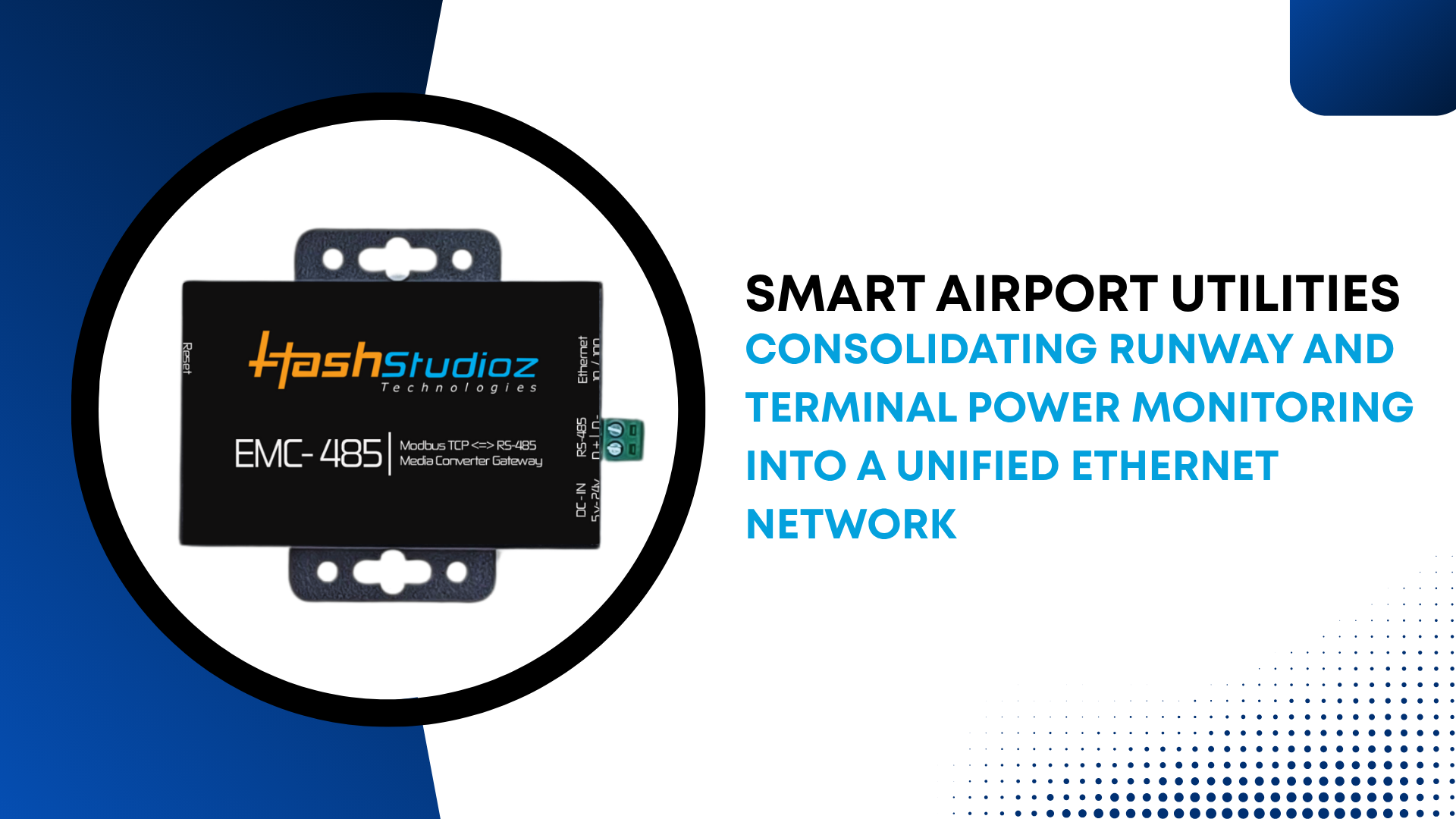
Standard Ethernet cables have a length limit of 328 feet (100 meters), making them impractical for wide airfield perimeters. As a result, airports installed RS485 serial networks decades ago. RS485 cables can span up to 4,000 feet without a repeater and carry data using Modbus RTU or Profibus protocols. An RS485 Sensor Ethernet Gateway bridges these long-distance serial sensor networks with modern Ethernet infrastructure, enabling centralized monitoring, seamless data transmission, and easier integration with airport management systems.
2. The Role of Airfield Power Substations
Runway lights do not connect directly to standard grid lines. They use constant current regulators (CCRs) located in remote substations. These regulators maintain exact light brightness despite voltage drops. These substations use older energy meters. These meters measure current, voltage, and power factor. They transmit this data via RS485 serial connections.
3. Disadvantages of Serial Monitoring
Serial networks are slow. They transmit data at low baud rates. A central server must poll each substation meter one by one. If an airfield has 50 submeters, updates take several seconds. This lag prevents real-time fault detection. Furthermore, modern energy management software cannot communicate directly with serial ports.
The Terminal Environment and Ethernet Networks
Inside the passenger terminal, the data landscape is different. Terminals use standard building automation networks.
1. Fiber Optic Backbones
Most modern terminals feature an industrial Ethernet backbone. This network uses fiber optic cables to connect different building levels. Fiber optics transmit data at speeds up to 10 Gigabits per second. They are also immune to electrical noise from baggage conveyor motors.
2. Modern Power Monitoring Protocols
Terminal energy meters use advanced protocols. Common protocols include Modbus TCP and BACnet/IP. These meters send data directly over local area networks (LANs). Terminal operators use dashboards to track energy use per gate, restaurant, and retail shop.
3. The Integration Wall
The terminal network cannot talk to the runway network. The hardware layers match up poorly. The software protocols do not align. To create a smart airport utility system, engineers must break down this wall. They must bring the runway serial data into the terminal Ethernet network.
Hardware for Network Consolidation
Bridging the gap requires specialized communication hardware. Two specific devices make this network consolidation possible.
1. The RS485 Sensor Ethernet Gateway
The RS485 Sensor Ethernet Gateway solves the airfield distance problem. Engineers install this gateway inside the remote runway substations. The gateway acts as a bridge. It connects to the legacy serial energy meters on one side. It connects to the airport Ethernet network on the other side. The gateway continuously reads the serial data. It translates the Modbus RTU packets into Modbus TCP or BACnet/IP packets. This process packages the serial data so it can travel over standard network switches.
2. The Energy Meter Ethernet Converter
Some substations use specialized electronic power meters without network ports. These meters feature proprietary serial ports. In this case, you need an Energy Meter Ethernet Converter. This converter attaches directly to the meter data port. It converts the electrical signals into standard IP packets. It assigns a unique IP address to the older meter. This allows the central automation system to read the meter as if it were a modern network device.
Designing the Unified Network Architecture
A consolidated airport network requires a layered design. This design must handle both short-range terminal data and long-range airfield data.
1. The Substation Layer (Airfield)
At the runway substations, energy meters track the power of constant current regulators. These meters connect to an RS485 Sensor Ethernet Gateway via twisted-pair copper wires. The gateway sits on a standard DIN rail inside the substation control panel.
2. The Airfield Media Conversion Layer
Because substations are far away, copper Ethernet cables cannot reach the terminal. Engineers connect the gateway Ethernet port to an industrial fiber optic media converter.
This converter changes electrical signals into light signals. The light signals travel through armored fiber optic cables buried alongside the runway.
3. The Terminal Aggregation Layer
The airfield fiber cables enter the main terminal server room. They plug into an aggregation network switch. The terminal energy meters also connect to this same switch network. Now, both airfield utility data and terminal utility data exist on the exact same physical network.
4. The Unified Management Layer
A central server runs Energy Management Software (EMS) or a SCADA system. This server reads the IP addresses of all meters across the entire airport. It combines all the information into a single user dashboard.
Step-by-Step Implementation Strategy
Consolidating an airport utility network requires careful planning. Airport operations cannot stop during installation. Follow this deployment path.
Step 1: Conduct a Protocol Audit
Document every energy meter across the airport property. Record the location, protocol, register map, and physical port type. Identify which meters require an Energy Meter Ethernet Converter and which require a gateway.
Step 2: Lay the Fiber Infrastructure
Ensure fiber optic lines exist between the main terminal and the airfield substations. Most airports have existing fiber ducts. Pull new single-mode fiber optic cables through these ducts to handle the utility data.
Step 3: Install the Gateways and Converters
Mount the conversion hardware during scheduled maintenance windows. This usually happens at night when flight traffic is lowest. Connect the serial lines from the meters to the RS485 Sensor Ethernet Gateway terminals.
Step 4: Configure IP Address Mapping
Assign static IP addresses to every gateway and converter. Group the IP addresses logically. For example, use one subnet for terminal meters and another subnet for runway meters. Create a central master list of all IP addresses.
Step 5: Build the Consolidated Dashboard
Configure the central SCADA software to poll the new IP addresses. Design a single graphical interface. Place airfield metrics on one side of the screen and terminal metrics on the other side. Set up combined reporting tools.
Technical Challenges and Solutions
Airport environments introduce specific technical difficulties. Engineers must address these during the design phase.
Problem 1: Lightning Strikes on the Airfield
Runways are wide, open spaces. Airfield substations are vulnerable to lightning strikes. A lightning strike creates massive voltage surges in communication wires. These surges can travel down the cable and destroy terminal servers.
-
The Solution: Use fiber optic cables for all outdoor runs. Fiber optic cables use glass strands to transmit light. They do not conduct electricity. This isolates the terminal network completely from airfield electrical surges.
Problem 2: Data Overload and Network Latency
An airport might have 500 meters tracking power simultaneously. If all meters send data at the same time, the network slows down. Critical runway alarms might face delays.
-
The Solution: Implement quality of service (QoS) rules on the network switches. Give runway power data higher priority than terminal sub-metering data. Configure the gateways to use report-by-exception mapping. This means meters only send data when a value changes significantly.
Problem 3: Strict Cybersecurity Rules
Airports form part of a nation's critical infrastructure. Connecting runway systems to a terminal network introduces security risks. A hacker could access the terminal Wi-Fi and attempt to turn off runway lights.
-
The Solution: Create a virtual local area network (VLAN) specifically for utilities. Separate this VLAN from the passenger Wi-Fi and airport business networks. Use industrial firewalls with deep packet inspection. Lock down the Energy Meter Ethernet Converter web interfaces with strong passwords.
Real-World Case Studies
1. Large Hub Airport Upgrade
A major hub airport handled 40 million passengers annually. They operated three runways and two massive terminals. The runway lighting system suffered from frequent data blackouts. Operators could not track energy waste during off-peak hours. The airport installed 45 RS485 Sensor Ethernet Gateway units in their airfield lighting vaults. They linked these units to the main terminal via single-mode fiber. The new system cut data latency from 12 seconds down to 50 milliseconds. The single dashboard revealed that two terminal HVAC units were running incorrectly at night. Fixing this error saved the airport $120,000 in utility costs in the first year.
2. Regional Airport Modernization
A regional airport wanted to lower its carbon footprint. They had older electronic meters without network ports in their hangar substations. They deployed the Energy Meter Ethernet Converter across 15 legacy meters. This avoided the high cost of buying new meters. The integrated network allowed them to view total airport power usage in real time. They used this data to install a solar panel array that perfectly matched their baseline power needs. They reduced grid energy consumption by 25%.
Future Trends in Smart Airport Utilities
Utility monitoring technology continues to advance. Network consolidation prepares airports for future upgrades.
1. Integration with Microgrids
Many airports are building their own microgrids. These microgrids combine solar power, diesel generators, and battery storage. A unified Ethernet network is essential for microgrids. The control system must balance runway power needs with terminal power production in real time.
2. Artificial Intelligence Diagnostics
Unified data allows airports to deploy artificial intelligence (AI) tools. AI software looks at the combined power data from the terminal and runway. It can predict when a constant current regulator or an elevator motor is about to fail. It spots tiny electrical deviations that human operators miss.
3. Power Quality Tracking
Modern Ethernet-based power monitoring does more than count kilowatt-hours. It tracks power quality factors like voltage sags and harmonics. Poor power quality damages sensitive airport electronics like radar equipment. Unified networks help engineers find the source of power quality issues quickly.
Final Thoughts
Consolidating runway and terminal power monitoring creates a smart airport utility system. It removes data silos and connects legacy infrastructure to modern software tools.
Using devices like the RS485 Sensor Ethernet Gateway and the Energy Meter Ethernet Converter protects older hardware investments. It allows airports to achieve real-time operational awareness.
The resulting single dashboard helps airport managers lower energy costs. It improves safety across the airfield. It also simplifies infrastructure maintenance. Modernizing your airport network infrastructure ensures reliable operations for millions of travelers every year.

 English