


 SPARK Website
Sustainable Packaging Drives Strong Growth in the Returnable Glass Bottle Market
Returnable Glass Bottle Market: Size, Share, Growth, Trends, and Forecast (2025–2031)
Market Overview
The Returnable Glass Bottle Market is witnessing steady growth as beverage manufacturers increasingly adopt reusable packaging solutions to support sustainability goals and circular packaging systems. Returnable glass bottles are designed for multiple filling cycles and are widely used across beer, soft drinks, dairy products, and bottled water industries. Their durability, recyclability, and long-term cost efficiency make them a preferred packaging option for companies seeking environmentally responsible solutions.
Governments and beverage manufacturers are promoting returnable bottle schemes to reduce packaging waste and carbon emissions. Deposit-return systems and refillable packaging programs are expanding across several regions, particularly in Europe and Asia Pacific, encouraging consumers to return bottles for reuse. In addition, beverage manufacturers continue investing in durable bottle designs and automated cleaning and refilling systems that improve operational efficiency while extending bottle lifecycles.
Request Sample Link:
https://packagingmarketinsights.com/report/returnable-glass-bottle-market/request-sample
Market Size and Forecast
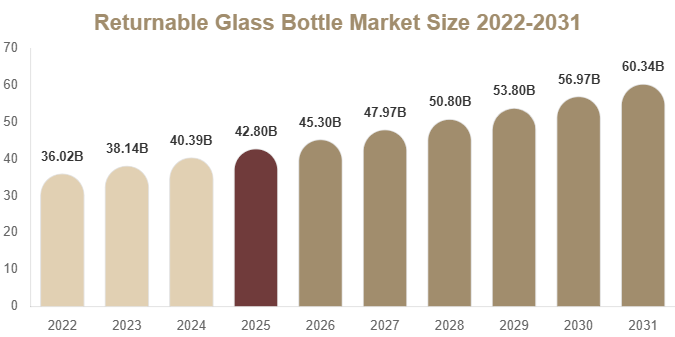
The Returnable Glass Bottle Market was valued at USD 42.80 billion in 2025 and is projected to reach USD 60.20 billion by 2030, registering a CAGR of 5.9% during the 2025–2031 forecast period.
The market continues to benefit from the global transition toward circular packaging systems. Sustainability commitments, refillable packaging initiatives, and investment in closed-loop packaging ecosystems are supporting long-term market expansion across developed and emerging markets.
Market Drivers
Rising Demand for Sustainable Packaging
Growing awareness regarding environmental sustainability is one of the primary drivers of the Returnable Glass Bottle Market. Governments, consumers, and businesses increasingly prefer packaging solutions that minimize waste and environmental impact. Returnable glass bottles support circular economy principles by enabling multiple reuse cycles before recycling, reducing packaging waste and raw material consumption.
Cost Efficiency in Long-Term Packaging Operations
Returnable glass bottles provide long-term economic advantages despite higher initial production costs. Their ability to be reused multiple times lowers overall packaging expenses for beverage manufacturers operating large-scale distribution networks. Automated washing and refilling technologies further improve operational efficiency and encourage wider adoption.
Market Challenges
High Logistics and Transportation Costs
One of the key challenges facing the Returnable Glass Bottle Market is the higher logistics and transportation cost associated with glass packaging. Glass bottles are heavier than plastic or aluminum alternatives, increasing transportation expenses and energy consumption.
Additionally, returnable bottle systems require well-developed collection, sorting, and cleaning infrastructure. Establishing and maintaining this infrastructure demands considerable investment and operational coordination, particularly in regions without organized return networks.
Market Opportunities
Growth in Emerging Beverage Markets
Emerging economies offer significant opportunities for market expansion. Rapid urbanization, increasing disposable incomes, and growing beverage consumption are supporting demand for packaged drinks across Asia Pacific, Latin America, and Africa. Expanding production facilities in these markets create opportunities for cost-effective and sustainable returnable glass bottle systems.
Integration with Smart Packaging Systems
The adoption of smart packaging technologies presents another growth opportunity. QR codes, RFID tags, and digital tracking systems can improve bottle lifecycle monitoring, optimize return cycles, and reduce supply chain losses. As digital technologies become increasingly accessible, they are expected to enhance operational efficiency and encourage broader adoption of returnable packaging systems.
Market Segmentation
By Product Type
The standard returnable glass bottles segment accounted for approximately 61.4% of the market share in 2024, supported by durability and compatibility with automated filling systems. Lightweight returnable bottles are projected to register the fastest CAGR of 6.8% during the forecast period due to reduced material usage, lower transportation costs, and improved sustainability performance.
By Capacity
The 500 ml to 1 liter segment held approximately 47.6% of the market share in 2024 and remains widely used for beer, carbonated beverages, and mineral water packaging. The less than 500 ml segment is expected to grow at the fastest CAGR of 6.4% as demand increases for portion-controlled beverage packaging.
By End-Use Industry
Alcoholic beverages dominated the market with approximately 52.3% share in 2024, supported by established bottle return and refill programs among breweries. The non-alcoholic beverages segment is forecast to grow at the fastest CAGR of 6.5% due to increasing demand for carbonated soft drinks, flavored beverages, and mineral water packaged in sustainable containers.
By Distribution Channel
The market includes direct supply to beverage manufacturers, retail return systems, and institutional distribution.
Regional Analysis
Europe led the Returnable Glass Bottle Market with approximately 38.5% share in 2025 and is expected to grow at a CAGR of 5.8% through 2033. The region's leadership is supported by established deposit-return systems, strong recycling participation, and standardized bottle formats. Germany remained the dominant country, with market values estimated at USD 6.10 billion in 2025 and USD 6.40 billion in 2026.
Asia Pacific accounted for 26.3% of the global market in 2025 and is projected to record the fastest CAGR of 7.1% during the forecast period. Growth is driven by expanding beverage manufacturing industries and increasing adoption of sustainable packaging solutions, with China leading the regional market.
North America represented approximately 21.5% of the market share in 2025 and is forecast to grow at a CAGR of 5.4%. Sustainability initiatives and refillable bottle programs among beverage manufacturers continue to support market growth, particularly in the United States.
The Middle East & Africa accounted for 7.2% of the market share in 2025 and is expected to expand at a CAGR of 5.6%. South Africa remains the leading country, supported by expanding returnable bottle systems within the beer industry.
Latin America represented 6.5% of the global market in 2025 and is forecast to grow at a CAGR of 6.2%. Brazil continues to lead the regional market due to widespread use of returnable glass bottles in beer and soft drink distribution.
Key Players
-
O-I Glass, Inc.
-
Ardagh Group S.A.
-
Verallia S.A.
-
Vetropack Holding AG
-
Vidrala S.A.
-
BA Glass
-
Toyo Glass Co., Ltd.
-
Nihon Yamamura Glass Co., Ltd.
Conclusion
The Returnable Glass Bottle Market continues to expand as beverage manufacturers prioritize sustainable packaging solutions and circular packaging systems. Increasing adoption of deposit-return programs, durable bottle designs, and automated refilling technologies is supporting market growth across both developed and emerging economies. While logistics and infrastructure requirements remain challenges, opportunities in emerging beverage markets and smart packaging integration continue to strengthen future market potential.
With a projected market value of USD 60.20 billion by 2030 and a CAGR of 5.9% during 2025–2031, the Returnable Glass Bottle Market is expected to remain an important segment within sustainable packaging, supported by growing investment in reusable packaging systems and long-term sustainability initiatives.
Report Link:
https://packagingmarketinsights.com/report/returnable-glass-bottle-market

 عربي
عربي