


 SPARK Website
How to Set Up an AI Voice Agent That Switches Languages Mid-Call Without Losing the Customer
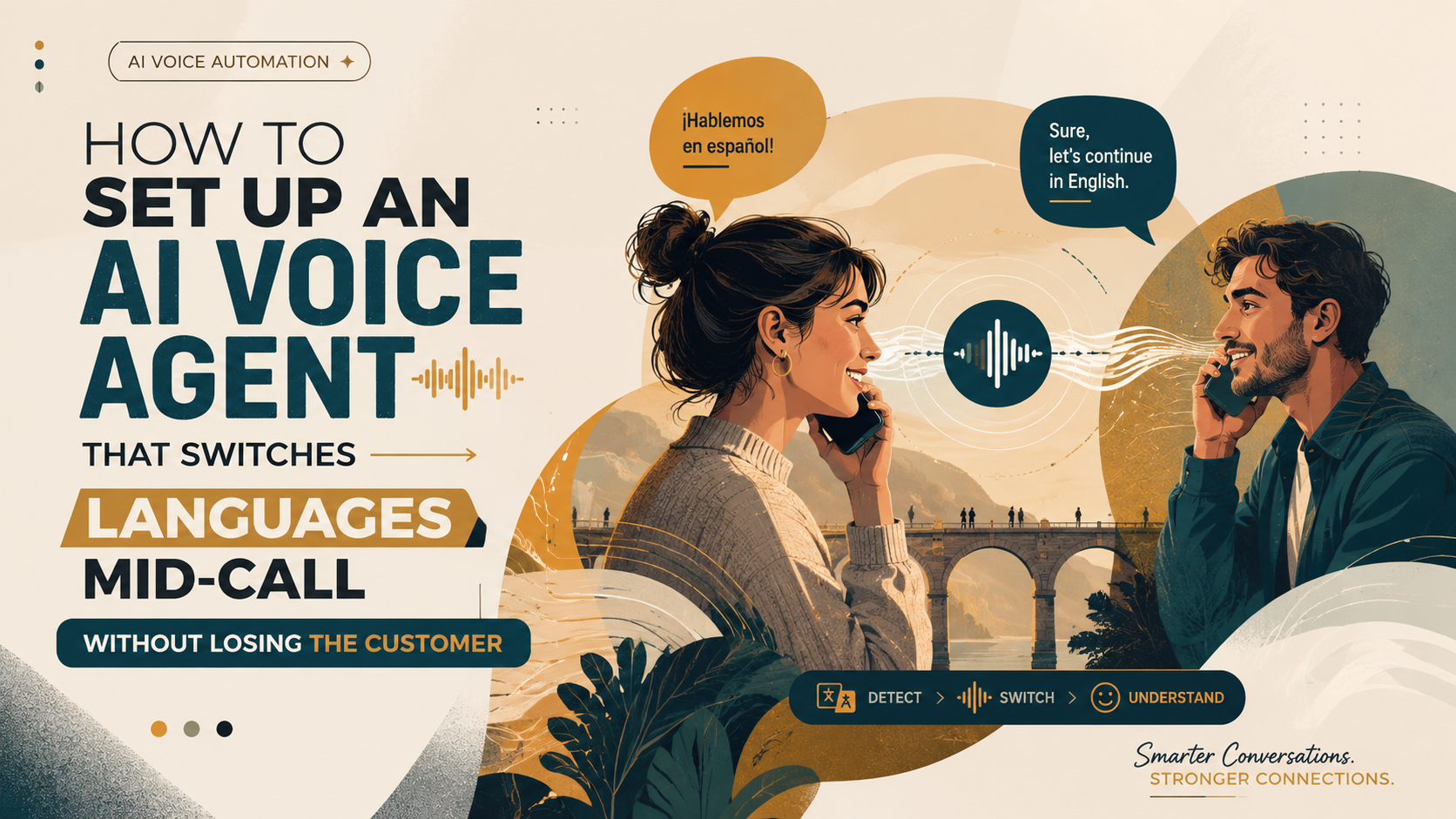
To set up an AI voice agent that switches languages mid-call, choose voice AI software with automatic language detection at the speech-to-text layer, configure per-language responses for each step, select natural voices per language, and enable context retention so the agent follows a caller who switches languages without restarting the conversation or losing captured data.
A caller dials your support line. They start in English, get frustrated explaining a delivery issue, and slip into their first language halfway through a sentence. What happens next decides whether you keep that customer or lose them.
With an AI voice agent built for mid-call language switching, the conversation simply continues. The agent detects the change, responds in the new language, and keeps every detail the caller already shared. No menu. No "press 1 for English." No starting over.
This guide breaks down how that works and how to set it up. You will learn why mid-call switching matters for revenue, how the underlying voice AI software detects and changes languages, the exact steps to configure a multilingual agent, and where this kind of conversational AI delivers the biggest wins across industries.
Why language switching mid-call is a real business problem
Most "multilingual" phone systems are not actually multilingual. They are an English bot with a few translated phrases, or an IVR that forces the caller to choose a language before trapping them in a rigid script.
Real customers do not behave that way. They start formally, then relax into their mother tongue. They switch to a regional language to explain something they can only express clearly that way. They mix two languages in a single sentence, like Hinglish or Spanglish, because that is simply how they talk.
When your phone automation cannot follow that switch, you create friction at the worst possible moment. The customer is trying to communicate something important, and your system pushes them back into a language they are less comfortable with.
The cost is real. Forcing a caller to pick a language up front loses people, especially the customers who are least comfortable in English and most likely to drop off at an English prompt. People also share more, trust more, and decide faster when they are spoken to in the language they think in.
There is a staffing angle too. Hiring fluent agents for every language and region is expensive, hard to schedule, and inconsistent across a large team. A single multilingual AI phone assistant can deliver the same quality conversation in every supported language, at any volume, around the clock. That is something a human team structurally cannot match.
How AI voice agents detect and switch languages
To configure mid-call switching well, it helps to understand what happens under the hood. A multilingual voice agent works in four coordinated stages.
Stage 1: Language detection
The agent detects the caller's language automatically from their first words. It does not ask them to choose.
Detection happens at the speech recognition layer. The speech-to-text engine identifies the language from the sounds, words, and patterns it hears, then transcribes the caller in that language. According to AssemblyAI (2026), modern speech-to-text models detect language within the first 2 to 3 seconds of speech.
Where detection happens decides how reliable it is. The speech-to-text layer carries most of the language-detection job, because the transcript it produces is what the language model reads. Get detection right early, and the rest of the conversation follows.
Stage 2: Understanding meaning
The agent converts recognized speech into language-independent intent. It works out what the caller wants, such as booking an appointment or checking an order, rather than matching fixed phrases.
Because the understanding layer operates on meaning, the same agent logic works whether the request arrives in Hindi, Spanish, or English. This is where word-for-word translation bots fall apart, since real speech includes idioms, regional phrasing, and half-finished sentences.
Stage 3: Generating and speaking the response
The agent generates its reply in the caller's language and speaks it through a text-to-speech voice chosen for the right accent and tone. A Hindi response should sound like a natural Hindi speaker, not an English voice reading Hindi words.
Stage 4: Following the switch
This is the part that matters most for smart call handling. If a caller starts in English and shifts to Spanish halfway through, the agent detects the change and continues in Spanish without restarting. The conversation, the captured details, and the workflow all carry forward. Only the language of the exchange changes.
The same mechanism handles code-switching, where a caller mixes two languages in one sentence. The agent processes the blended speech as a single intent rather than forcing it into one "pure" language.
Want a deeper look at how natural these conversations can sound? This breakdown of whether an AI Call Agent can talk like a human is a useful companion read.
Step by step: setting up a multilingual AI voice agent
You do not need to be an engineer to build this. Modern voice AI software lets you create and configure an agent using plain prompts on a no-code platform, then run test calls instantly. Here is the practical sequence.
Step 1: Pick the languages you actually serve
Start with the languages your callers really use, not a wish list. Look at your call logs, your customer base, and the regions you operate in. A focused set of well-tuned languages beats a long list you never test.
Step 2: Choose voice AI software with automatic detection
Confirm that the platform detects language at the speech recognition layer and does not rely on a menu. This single capability is what makes reliable auto-switching possible. Aim for tools that target at least 90% word accuracy across your supported languages, since transcription errors compound through the rest of the pipeline.
Step 3: Map your conversation flow
Lay out the key moments of the call: the greeting, qualification questions, confirmations, and closings. These scripted moments are where wording quality matters most, so identify each step before you write a single line.
Step 4: Write a response for each language at each step
Rather than letting the agent translate on the fly, give it an example response for every language at each step. When the design holds the exact phrasing for English, Spanish, Hindi, and any other supported language, the agent uses your reviewed wording instead of an approximate machine translation.
This keeps your AI customer service on-brand and predictable in every market. It is the difference between an agent that happens to speak Spanish and one that says exactly what you want it to say in Spanish.
Step 5: Select a voice, accent, and tone per language
Choose the voice provider, accent, and tonal style that fit your brand and each region. Accent signals familiarity and trust, so a flat or mismatched voice can break the experience even when the words are correct.
Step 6: Connect your business systems
Link the agent to your CRM, APIs, and workflows. Because the understanding layer turns every conversation into structured data, a booking captured in Spanish and one captured in English write into your system the same way. Your team works from one clean source of truth, no matter how many languages your virtual call agent speaks.
Step 7: Test by ear, then refine
Run test calls and listen to the agent in each language before going live. Most pronunciation problems are actually text problems, so clean response text fixes the majority of speech issues before you touch the voice settings.
What to configure for seamless language transitions
A few configuration choices separate an agent that switches smoothly from one that stumbles.
Enable context retention across languages. The agent must carry the full conversation, captured details, and workflow forward when the language changes. A caller who books a service in English, then switches to explain a special instruction in another language, should never have to repeat themselves.
Write responses for the ear, not the screen. Use natural, flowing sentences. Strip out bullet points, numbered lists, markdown symbols, emojis, and stray characters, since those formatting artifacts make the voice stumble on real calls.
Allow natural code-switching in your wording. When customers mix English technical terms into a regional-language sentence, keep those English terms where they belong. Forcing a stiff "pure" translation sounds robotic and unnatural.
Fix stubborn words deliberately. When a particular word is consistently mispronounced, swap in a clearer synonym, or spell it the way it should sound rather than the way the dictionary spells it.
Build in confidence checks. Good systems avoid false switches when detection is uncertain, using signals like the caller's region or profile as supporting hints.
Real-world use cases
Mid-call language switching pays off anywhere your callers do not all speak the same language. Here is where it lands hardest.
Real estate
A property team fields inquiries from buyers across different regions. An AI receptionist greets a caller in one language, then follows naturally when the caller switches to explain budget or location preferences, capturing every detail into the CRM for follow-up.
Healthcare
Clinics serve patients who are far more comfortable describing symptoms or scheduling in their first language. A multilingual agent handles appointment booking and reminders across languages while writing consistent records, which reduces no-shows and easing the load on front-desk staff.
SaaS
For SaaS founders scaling into new markets, a single voice AI agent handles onboarding calls, trial check-ins, and support questions in every target language, without hiring a separate team for each region.
Customer support
Customer support automation is the biggest deployment of multilingual voice agents today. The agent resolves routine requests like password resets, balance checks, and order tracking in dozens of languages, then escalates to a human while preserving both the conversation context and the caller's language preference.
Sales
A sales team runs qualification calls in several languages across different cities. Every qualified lead lands in the same CRM with the same structured fields, so the team compares and works leads uniformly regardless of which language the call happened in.
Frequently asked questions
Can one AI voice agent handle multiple languages in the same call?
Yes. A single agent detects the caller's language automatically and can switch languages mid-conversation if the caller switches, carrying the full context and captured data forward. The caller never has to choose a language or restart the conversation.
Does the agent ask the caller to choose a language first?
No. The agent detects the spoken language automatically from the caller's first words and responds in that language. There is no "press 1 for English" menu, which removes the friction that loses callers who are less comfortable in English.
How quickly does the agent detect the language?
Modern speech-to-text models detect language within the first 2 to 3 seconds of speech, according to AssemblyAI (2026). Detection happens at the speech recognition layer, which is what makes reliable mid-call switching possible.
Can the agent handle code-switching, like mixing two languages in one sentence?
Yes. The agent understands naturally mixed speech as a single intent rather than forcing the caller into one language. Its responses can keep natural English terms inside a regional-language sentence, matching how people actually talk.
Do I need coding skills to set this up?
No. You can build and configure a multilingual agent using simple prompts on a no-code platform, then run test calls instantly to hear how it performs across languages before deploying.
Why does my agent sometimes mispronounce words?
Most pronunciation issues come from the response text, not the voice. Writing responses as clean, natural speech, with no markdown, bullets, emojis, or stray symbols, fixes the large majority of them. For a stubborn word, swap in a clearer synonym or spell it the way it should sound.
How accurate does the speech recognition need to be?
Aim for at least 90% word accuracy across all supported languages and accents. Lower accuracy causes errors to compound through the pipeline, which reduces reliability for real conversations.
The conversation that keeps your customer
The businesses winning right now are the ones whose first conversation with every customer happens in that customer's language, automatically and naturally. Mid-call language switching is no longer a nice-to-have. It is what separates business phone automation that works on real calls from automation that only works in a scripted demo.
The setup is straightforward. Pick the languages you serve, choose voice AI software with automatic detection, write reviewed responses per language, give the agent a natural voice for each one, connect your systems, and test by ear before you launch.
If you are exploring AI calling solutions for your team, OnDial is worth a look as a platform built around natural, multilingual phone conversations. Start with the languages your customers actually speak, run a few test calls, and listen for the moment the agent follows a switch without missing a beat. That moment is where customer loyalty is won.
Meta data
Meta title
Set Up an AI Voice Agent That Switches Languages Mid-Call
Meta description
Learn how to set up an AI voice agent that switches languages mid-call without losing the customer. Step-by-step setup, configuration tips, and real use cases.

 English