


 SPARK Website
Automotive Smart Lighting Market Outlook: Key Growth Opportunities Emerging from Electric, Autonomous, and Premium Vehicles
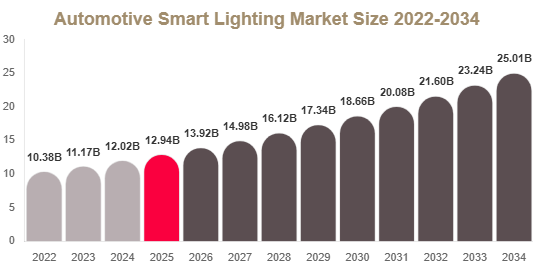
Automotive Smart Lighting Market Size, Share & Growth Analysis Report 2025–2034
Market Overview
The Automotive Smart Lighting Market is witnessing substantial growth as automotive manufacturers increasingly integrate intelligent lighting technologies to improve vehicle safety, visibility, energy efficiency, and overall driving experience. Smart lighting systems utilize advanced technologies such as adaptive front lighting, matrix LED headlights, OLED lighting, laser lighting, ambient lighting systems, and intelligent signaling solutions to automatically adjust illumination based on road conditions, vehicle speed, weather, and surrounding traffic.
Report Link: https://www.redlinepulse.com/report/automotive-smart-lighting-market
The growing emphasis on road safety and premium vehicle features is significantly contributing to market expansion. Modern smart lighting systems combine sensors, cameras, electronic control units, and software algorithms to provide enhanced visibility and driving comfort. These technologies enable vehicles to intelligently adapt lighting intensity and beam direction, helping drivers navigate challenging environments while reducing glare for other road users.
In addition, the rapid advancement of LED, OLED, and laser lighting technologies is transforming automotive lighting systems. Vehicle manufacturers are increasingly incorporating smart lighting into both premium and mainstream vehicle models to differentiate their offerings and comply with evolving safety standards. As connected vehicles and advanced driver assistance systems become more widespread, the role of intelligent lighting solutions is expected to expand further throughout the forecast period.
Market Size and Forecast
The global Automotive Smart Lighting Market was valued at USD 12.84 billion in 2025 and is projected to reach USD 13.92 billion in 2026. The market is anticipated to reach USD 24.87 billion by 2034, expanding at a CAGR of 7.6% during the forecast period from 2025 to 2034.
Market growth is being driven by increasing adoption of advanced safety technologies, rising demand for premium vehicle features, expanding electric vehicle production, and continuous innovations in automotive lighting systems. Automakers are investing heavily in intelligent lighting platforms that improve vehicle functionality while enhancing aesthetics and brand differentiation. These developments are expected to support sustained growth across global automotive markets.
Market Drivers
Rising Demand for Enhanced Vehicle Safety Features
The growing focus on vehicle safety remains one of the primary drivers of the Automotive Smart Lighting Market. Governments and automotive safety organizations continue promoting technologies that improve visibility and reduce accident risks, particularly during nighttime driving and adverse weather conditions. Smart lighting systems help drivers identify road signs, pedestrians, obstacles, and changing road conditions more effectively.
Automotive manufacturers are increasingly integrating adaptive lighting technologies to meet evolving safety regulations and consumer expectations. Features such as adaptive front lighting systems, matrix LED headlights, and intelligent signaling technologies provide improved road illumination while minimizing glare for other drivers. As consumers continue prioritizing safety when purchasing vehicles, demand for advanced smart lighting solutions is expected to increase steadily.
Expanding Production of Premium and Electric Vehicles
The rapid growth of premium and electric vehicle production is creating strong demand for intelligent automotive lighting technologies. Premium vehicle manufacturers frequently utilize advanced lighting systems as a distinguishing feature that enhances both vehicle appearance and functionality. Smart lighting technologies contribute to luxury vehicle design while improving driving comfort and safety.
Electric vehicle manufacturers are also increasingly adopting intelligent lighting solutions to improve energy efficiency and strengthen vehicle identity. LED, OLED, and laser lighting technologies consume less power while delivering superior illumination performance. As electric mobility continues expanding globally and premium vehicle demand remains strong, smart lighting adoption is expected to accelerate significantly.
Market Challenges
High Cost of Advanced Lighting Technologies
The relatively high cost of advanced automotive smart lighting systems remains a key challenge affecting market growth. Technologies such as matrix LED headlights, laser lighting systems, OLED lighting modules, and adaptive lighting control units require sophisticated electronic components and advanced manufacturing processes. These factors contribute to higher production costs compared to conventional automotive lighting systems.
The challenge is particularly noticeable within entry-level and budget vehicle segments where affordability remains a critical purchasing factor. Advanced lighting systems can increase overall vehicle costs, limiting adoption in cost-sensitive markets. Furthermore, repair and replacement expenses associated with intelligent lighting technologies are often significantly higher than traditional lighting systems. Although economies of scale and technological advancements are gradually reducing costs, pricing concerns continue to influence adoption rates in several automotive markets.
Buy Now Link: https://www.redlinepulse.com/report/automotive-smart-lighting-market/buy-now
Market Opportunities
Emergence of Autonomous and Semi-Autonomous Vehicles
The development of autonomous and semi-autonomous vehicles presents substantial opportunities for the Automotive Smart Lighting Market. Intelligent lighting systems are becoming increasingly important for vehicle communication, environmental awareness, and interaction with pedestrians and surrounding vehicles. Advanced lighting technologies can provide visual signals regarding vehicle intentions and operational status, enhancing safety and communication capabilities.
As autonomous mobility solutions continue evolving, manufacturers are expected to develop sophisticated lighting platforms that support both illumination and communication functions. This evolution creates significant opportunities for automotive lighting suppliers and technology developers seeking to support future mobility ecosystems.
Expansion of Vehicle Personalization and Ambient Lighting Solutions
Growing consumer demand for personalized vehicle experiences is creating new opportunities within the smart lighting industry. Interior ambient lighting systems, customizable lighting effects, and dynamic illumination features are becoming increasingly popular among vehicle buyers. Modern lighting platforms allow users to customize cabin environments through infotainment systems and smartphone applications.
Automakers are investing in innovative ambient lighting technologies that enhance comfort, aesthetics, and overall user experience. The increasing popularity of connected vehicles and digital cockpit technologies is further accelerating demand for advanced interior lighting systems. This trend is expected to generate significant growth opportunities throughout the forecast period.
Market Segmentation
By Technology
LED smart lighting dominated the Automotive Smart Lighting Market with a market share of 46.27% in 2025. LED technology remains the preferred choice for automotive manufacturers due to its energy efficiency, long lifespan, compact design, and superior illumination performance. These systems are widely used across headlights, taillights, daytime running lights, and ambient lighting applications. Continued improvements in LED technology and declining manufacturing costs are expected to support future growth.
Laser lighting is projected to register the fastest CAGR of 10.2% through 2034. The segment is benefiting from increasing demand for high-performance lighting systems that offer extended illumination range and improved precision. Premium vehicle manufacturers are increasingly integrating laser lighting technologies to enhance nighttime visibility and driving performance.
Other key technology segments include OLED lighting and Xenon adaptive lighting, which continue to serve specialized automotive applications requiring advanced lighting functionality and design flexibility.
By Vehicle Type
Passenger vehicles accounted for the largest market share of 68.41% in 2025. High production volumes and increasing consumer demand for advanced safety and convenience features continue supporting segment dominance. Automotive manufacturers are incorporating smart lighting technologies into passenger vehicles to improve visibility, enhance aesthetics, and create premium driving experiences.
Electric vehicles represent the fastest-growing vehicle category and are expected to expand at a CAGR of 9.4% through 2034. Smart lighting systems complement the futuristic design language associated with electric vehicles while supporting energy efficiency and advanced connectivity features. Growing EV production worldwide is expected to create significant opportunities for lighting suppliers.
Other vehicle segments include light commercial vehicles and heavy commercial vehicles, which are increasingly adopting intelligent lighting technologies to improve operational safety and visibility.
By Application
Adaptive front lighting systems dominated the market with a share of 37.85% in 2025. These systems automatically adjust lighting direction and intensity based on vehicle speed, steering angle, road conditions, and surrounding traffic. Their ability to improve driving safety and visibility makes them one of the most widely adopted smart lighting applications.
Ambient lighting systems are expected to witness the fastest growth, expanding at a CAGR of 9.7% during the forecast period. Consumers increasingly seek personalized interior environments, prompting automakers to introduce advanced ambient lighting features with customizable colors and dynamic lighting effects.
Additional application segments include intelligent signal lighting and exterior smart lighting systems, both of which continue gaining popularity as vehicle connectivity and intelligent mobility solutions advance.
Regional Analysis
North America
North America dominated the Automotive Smart Lighting Market with a market share of 34.18% in 2025 and is projected to grow at a CAGR of 7.1% through 2034. The region benefits from strong demand for premium vehicles, widespread adoption of advanced driver assistance systems, and increasing investments in intelligent mobility technologies.
The United States leads the regional market and was valued at USD 3.61 billion in 2025, reaching USD 3.92 billion in 2026. Growing deployment of connected vehicle platforms integrated with intelligent lighting systems is supporting market expansion. Automotive manufacturers continue introducing advanced lighting technologies that enhance safety, comfort, and vehicle performance.
Europe
Europe accounted for 29.12% of the global market in 2025 and is expected to expand at a CAGR of 7.4% during the forecast period. Market growth is supported by strict vehicle safety regulations, strong automotive manufacturing capabilities, and increasing demand for premium vehicle technologies.
Germany remains the leading market within Europe due to its concentration of premium automotive manufacturers and advanced engineering expertise. Increasing adoption of digital lighting technologies, matrix LED systems, and dynamic lighting controls continues supporting regional market growth.
Asia Pacific
Asia Pacific represented 24.76% of global market revenue in 2025 and is forecast to register the fastest CAGR of 8.91% through 2034. Rising vehicle production, increasing urbanization, growing disposable incomes, and expanding electric vehicle adoption are supporting strong regional demand for automotive smart lighting systems.
China dominates the Asia Pacific market due to its extensive automotive manufacturing ecosystem and rapidly expanding electric vehicle industry. Government support for intelligent transportation systems and vehicle technology innovation is encouraging broader adoption of advanced lighting technologies across both conventional and electric vehicles.
Middle East & Africa
The Middle East & Africa accounted for 5.48% of the market in 2025 and is projected to grow at a CAGR of 6.7% through 2034. Increasing vehicle ownership, growing demand for premium automobiles, and rising awareness regarding vehicle safety technologies continue supporting market development.
Saudi Arabia leads the regional market due to increasing automotive sales and strong consumer interest in technologically advanced vehicles. Demand for premium SUVs equipped with intelligent lighting systems is creating attractive opportunities for smart lighting manufacturers.
Latin America
Latin America represented 6.46% of the global market in 2025 and is expected to expand at a CAGR of 6.9% through 2034. Growing vehicle ownership, improving economic conditions, and increasing consumer awareness regarding advanced safety technologies are contributing to market growth.
Brazil remains the dominant market in the region due to its established automotive manufacturing industry and rising demand for technologically advanced passenger vehicles. Automotive manufacturers are increasingly incorporating LED headlights, adaptive lighting systems, and intelligent illumination technologies into locally produced vehicles.
Key Players
Koito Manufacturing Co., Ltd.
Koito Manufacturing Co., Ltd. remains one of the leading participants in the Automotive Smart Lighting Market due to its expertise in automotive lighting technologies and strong partnerships with global vehicle manufacturers.
Valeo SA
Valeo SA continues expanding its smart lighting portfolio through investments in adaptive lighting systems, LED technologies, and intelligent vehicle integration solutions.
HELLA GmbH & Co. KGaA
HELLA GmbH & Co. KGaA focuses on advanced lighting innovation, offering intelligent automotive lighting systems designed to improve safety and vehicle performance.
Stanley Electric Co., Ltd.
Stanley Electric Co., Ltd. remains a key supplier of automotive lighting solutions, supporting global automakers with advanced LED and adaptive lighting technologies.
Marelli Holdings Co., Ltd.
Marelli Holdings Co., Ltd. continues investing in intelligent lighting platforms that support vehicle safety, connectivity, and energy efficiency objectives.
OSRAM GmbH
OSRAM GmbH is actively involved in developing innovative lighting technologies that improve illumination quality and automotive lighting performance.
ZKW Group GmbH
ZKW Group GmbH specializes in premium lighting systems and continues expanding its presence through advanced LED and laser lighting solutions.
Hyundai Mobis
Hyundai Mobis continues strengthening its smart lighting portfolio through technological innovation and integration of connected vehicle lighting solutions.
Frequently Asked Questions
How big is the Automotive Smart Lighting Market?
According to Redline Pulse, the Automotive Smart Lighting Market was valued at USD 12.84 billion in 2025 and is projected to reach USD 24.87 billion by 2034, expanding at a CAGR of 7.6% during 2025–2034.
What are the key opportunities in the market?
Major opportunities include the emergence of autonomous and semi-autonomous vehicles and the expansion of vehicle personalization through advanced ambient lighting systems.
Which technology segment dominated the market?
LED smart lighting dominated the market with a share of 46.27% in 2025 due to its energy efficiency, durability, and compatibility with intelligent lighting applications.
Conclusion
The Automotive Smart Lighting Market is poised for sustained growth as vehicle manufacturers increasingly prioritize safety, connectivity, energy efficiency, and premium driving experiences. The market is projected to grow from USD 12.84 billion in 2025 to USD 24.87 billion by 2034, supported by rising adoption of intelligent lighting technologies across passenger, commercial, and electric vehicle segments.
Request Sample Link: https://www.redlinepulse.com/report/automotive-smart-lighting-market/request-sample
Growing investments in adaptive lighting systems, connected vehicle technologies, and advanced illumination solutions will continue shaping the future of automotive lighting. With North America leading the market and Asia Pacific emerging as the fastest-growing region, manufacturers are expected to focus on innovation, software integration, and next-generation lighting platforms to capitalize on evolving industry opportunities throughout the forecast period.

 عربي
عربي