


 SPARK Website
Driveway Moss Killer: The UK Homeowner's Honest Guide to Beating Green Growth for Good
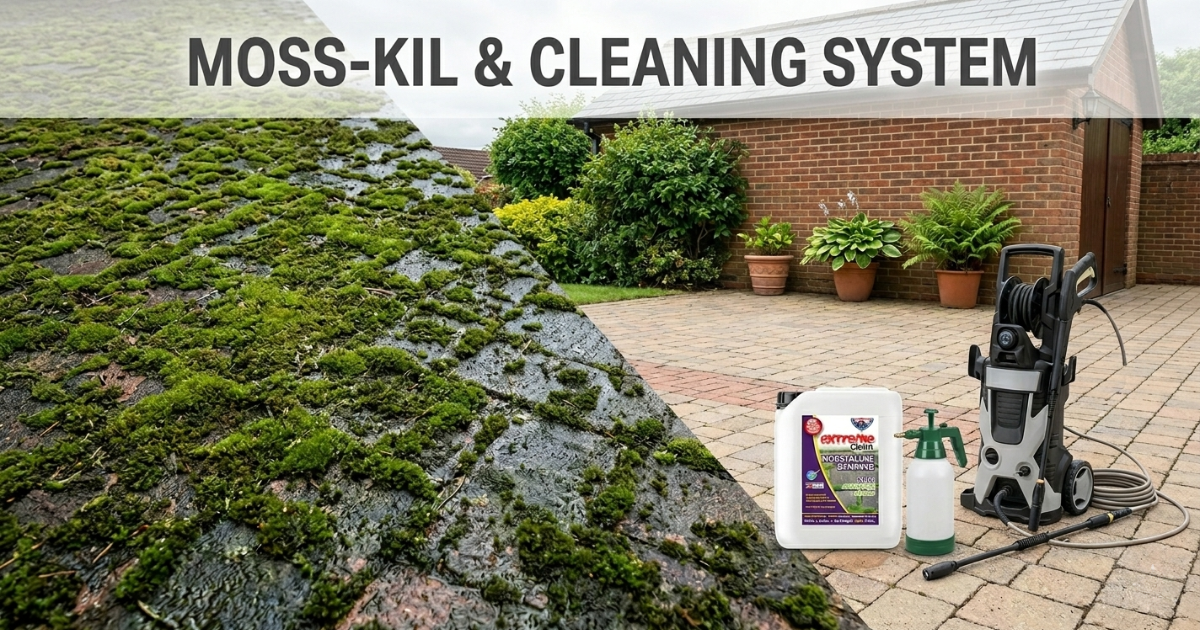
A good driveway moss killer is where most homeowners should start. Not a bucket of bleach, not three hours behind a pressure washer, not a trial of whatever the neighbour swears by. A properly formulated moss and algae remover treats the biological growth at its source, clears the surface effectively, and — if you choose wisely — leaves a residual barrier that slows the regrowth considerably. This guide explains exactly how to do it right.
Moss vs Algae vs Mould: Know What You're Dealing With
Before you reach for any treatment, it's worth spending thirty seconds identifying what you're actually dealing with. These three common driveway invaders look similar at a glance but behave differently, and the best approach to each varies slightly.
Moss
Moss is a small, non-vascular plant that anchors itself to porous surfaces using root-like structures called rhizoids. It's typically a vivid green when wet, turning brown and crusty when dry. You'll find it most often in shaded, damp areas — the north-facing side of the house, under trees, or wherever the surface stays moist longest.
Moss has physical structure — it forms cushions and clumps — and once established, it holds moisture against the surface beneath, which can accelerate the deterioration of block paving joints, mortar, and the surface of tarmac. A dedicated drive moss killer needs to penetrate this physical layer and kill the plant at the root level.
Algae
Algae is what causes that slippery green, black, or brownish film that appears on hard surfaces — particularly on smoother surfaces like concrete, natural stone, or well-worn tarmac. Unlike moss, algae doesn't have a physical plant structure; it's a microscopic organism that forms a thin biofilm across the surface. That film is why paths and driveways become treacherously slippery — algae reduces surface friction dramatically when wet.
A quality algae killer or moss algae remover typically works by disrupting the cell structure of the organism, causing it to die off and wash away. Because algae is a surface-level growth rather than a rooted plant, it generally responds more quickly to treatment than established moss.
Mould
Mould on driveways presents as dark, often black or dark grey patches — particularly in areas of very poor drainage or heavy shade. Mould and algae removal often go hand-in-hand because the conditions that favour one tend to favour the other. Mould on external surfaces is a fungal growth and, like algae, responds well to biocidal treatments — though some stubborn mould staining may remain even after the organism is dead, requiring additional cleaning.
Why Pressure Washing Alone Isn't Enough
Ask around and you'll find no shortage of people who swear by the pressure washer as the universal solution to a green driveway. And to be fair, a good pressure wash does a fine job of physically removing visible growth. The problem is what it doesn't do.
Pressure washing removes the above-surface portion of moss, algae, and mould — but the spores and root structures remain embedded in the pores of the surface. Within weeks, often less in wet weather, the growth returns. In some cases, pressure washing can make things worse by spreading spores to areas of the driveway that weren't previously affected, and by blasting out the jointing sand or mortar from between block paving and flags.
It's also worth noting that pressure washing alone does nothing for the underlying conditions that allowed the growth to establish in the first place. The surface is still porous, still damp, still in shade — the moss and algae simply regrow.
A moss and algae killer used before or after washing breaks this cycle. It kills the organism — including the root structures and spores — so that what regrows from the surface after cleaning is far less vigorous, and the residual active ingredient continues working in the surface for weeks or months after application.
How Driveway Moss Killers Actually Work
Most modern moss algae killers are formulated around biocidal active ingredients — compounds that are toxic to biological organisms like moss, algae, lichen, and mould, but designed to be used safely on hard outdoor surfaces.
The most common active ingredients you'll encounter include:
Quaternary ammonium compounds (QACs) — sometimes listed as benzalkonium chloride or similar. These are effective broad-spectrum biocides that disrupt cell membranes in algae and fungi, causing the organism to die. They work relatively quickly and leave a residual protective effect on the surface.
Didecyl dimethyl ammonium chloride (DDAC) — another QAC variant widely used in professional-grade moss and algae removers. Often found in products marketed for trade or professional use, where a longer-lasting residual effect is required.
Iron sulphate — a more traditional ingredient particularly associated with moss control on lawns, though some driveway formulations include it. It works by desiccating the moss rather than using a broad biocidal action. It can cause temporary staining on light-coloured surfaces.
Acetic acid-based formulations — a more environmentally considerate option, though generally slower-acting and less effective on established, heavy growth.
When you apply a driveway moss killer, the active ingredient is absorbed into the biological matter — the moss fronds, the algal biofilm, the fungal hyphae — and disrupts the cellular processes that keep the organism alive. Within days to weeks (depending on the product and the weather), the growth dies, turns brown or black, and can then be swept or washed away.
The residual action is what separates a good moss algae removal product from a basic one: some formulations leave an active layer on the surface that continues to inhibit regrowth for months, dramatically extending the time before you need to treat again.
Choosing the Right Moss and Algae Remover
The market for driveway moss killer products in the UK is broad, ranging from budget concentrate bottles to professional-grade treatments used by landscapers and facilities managers. Here's what to look for.
Ready-to-Use vs Concentrate
Ready-to-use products come pre-diluted and are applied straight from the bottle — convenient for smaller driveways or occasional spot treatments. Concentrate products are diluted with water before use and typically offer much better value per square metre for larger areas. If you have a sizeable driveway or multiple hard surfaces to treat, a concentrate is almost always the more economical choice.
Application Method
Some moss and algae killers are applied with a watering can or pump sprayer, others with a brush or roller. For large driveways, a knapsack sprayer or garden pressure sprayer gives the most even coverage and is far less labour-intensive than working with a watering can. Check the application method before you buy and make sure you have the right equipment.
Surface Compatibility
Most driveway moss killers are suitable for a wide range of hard surfaces — tarmac, concrete, block paving, natural stone, gravel, and so on — but it's always worth checking. Some iron sulphate-based products can temporarily stain lighter-coloured natural stone or concrete, which may matter to you depending on your surface.
Residual Effect
This is the factor that most separates a one-season treatment from a genuinely effective long-term solution. Look for products that specifically mention a lasting residual protective effect — this is what inhibits regrowth and extends the time between applications. A product that kills growth on contact but leaves no residue will require re-application far more frequently.
Environmental Considerations
All biocidal products require careful handling near drains, watercourses, and garden plants. Look for products with a clear environmental safety profile — many modern moss and algae removers are formulated to be safer around plants and drains than older chemistry. That said, no biocidal product should be treated casually; always read the label.
For a well-curated range of professional-grade treatments — including concentrated moss and algae killers, mould and algae removers, and surface biocides suitable for residential and commercial driveways — Trade Supplies UK is worth a look. Their product range covers both DIY-friendly options and trade-grade solutions, with clear guidance on dilution rates, application methods, and surface suitability.
Step-by-Step: How to Treat Your Driveway Properly
Here's a practical walkthrough for getting the best results from a driveway moss killer treatment.
What You'll Need
- Your chosen moss and algae remover (concentrate or ready-to-use)
- A garden pump sprayer, knapsack sprayer, or watering can with a rose head
- Stiff-bristled brush or broom
- Pressure washer or garden hose (optional — for post-treatment cleaning)
- Gloves, eye protection, and old clothing
- Buckets or sheeting to protect nearby plants if required
Step 1: Clear the Surface
Remove any vehicles, plant pots, garden furniture, and other objects. Sweep the driveway thoroughly to remove loose debris, leaves, and any thick clumps of moss that can be physically removed first. This improves the penetration of the treatment.
Step 2: Protect Surrounding Plants and Drains
If your driveway runs close to borders, lawns, or planted areas, water them well before treatment to dilute any overspray, and consider covering sensitive plants with plastic sheeting. Block any surface drains if the product label indicates this is necessary — check local guidance on this, as different formulations have different requirements.
Step 3: Apply the Treatment
Dilute your concentrate to the rate specified for the level of growth you're dealing with — most products offer a stronger dilution for heavy infestations and a lighter rate for maintenance applications. Apply evenly across the surface using your sprayer or watering can, ensuring good coverage of all affected areas including joints and edges. Don't rush this step.
Step 4: Allow the Product to Work
This is where patience pays off. Most moss algae killers need to remain on the surface for a minimum dwell time — often 24 hours to several days — before the full biocidal action takes effect. Avoid rinsing or walking heavily on the surface during this period. You'll see the growth beginning to discolour and die back.
Step 5: Remove Dead Growth
Once the moss and algae have died — they'll typically turn brown, black, or grey — sweep or brush away the dead material. For algal biofilms, a stiff brush and a rinse with a garden hose is usually sufficient. For heavier moss growth, a pressure wash at this stage is safe and effective, as you're now removing dead matter rather than live organisms.
Step 6: Consider a Follow-Up or Sealing Treatment
For heavily infested areas, a second application after the initial clean may be worthwhile. Once the surface is clean, applying a driveway sealer or surface biocide treatment will help maintain the clean result and inhibit future moss and algae regrowth.
Is It Safe for Plants, Pets, and Drains?
This is one of the most common questions around moss and algae removal products, and the honest answer is: it depends on the product and how carefully it's applied.
Plants and lawns: Most QAC-based biocides can damage or kill plants if applied directly or in heavy concentrations via overspray or runoff. Protect borders and lawns during application and avoid treating immediately before heavy rain, which can wash product into planted areas. Water surrounding plants well before and after treatment as a precaution.
Pets: Most moss algae remover products are safe for pets once the treated surface is dry. Keep animals away during application and for the drying period stated on the label — typically a few hours in reasonable weather. Always store products securely and out of reach.
Drains and watercourses: Biocidal products should never be allowed to enter watercourses, streams, ponds, or surface water drains. The regulations around this in the UK are clear — the Water Resources Act 1991 makes it an offence to pollute controlled waters, and the Environment Agency takes this seriously. Block surface drains during treatment if there is any risk of direct runoff, and always apply in dry weather with no rain forecast for at least 24 hours.
Children: As with any chemical product, keep children away from the area during application and until the surface is dry.
How to Stop Moss and Algae Coming Back
Treating the growth is only half the job. If the underlying conditions remain unchanged, moss algae removal becomes a recurring seasonal chore rather than a one-time fix. Here are the most effective steps to reduce regrowth.
Improve drainage. Standing water is the single biggest contributor to moss and algae growth. If your driveway has areas where water pools, addressing the drainage — re-grading the surface, improving the falls, clearing blocked channels — will make a dramatic difference.
Increase light and airflow. Shade keeps surfaces cool and damp, which is exactly what moss and algae love. Cutting back overhanging trees and shrubs, even modestly, can significantly reduce the rate of regrowth in problem areas.
Apply a surface biocide treatment annually. Rather than waiting until you have a visible problem, a light annual treatment with a diluted moss and algae killer — applied in autumn before the damp season — will inhibit the conditions for growth before they become established.
Seal the surface. For block paving and tarmac driveways, applying a quality driveway sealer after a mould and algae removal treatment reduces the porosity of the surface. Less porous surfaces are less hospitable to biological growth, and water runs off rather than sitting and providing a habitat.
Keep joints maintained. Cracked or missing jointing sand in block paving is an open invitation for moss to take root. Keeping joints topped up with kiln-dried sand and in good repair removes one of moss's favourite anchoring points.
Frequently Asked Questions
How long does a driveway moss killer take to work? Most products begin to show visible results — browning and dying of the moss or algae — within 24 to 72 hours, though heavily established growth may take up to two weeks to fully die back. Weather conditions affect speed: warmer, drier weather accelerates the process; cold and wet conditions slow it down.
Can I use a moss and algae killer on block paving? Yes — most dedicated driveway treatments are suitable for block paving, concrete, tarmac, natural stone, and other hard surfaces. Always check the label for surface compatibility, and be aware that some products can temporarily affect the colour of lighter-coloured paving if left at high concentration.
Will a driveway moss killer damage my lawn if it runs off? Most biocidal moss algae killers can damage grass and plants if they come into direct contact or run off in significant quantities. Apply in dry weather, protect adjacent areas, and water surrounding grass well before treatment to dilute any incidental contact.
How often do I need to treat my driveway for moss and algae? For most UK driveways, a full treatment once a year — ideally in autumn — combined with a light maintenance application in spring is sufficient. Driveways in heavily shaded or damp positions may need more frequent attention.
Is bleach a good driveway moss killer? Household bleach (sodium hypochlorite) will kill surface algae and mould reasonably effectively, but it has significant drawbacks: it can bleach and stain certain surfaces, it deteriorates quickly in sunlight, it has no residual effect, and it's environmentally problematic near drains and plants. A purpose-made moss and algae remover is a safer, more effective, and longer-lasting choice.
Final Thoughts
Moss, algae, and mould on a driveway are amongst the most common and persistent maintenance challenges facing UK homeowners — and entirely understandably so, given our climate. But they are not inevitable, and they're certainly not permanent.
A good driveway moss killer, applied correctly and at the right time of year, can transform a green, slippery, tired-looking drive back into something you're pleased to come home to. The key is treating the problem properly rather than just masking it: kill the growth at the source, remove the dead material, address the underlying conditions where you can, and apply a preventive treatment to keep on top of it going forward.
The whole process is well within the reach of any homeowner with an afternoon to spare and the right products to hand. Choose wisely, follow the instructions carefully, and give the treatment time to work — and you'll find that moss and algae removal is one of those satisfying jobs where the results genuinely speak for themselves.
Looking for professional-grade moss and algae treatments for driveways, patios, and hard surfaces? Trade Supplies UK stocks a comprehensive range of biocidal cleaners, moss killers, and surface treatments suitable for residential and commercial use — with clear guidance to help you pick the right product for your surface and the level of growth you're dealing with.

 English