


 SPARK Website
Beverage Packaging Market Benefits from Innovations in Bottle and Closure Technologies
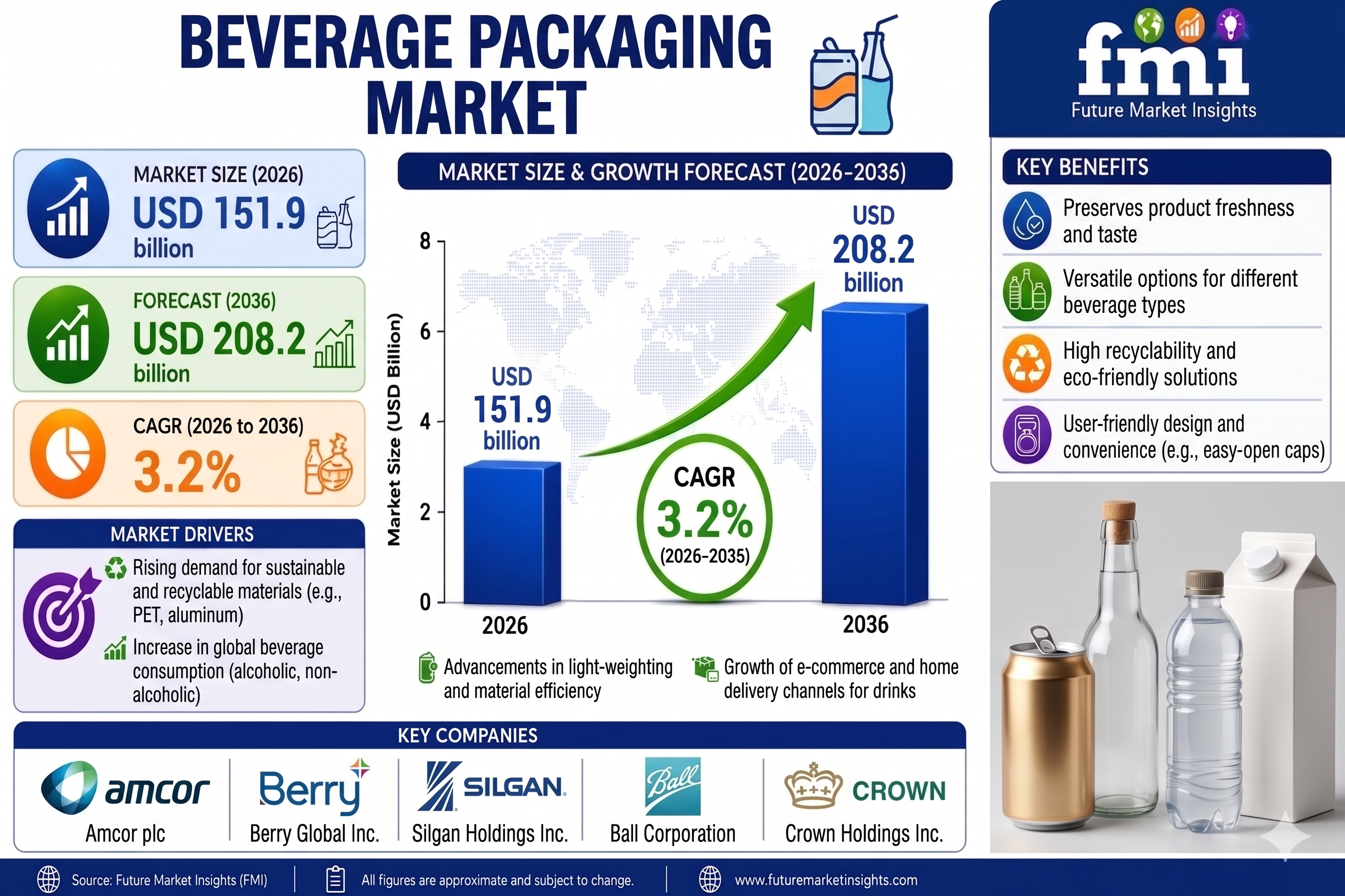
The global beverage packaging market is projected to grow from USD 149.7 billion in 2026 to USD 241.5 billion by 2036, expanding at a CAGR of 4.9%. Unlike traditional volume-driven growth cycles, this expansion is increasingly shaped by regulatory compliance, recycled material mandates, and circular economy transitions.
Government policies across major economies are accelerating the shift toward post-consumer recycled (PCR) materials, compelling beverage manufacturers to realign procurement strategies and invest in sustainable packaging infrastructure.
Get Access of Research Report Sample: https://www.futuremarketinsights.com/reports/sample/rep-gb-196
Market Drivers: Regulatory Compliance and Sustainability Lead Industry Transformation
The market is undergoing a structural transformation driven by policy enforcement and environmental accountability.
Key growth drivers include:
- Mandatory recycled content regulations across North America and Europe
• Rising demand for lightweight and cost-efficient packaging formats
• Increasing consumption of functional and ready-to-drink beverages
• Expansion of high-speed automated bottling and filling lines
• Shift toward circular economy and closed-loop recycling systems
Compliance requirements are forcing beverage companies to secure long-term PCR supply agreements, reshaping supplier ecosystems globally.
Segment Insights: Plastic and Bottles Maintain Dominance
Plastic Leads with 39.5% Market Share
Plastic remains the dominant material due to its lightweight nature and cost efficiency.
Key advantages include:
- Reduced transportation and logistics costs
• High durability and flexibility in design
• Compatibility with high-speed bottling operations
• Increasing integration of recycled PET (rPET) materials
However, regulatory pressure is accelerating the transition from virgin plastics to certified recycled polymers.
Bottles Account for 35% of Packaging Formats
Bottles continue to dominate due to their versatility and barrier properties.
Key demand factors include:
- Protection against oxidation and carbonation loss
• Compatibility with carbonated and non-carbonated beverages
• Increasing focus on lightweight bottle design optimization
• Strong presence in retail and on-the-go consumption formats
Manufacturers are investing in advanced preform technologies to improve efficiency and reduce material usage.
Read Full Report- https://www.futuremarketinsights.com/reports/global-beverage-packaging-market
Beverage Trends: Carbonated Drinks and Small Formats Drive Volume
Carbonated Soft Drinks Lead with 28.3% Share
Carbonated beverages require advanced packaging solutions with strong barrier properties.
Key requirements include:
- High pressure resistance and structural integrity
• Advanced coatings to preserve flavor and carbonation
• Strict gas permeability standards
Small Pack Sizes (<250 ml) Capture 38% Share
Consumer preferences are shifting toward smaller, portable formats.
Key drivers include:
- Growth in on-the-go consumption trends
• Rising demand for portion control and convenience
• Increased penetration in urban retail channels
Closure Innovations: Screw Caps Lead with 33% Share
Closure systems are evolving to meet both consumer and regulatory needs.
Key trends include:
- Adoption of tamper-evident and leak-proof designs
• Transition to tethered caps for recycling compliance
• Focus on precision torque control for sealing efficiency
These innovations are critical for e-commerce logistics and product safety.
Regional Insights: Asia Pacific Leads Growth, Europe Drives Regulation
Country-level growth highlights:
- India (7.6% CAGR): Fastest growth driven by urbanization and retail expansion
• China (6.2%): Strong demand supported by sustainability mandates
• Brazil (5.9%): Growth driven by local manufacturing and consumption
• USA (4.3%): Regulatory-driven material transitions
• Germany (4.1%) & France (4.5%): Sustainability-focused market evolution
• Japan (3.7%): Innovation-led steady growth
Asia Pacific dominates in volume growth, while Europe leads in regulatory transformation and circular economy adoption.
Industry Challenges: Capex Pressure and Material Supply Constraints
Despite strong growth, the industry faces significant operational challenges:
- High capital expenditure for recycling infrastructure upgrades
• Limited availability of food-grade recycled materials
• Rising raw material and energy costs
• Margin pressure from regulatory compliance investments
Mid-sized players face increased difficulty in meeting compliance thresholds, leading to market consolidation.
Competitive Landscape: Sustainability and Scale Define Market Leaders
The market is highly competitive, with global players focusing on innovation and circular solutions.
Key companies include:
Amcor plc, Berry Global Inc., Ball Corporation, Crown Holdings Inc., Ardagh Group S.A., Tetra Pak International S.A., Silgan Holdings Inc., Huhtamaki, Stora Enso, Duni Group
Competitive strategies include:
- Expansion of recycled and bio-based packaging portfolios
• Investment in advanced recycling and material processing technologies
• Strategic mergers and acquisitions to strengthen market position
• Development of lightweight and high-performance packaging formats
• Integration of digital technologies for recycling and traceability
Companies with strong recycling networks and compliance capabilities are gaining a competitive advantage.
Analyst Perspective: Compliance Becomes a Core Competitive Differentiator
Industry analysts emphasize that regulatory compliance is now a central driver of market competitiveness:
- Procurement decisions are increasingly based on verified recycled content
• Suppliers must provide auditable sustainability credentials
• Packaging innovation is shifting toward material reduction and circularity
Failure to meet compliance standards risks market exclusion and supply chain disruption.
Future Outlook: Circular Economy and Smart Packaging to Shape Growth
The next phase of market evolution will be defined by sustainability and technology integration.
Key opportunities include:
- Development of bio-based and alternative polymer materials
• Expansion of closed-loop recycling systems
• Growth in lightweight and material-efficient packaging designs
• Adoption of digital watermarking for recycling efficiency
• Integration of smart packaging and traceability solutions
As regulatory frameworks tighten globally, beverage packaging will transition toward a fully circular, technology-enabled ecosystem.
Why FMI: https://www.futuremarketinsights.com/why-fmi
Have a Look at Related Research Reports on the Packaging Domain:
Beverage Metal Can Market: https://www.futuremarketinsights.com/reports/beverage-metal-cans-market
Packaging Tubes Market: https://www.futuremarketinsights.com/reports/packaging-tubes-market
Beverage Filter Paper Market: https://www.futuremarketinsights.com/reports/beverage-filter-paper-market
Contact Us:
Future Market Insights Inc.
Christiana Corporate, 200 Continental Drive,
Suite 401, Newark, Delaware - 19713, USA
T: +1-347-918-3531
For Sales Enquiries: sales@futuremarketinsights.com
Website: https://www.futuremarketinsights.com
About Future Market Insights (FMI)
Future Market Insights, Inc. (FMI) is an ESOMAR-certified, ISO 9001:2015 market research and consulting organization, trusted by Fortune 500 clients and global enterprises. With operations in the U.S., UK, India, and Dubai, FMI provides data-backed insights and strategic intelligence across 30+ industries and 1200 markets worldwide.

 English