In modern manufacturing, achieving consistent, high-strength joints at scale is essential for productivity, product reliability, and cost efficiency. One of the most effective resistance welding technologies used across automotive, appliance, and heavy fabrication industries is the projection welder. Designed for precision, speed, and repeatability, projection welding plays a critical role in joining complex components with multiple weld points in a single operation.
This article explains the working principle of projection welders, their key advantages, industrial applications, and how manufacturers can optimize performance. It also highlights how advanced solutions from Heron Welder support high-efficiency automated welding production.
What is a Projection Welder?
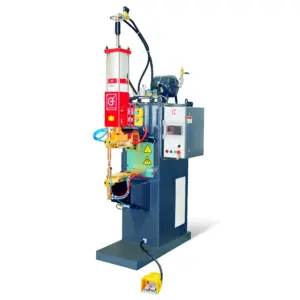
A projection welder is a type of resistance welding machine that uses localized contact points (projections) on one or both workpieces to concentrate electrical current and heat during the welding process. These projections act as predetermined weld sites, allowing multiple welds to be formed simultaneously with high precision.
Unlike traditional spot welding, where electrodes define the weld location, projection welding relies on the geometry of the part itself to control current flow and heat generation.
This makes projection welding ideal for:
Nuts, bolts, and threaded fasteners
Sheet metal assemblies with embossed projections
Crossed wire welding
Automotive brackets and stamped components
Working Principle of Projection Welding
Projection welding operates on the principle of resistance heating combined with controlled pressure.
1. Formation of Projections
Before welding, small raised features (projections) are formed on one of the workpieces. These can be:
Embossed dimples on sheet metal
Machined or stamped protrusions
Pre-formed studs or nuts
2. Electrode Clamping
The two workpieces are placed between flat or shaped electrodes. Pressure is applied uniformly across the joint.
3. Current Concentration
When electrical current flows through the joint, it concentrates at the projection points due to their reduced contact area.
4. Heat Generation and Collapse
The concentrated resistance at the projections generates heat rapidly, causing the projections to collapse and fuse the materials together.
5. Solid-State Bond Formation
Under continued pressure, a strong metallurgical bond is formed at each projection site, resulting in multiple high-strength welds in a single cycle.
This controlled process ensures repeatability and reduces dependency on operator skill.
Key Advantages of Projection Welding
Projection welding offers several benefits that make it highly attractive for mass production environments:
1. Multiple Welds in One Cycle
One of the biggest advantages is the ability to create several weld points simultaneously, significantly increasing production efficiency.
2. Precise Weld Location
Since projections define the weld points, accuracy is inherently built into the component design.
3. Reduced Electrode Wear
Compared to spot welding, electrodes experience less wear because current density is distributed across multiple projection points.
4. High Repeatability
Projection welding is highly consistent, making it suitable for automated production lines and robotic integration.
5. Improved Aesthetic Finish
Weld marks are minimal and uniform, making it ideal for visible or precision components.
Industrial Applications of Projection Welders
Projection welders are widely used across industries where precision fastening and structural integrity are critical.
Automotive Industry
Projection welding is heavily used in automotive manufacturing for:
Seat frames
Brackets and supports
Fasteners (nuts, studs, bolts)
Transmission components
Its ability to produce multiple welds in a single cycle makes it ideal for high-volume vehicle production.
Appliance Manufacturing
Household appliances rely on projection welding for:
Compressor parts
Motor housings
Metal enclosures
Internal structural supports
The process ensures strong joints while maintaining dimensional accuracy.
Electrical and Electronic Components
Projection welding is used for:
Busbars
Terminals
Electrical contacts
The process provides excellent conductivity and structural integrity.
Heavy Fabrication and Industrial Equipment
For structural assemblies, projection welding ensures:
High load-bearing strength
Reliable joint performance under stress
Reduced assembly time
Projection Welding vs Spot Welding
Although both methods belong to resistance welding, they differ significantly in process and application.
1. Weld Formation
Projection Welding: Uses pre-formed projections to define weld locations.
Spot Welding: Uses electrode tips to localize current and create welds.
2. Production Efficiency
Projection welding allows multiple welds at once.
Spot welding typically creates one weld per cycle.
3. Tool Wear
Projection welding reduces electrode wear.
Spot welding electrodes wear faster due to concentrated pressure points.
4. Application Suitability
Projection welding is better for repetitive, high-volume parts.
Spot welding is better for flexible or irregular assemblies.
In summary, projection welding is more efficient for structured, repeatable components, while spot welding offers greater flexibility for variable designs.
Best Practices for High-Quality Projection Welding
To ensure optimal performance, manufacturers should follow key process guidelines:
1. Proper Projection Design
Projection geometry is critical. The height, shape, and spacing must be engineered to ensure uniform collapse and consistent weld formation.
2. Material Compatibility
Ensure materials have compatible electrical resistance and melting points. Common materials include low-carbon steel, stainless steel, and coated metals.
3. Controlled Welding Parameters
Key parameters include:
Welding current
Electrode force
Weld time
Cooling time
Precise control prevents defects such as expulsion or weak joints.
4. Electrode Maintenance
Although wear is reduced, periodic inspection ensures consistent pressure distribution and alignment.
5. Automation Integration
Using automated projection welding systems improves consistency and reduces human error in high-volume production environments.
Advanced Projection Welding Solutions by Heron Welder
Modern manufacturing demands high-speed, intelligent, and automated welding systems. Heron Welder provides advanced resistance welding technologies designed for industrial-scale production.
Their projection welding solutions are engineered for:
High-precision multi-point welding
Integration with automated production lines
Energy-efficient MFDC control systems
Stable and repeatable weld quality
OEM customization for specific manufacturing requirements
With a strong focus on automation, durability, and process control, Heron Welder systems are widely used in automotive, appliance, and industrial manufacturing sectors where reliability and throughput are critical.
Future of Projection Welding in Smart Manufacturing
As factories move toward Industry 4.0, projection welding is evolving with:
Digital monitoring systems
AI-based process optimization
Real-time weld quality tracking
Integration with robotic assembly lines
These advancements are making projection welding more intelligent, traceable, and efficient than ever before.
FAQs About Projection Welder
1. What is the main purpose of a projection welder?
A projection welder is used to join metal components at predefined points using raised projections that concentrate heat and current, enabling multiple welds in one cycle.
2. Which industries use projection welding the most?
It is widely used in automotive, appliance manufacturing, electrical components, and heavy industrial fabrication.
3. How is projection welding different from spot welding?
Projection welding uses pre-formed projections for weld locations, while spot welding uses electrode tips to create individual weld points.
4. Can projection welding be automated?
Yes, projection welding is highly suitable for automation and is commonly integrated into robotic and high-volume production lines.
5. What materials are suitable for projection welding?
Low-carbon steel, stainless steel, and various coated metals are commonly used, depending on application requirements.
Conclusion
Projection welding is a highly efficient and precise resistance welding method designed for modern industrial production. Its ability to deliver multiple strong welds in a single cycle makes it indispensable in automotive, appliance, and heavy manufacturing industries.
With advancements in automation and process control, projection welding continues to evolve as a core technology in smart manufacturing systems.
Request a Custom Welding Solution
For manufacturers looking to improve production efficiency, weld quality, and automation integration, Heron Welder offers customized projection welding machines and complete welding system solutions tailored to industrial needs.
Contact Heron Welder to request a quote or discuss a tailored welding automation solution for your production line.



 SPARK Website

 English