


 SPARK Website
Dip Tube Market 2025–2034: Growth Trends in Aerosol and Liquid Packaging
Market Overview
The dip tube market is witnessing steady growth due to increasing demand for efficient liquid dispensing systems across aerosol packaging, personal care, pharmaceutical, food & beverage, and household product industries. Dip tubes are critical packaging components that help transfer liquid products from containers to dispensing systems such as sprays, pumps, and aerosol valves.
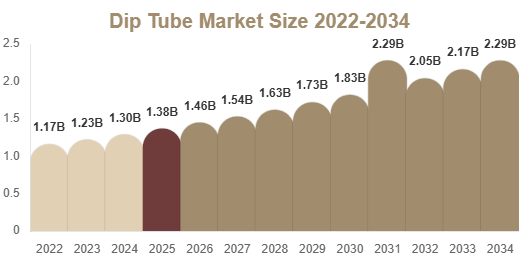
The global dip tube market size was valued at USD 1.38 billion in 2025 and is estimated to reach USD 1.46 billion in 2026. The market is forecasted to grow to approximately USD 2.29 billion by 2034, expanding at a CAGR of 5.8% during 2025–2034.
Full Report Link: https://packagingmarketinsights.com/report/dip-tube-market
The market is benefiting from rising demand for aerosol products, expansion of cosmetic and personal care industries, increasing pharmaceutical packaging requirements, and growing adoption of advanced dispensing technologies worldwide.
Market Drivers
Rising Demand for Aerosol Packaging
The growing use of aerosol packaging in personal care, household cleaning products, automotive sprays, and industrial applications is significantly driving demand for high-performance dip tubes. These tubes ensure smooth and consistent product dispensing.
Expansion of Cosmetic and Personal Care Industry
Increasing consumption of skincare, haircare, perfumes, deodorants, and beauty products is supporting growth of the dip tube market. Cosmetic packaging manufacturers are increasingly adopting customized dip tube solutions for improved dispensing efficiency.
Growth of Pharmaceutical Packaging Applications
Dip tubes are widely used in pharmaceutical sprays, liquid medications, nasal sprays, and medical dispensing systems. Rising healthcare demand and pharmaceutical production are contributing to market expansion.
Technological Advancements in Dispensing Systems
Innovations in precision dispensing technologies, flexible tube materials, and advanced aerosol valve systems are improving packaging performance and product usability across industries.
Increasing Demand for Household and Industrial Products
The rising consumption of cleaning agents, disinfectants, lubricants, paints, and industrial chemicals packaged in spray containers is accelerating demand for durable and chemically resistant dip tubes.
Market Challenges
Fluctuating Raw Material Prices
Changes in prices of plastic resins and polymer materials used in dip tube manufacturing can impact production costs and profitability for manufacturers.
Environmental Concerns Related to Plastic Components
Plastic packaging components continue to face environmental scrutiny due to waste generation and recycling challenges, encouraging manufacturers to explore recyclable and bio-based materials.
Compatibility Issues with Certain Chemicals
Dip tubes used in chemical and industrial applications must maintain compatibility with aggressive liquid formulations, requiring specialized material selection and testing processes.
Get Your Sample Report Here: https://packagingmarketinsights.com/report/dip-tube-market/request-sample
Market Segmentation
By Material Type
The market includes polyethylene, polypropylene, fluoropolymer, and specialty plastic materials. Polypropylene dip tubes dominate the market due to durability, chemical resistance, and lightweight properties.
By Product Type
Product categories include standard dip tubes, flexible dip tubes, multi-layer dip tubes, custom-cut dip tubes, and aerosol valve dip tubes. Aerosol valve dip tubes account for a major market share because of widespread use in spray packaging applications.
By Application
Applications include personal care products, pharmaceuticals, household cleaners, industrial chemicals, food & beverages, and automotive products. Personal care and household cleaning applications represent leading market segments globally.
By End-Use Industry
Key end-use industries include cosmetics and personal care, pharmaceuticals, food processing, industrial manufacturing, automotive, and household product companies. Cosmetic and aerosol packaging industries remain dominant contributors to market demand.
Regional Insights
Asia-Pacific dominates the dip tube market due to rapid expansion of cosmetic manufacturing, aerosol packaging production, and industrial packaging industries in countries such as China, India, Japan, and South Korea.
North America is witnessing stable market growth supported by increasing demand for personal care products, pharmaceutical packaging innovations, and advanced aerosol technologies.
Europe is experiencing significant market expansion due to sustainability initiatives, premium cosmetic packaging demand, and strong presence of aerosol product manufacturers.
Latin America and the Middle East & Africa are emerging markets benefiting from growing household product consumption and expanding industrial packaging activities.
Key Players Analysis
The dip tube market is highly competitive with manufacturers focusing on precision dispensing technologies, sustainable materials, and customized packaging solutions.
- Leading companies are investing in recyclable and lightweight dip tube materials to support sustainability initiatives and environmental regulations.
- Manufacturers are expanding production capacities to meet rising global demand from aerosol and personal care packaging industries.
- Strategic collaborations with packaging companies and aerosol product manufacturers are increasing for development of customized dispensing systems.
- Research and development activities are focused on improving chemical resistance, dispensing accuracy, and product compatibility.
- Automation technologies are being integrated into dip tube manufacturing processes to improve efficiency and reduce production costs.
- Companies are introducing flexible and high-performance dip tube designs for advanced packaging applications across industries.
Market Outlook
The dip tube market is expected to witness steady growth through 2034 due to increasing demand for aerosol packaging, expansion of personal care industries, and rising adoption of advanced dispensing technologies. Continuous innovation in recyclable materials, precision dispensing systems, and lightweight packaging components will continue to create significant market opportunities globally.
Conclusion
The dip tube market is evolving rapidly with growing emphasis on packaging efficiency, product compatibility, and sustainability. Despite challenges related to raw material costs and environmental concerns, advancements in dispensing technologies and increasing demand from cosmetic, pharmaceutical, and household product industries are expected to support long-term market expansion worldwide.

 English