


 SPARK Website
Truck Auxiliary Braking Device Market Market Size Trends
Truck Auxiliary Braking Device Market Market Research Report
Market Size
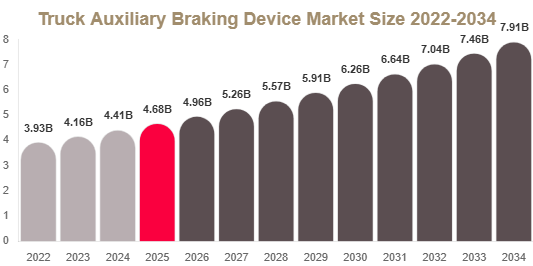
The Truck Auxiliary Braking Device Market Market size was valued at USD 3.42 Billion in 2025.
The market is projected to reach USD 5.97 Billion by 2034, growing at a CAGR of 6.5% during 2025–2034.
Get Your Sample Report Here:
https://www.redlinepulse.com/report/truck-auxiliary-braking-device-market/request-sample
Introduction
The Truck Auxiliary Braking Device Market is expanding steadily as global transportation systems evolve toward higher safety standards, improved vehicle control systems, and stricter regulatory frameworks. Auxiliary braking devices are critical components in heavy-duty trucks and commercial vehicles, designed to assist primary braking systems by reducing wear, improving control during downhill driving, and enhancing overall road safety. These systems are especially important in long-haul transportation, freight logistics, and heavy cargo operations where continuous braking performance is essential.
The growing demand for commercial transportation and logistics services is significantly driving market expansion. With increasing global trade activities and rising freight movement across highways and industrial corridors, the need for advanced braking systems has intensified. Auxiliary braking devices such as engine brakes, exhaust brakes, and hydraulic retarders are being widely adopted to ensure safer and more efficient truck operations under high-load conditions.
The market is also influenced by tightening safety regulations imposed by governments and transportation authorities worldwide. Regulatory bodies are mandating the adoption of advanced braking technologies to reduce road accidents involving heavy vehicles. This has encouraged fleet operators and OEMs to integrate auxiliary braking systems into new truck models, improving braking reliability and reducing dependency on conventional friction-based systems.
Technological advancements in vehicle safety systems are further transforming the market landscape. Modern auxiliary braking devices are increasingly integrated with electronic control systems, automated braking assistance, and predictive safety technologies. As commercial transportation continues to modernize, the Truck Auxiliary Braking Device Market is expected to experience sustained long-term growth driven by safety innovation and fleet modernization initiatives.
Market Dynamics
Market Drivers
The expansion of global logistics and freight transportation is one of the strongest drivers of the Truck Auxiliary Braking Device Market. Increasing movement of goods across highways, ports, and industrial zones has significantly raised demand for heavy-duty trucks equipped with advanced braking technologies. Auxiliary braking devices help maintain vehicle stability and reduce brake overheating during long-distance and downhill operations.
Rising road safety concerns and strict government regulations are also fueling market growth. Authorities across regions such as North America, Europe, and Asia Pacific are enforcing stringent safety norms for commercial vehicles. These regulations require trucks to be equipped with efficient braking support systems that reduce accident risks, particularly in mountainous and high-speed highway conditions.
The increasing adoption of heavy-duty trucks in construction, mining, and industrial applications further supports market expansion. These industries require vehicles capable of handling extreme loads and challenging terrains. Auxiliary braking devices play a crucial role in maintaining safe speed control and reducing mechanical stress on primary braking systems, enhancing vehicle durability and operational efficiency.
Technological improvements in braking systems are also accelerating market growth. The integration of electronic control units, automated braking assistance, and sensor-based monitoring systems has improved braking precision and response time. These advancements are making auxiliary braking devices more efficient, reliable, and compatible with modern truck architectures.
Market Challenges
Despite strong growth potential, the Truck Auxiliary Braking Device Market faces several challenges. One of the key issues is the high installation and maintenance cost of advanced braking systems. Technologies such as hydraulic retarders and electronic braking systems require significant investment, which can be a barrier for small and medium fleet operators.
Complexity in system integration is another major challenge. Modern auxiliary braking devices must be compatible with electronic vehicle control systems and engine management modules. Ensuring seamless integration across different truck models and manufacturers can be technically challenging and may increase development costs.
Fluctuating raw material prices also impact market stability. Components used in braking systems, such as steel alloys, hydraulic fluids, and electronic sensors, are subject to price volatility and supply chain disruptions. This can affect production costs and profit margins for manufacturers.
Additionally, limited awareness among small fleet operators in emerging markets may slow adoption rates. Many operators still rely on conventional braking systems due to cost considerations and lack of technical knowledge about advanced auxiliary braking technologies.
Market Opportunities
The increasing adoption of electric and hybrid commercial vehicles presents significant opportunities for the Truck Auxiliary Braking Device Market. These vehicles require advanced regenerative braking systems and electronic braking support mechanisms, creating new demand for innovative auxiliary braking solutions.
The rapid expansion of smart transportation and connected vehicle technologies is also creating growth opportunities. Integration of AI-based predictive braking systems, telematics, and real-time vehicle monitoring is enhancing braking efficiency and safety, encouraging manufacturers to develop intelligent auxiliary braking devices.
Emerging economies offer substantial market potential due to increasing infrastructure development and logistics expansion. Countries in Asia Pacific, Latin America, and Africa are witnessing rapid growth in commercial transportation activities, creating strong demand for advanced truck braking systems.
The aftermarket segment also presents a lucrative opportunity. As commercial vehicles age, fleet operators increasingly invest in upgrading braking systems to meet safety standards and improve performance. Replacement demand for auxiliary braking components is expected to grow steadily throughout the forecast period.
Market Trends
The Truck Auxiliary Braking Device Market is witnessing a strong trend toward electronic and automated braking technologies. Modern trucks are increasingly equipped with electronically controlled braking systems that enhance precision, reduce driver workload, and improve overall safety performance. These systems are becoming standard in advanced commercial vehicle models.
Another major trend is the integration of regenerative braking systems in hybrid and electric trucks. These systems not only improve braking efficiency but also contribute to energy recovery, enhancing vehicle fuel efficiency and reducing emissions. This trend is particularly strong in regions promoting sustainable transportation solutions.
Lightweight and compact braking system designs are also gaining traction. Manufacturers are focusing on reducing the weight of auxiliary braking components to improve fuel efficiency and payload capacity without compromising performance. This is especially important in long-haul freight transportation.
The adoption of predictive maintenance and telematics-based braking diagnostics is also shaping the market. Fleet operators are increasingly using real-time monitoring systems to track brake performance, predict maintenance needs, and prevent system failures, improving operational efficiency and safety.
Market Segmentation
The Truck Auxiliary Braking Device Market is segmented based on type, vehicle type, technology, and end-user industry. By type, the market includes engine brakes, exhaust brakes, hydraulic retarders, and electric retarders. Engine brakes hold a significant market share due to their cost-effectiveness and widespread use in heavy-duty trucks.
Based on vehicle type, the market is categorized into light commercial vehicles, medium-duty trucks, and heavy-duty trucks. Heavy-duty trucks dominate the market due to their extensive use in long-distance freight transportation, mining operations, and construction activities where enhanced braking control is essential.
In terms of technology, the market includes mechanical braking systems, electronic braking systems, and hybrid braking systems. Electronic braking systems are witnessing rapid growth due to their integration with modern vehicle safety and control systems, offering improved precision and responsiveness.
By end-user industry, the market includes logistics, construction, mining, oil and gas, and manufacturing sectors. The logistics industry represents the largest segment due to increasing global freight transportation and rising demand for safe and efficient truck operations.
Regional Analysis
North America
North America represents a mature and technologically advanced market for truck auxiliary braking devices. The United States plays a dominant role due to its extensive freight transportation network and strong regulatory focus on road safety.
Fleet operators in the region are increasingly adopting advanced braking technologies to comply with safety standards and improve operational efficiency. The presence of leading automotive manufacturers further supports market growth.
Europe
Europe is a significant market driven by strict vehicle safety regulations and strong adoption of advanced automotive technologies. Countries such as Germany, France, and the United Kingdom are leading contributors to market expansion.
European transportation companies are focusing on sustainability and safety, encouraging the adoption of electronic and regenerative braking systems in commercial vehicles.
Asia Pacific
Asia Pacific dominates the Truck Auxiliary Braking Device Market due to rapid industrialization, infrastructure development, and expanding logistics networks. China and India are major contributors due to rising freight transportation demand.
The region benefits from increasing commercial vehicle production and growing investments in highway infrastructure, supporting strong market growth.
Latin America
Latin America is experiencing steady growth driven by expanding transportation and construction industries. Brazil and Mexico are key markets due to increasing commercial vehicle usage.
Rising investments in logistics infrastructure and industrial development are further supporting market expansion.
Middle East & Africa
The Middle East & Africa region is witnessing moderate growth due to increasing construction activities and expanding logistics sectors. Demand for heavy-duty trucks is rising across infrastructure projects.
Government investments in transportation modernization are expected to support long-term market development.
Competitive Landscape
The Truck Auxiliary Braking Device Market is highly competitive, with manufacturers focusing on safety innovation, system efficiency, and electronic integration. Companies are investing in research and development to improve braking performance, durability, and compatibility with modern truck systems.
Strategic collaborations with OEMs and fleet operators are becoming increasingly important for market expansion. Manufacturers are also emphasizing advanced electronic braking technologies and predictive safety systems to strengthen their market position.
Top Players Analysis
1. Knorr-Bremse AG
Knorr-Bremse AG is a global leader in braking systems for commercial vehicles and rail transport. The company offers advanced auxiliary braking technologies designed to improve safety and performance in heavy-duty trucks.
Its strong focus on innovation and electronic braking systems supports continued leadership in the global market.
2. ZF Friedrichshafen AG
ZF Friedrichshafen AG is a major player in automotive and commercial vehicle technologies. The company develops advanced braking and drivetrain solutions integrated with modern vehicle control systems.
Its investments in smart mobility and safety technologies enhance its position in the auxiliary braking device market.
3. Cummins Inc.
Cummins Inc. specializes in engine braking technologies and powertrain solutions. The company provides high-performance auxiliary braking systems designed for heavy-duty applications.
Its strong presence in global commercial vehicle markets supports continued demand for its braking solutions.
4. Jacobs Vehicle Systems
Jacobs Vehicle Systems is a leading provider of engine braking technologies. The company is widely recognized for its compression release engine brake systems used in heavy-duty trucks.
Its focus on performance, durability, and safety innovation strengthens its competitive position.
5. WABCO Holdings
WABCO Holdings is known for its advanced braking and safety systems for commercial vehicles. The company develops integrated braking solutions that enhance vehicle control and safety performance.
Its expertise in electronic braking systems supports strong market relevance.
Future Outlook
The Truck Auxiliary Braking Device Market is expected to grow steadily as global transportation networks expand and safety regulations become more stringent. Increasing demand for efficient freight movement will continue driving adoption of advanced braking systems.
Technological advancements in electronic braking, predictive maintenance, and regenerative systems will play a crucial role in shaping future market development. Manufacturers will increasingly focus on intelligent braking solutions integrated with vehicle control systems.
The rise of electric and hybrid trucks will further accelerate innovation in braking technologies. These vehicles require advanced braking systems capable of energy recovery and precise control, creating new opportunities for manufacturers.
Overall, the market is expected to witness sustained growth supported by infrastructure expansion, logistics development, and continuous improvements in vehicle safety technologies.
Conclusion
The Truck Auxiliary Braking Device Market continues to evolve with advancements in vehicle safety systems and increasing demand for efficient commercial transportation solutions. Auxiliary braking devices remain essential for ensuring safety, reducing wear on primary braking systems, and improving operational efficiency.
With rising adoption of smart vehicle technologies and growing emphasis on road safety regulations, the market is poised for long-term expansion. Manufacturers focusing on innovation, electronic integration, and sustainable braking technologies are expected to lead future growth opportunities.

 عربي
عربي