


 SPARK Website
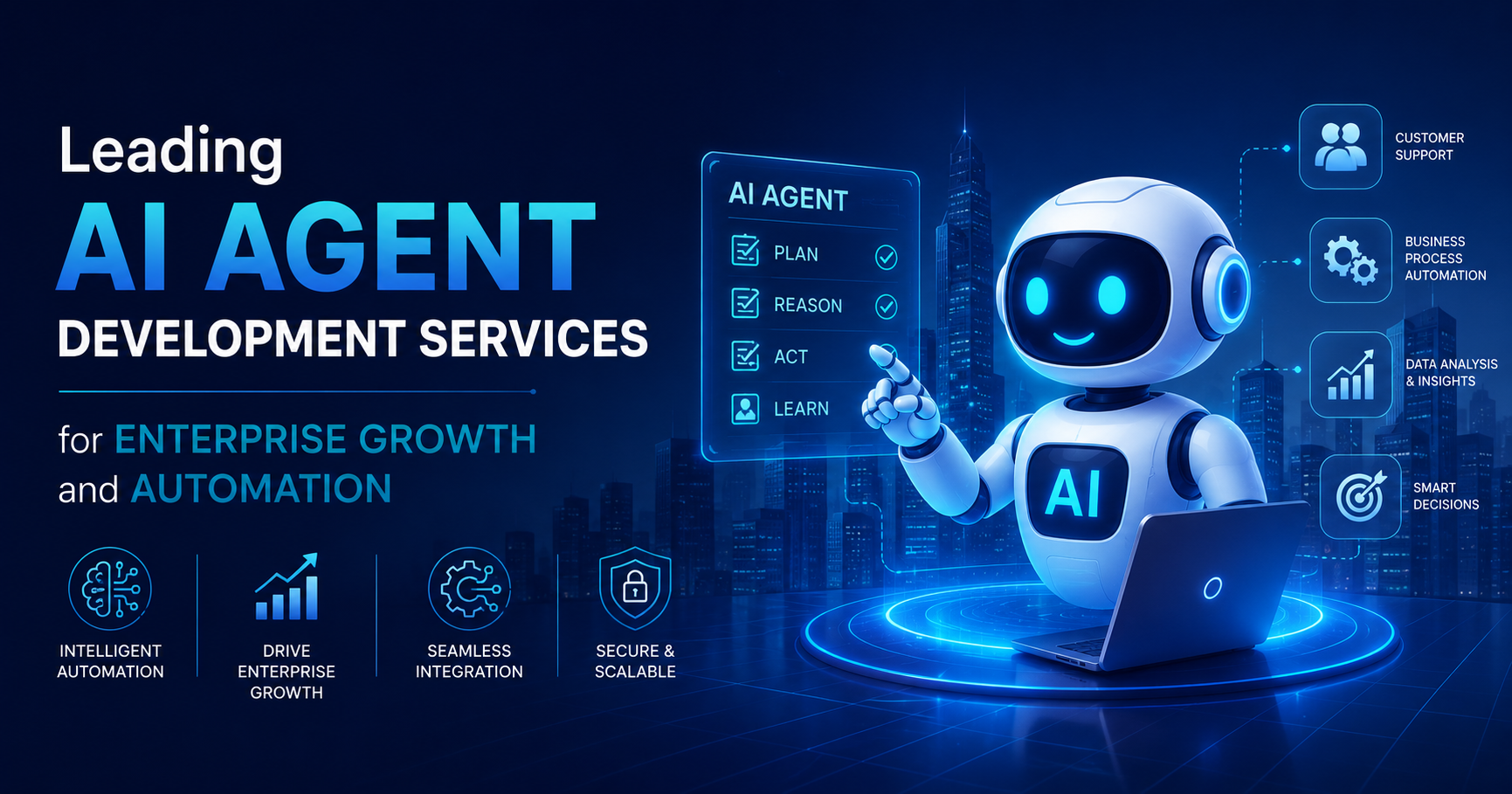
Leading AI Agent Development Services for Enterprise Growth and Automation
The Business Landscape Has Changed — Have You?
There's a quiet revolution happening inside the world's most competitive businesses. It's not loud, it doesn't announce itself with press releases, but its impact is showing up in balance sheets, operational efficiency reports, and customer retention numbers. We're talking about AI agents — not just artificial intelligence tools that assist humans, but autonomous systems that think, decide, and act on behalf of your business around the clock.
If you're a business owner who's been watching AI developments from a distance, waiting for the "right moment" to act, here's a sobering truth: your competitors aren't waiting. The companies investing in AI agent development services today are building infrastructures that will be virtually impossible to catch up with in three to five years. AI agents aren't a future concept anymore — they're actively handling customer queries, processing invoices, qualifying leads, managing inventory logic, and executing complex workflows without any human intervention. The window to get ahead of this curve is open right now, but it won't stay that way indefinitely.
The core question isn't whether your business needs AI agents. If you're running an enterprise with recurring operational tasks, customer-facing processes, or data-heavy workflows, you already need them. The real question is: who's going to build them for you, and how well?
What AI Agents Actually Do — Beyond the Buzzword
Before you can make a smart investment decision, you need to understand what separates a genuine AI agent from a glorified chatbot or a basic rule-based automation script. This distinction matters enormously because it determines the ceiling of value you can extract.
A true AI agent is a system capable of perceiving its environment, processing contextual information, making decisions based on set objectives, and taking actions — all without requiring step-by-step human instruction. Unlike traditional automation, which follows rigid if-then logic, AI agents can handle exceptions, learn from patterns, and adapt their behavior over time. Think of it this way: traditional automation is a vending machine; an AI agent is an intelligent employee who understands the goal behind the task, not just the task itself. When built by a capable AI agent development company, these systems can be deeply integrated into your existing tech stack — your CRM, ERP, communication tools, and databases — functioning as a true operational layer underneath your business.
Here's where this gets tangible for enterprise owners:
- Autonomous Customer Support Agents that handle Tier 1 and Tier 2 queries, escalate intelligently, and personalize responses based on customer history — reducing support costs by up to 60% in some enterprise deployments.
- Sales Intelligence Agents that monitor pipeline activity, auto-send follow-ups at optimal times, flag deals at risk of going cold, and surface actionable insights to your sales leaders every morning.
- Finance & Compliance Agents that audit transactions in real-time, flag anomalies, generate reports on schedule, and ensure policy adherence without manual review.
- HR Automation Agents that screen resumes, schedule interviews, answer candidate FAQs, onboard new hires, and track documentation — handling repetitive HR workflows end-to-end.
- Supply Chain & Operations Agents that monitor inventory levels, trigger purchase orders, coordinate with vendors, and predict demand fluctuations weeks in advance.
The breadth is significant, but what matters more is the depth of customization. Off-the-shelf AI tools give you generic capability. Custom AI agent development solutions give you competitive advantage.
Why Custom Development Beats Off-the-Shelf Solutions
Walk into any SaaS marketplace and you'll find dozens of AI-powered tools promising to transform your business. Some of them are genuinely useful. But here's the fundamental limitation no vendor will put in their sales deck: pre-built AI tools are designed for everyone, which means they're optimized for no one in particular.
Your business isn't generic. You have a specific customer base with specific expectations, internal workflows shaped by years of operational learning, compliance requirements particular to your industry, and strategic priorities that are unique to your growth stage. A retail conglomerate managing 400 SKUs across 12 regional warehouses doesn't need the same AI agent architecture as a B2B SaaS company managing enterprise customer success. Yet most off-the-shelf tools treat both identically.
When you partner with an experienced AI agent development company, the engagement starts with a diagnostic — understanding your data environment, your team's workflows, your integration requirements, and the specific outcomes you want to drive. The agents built in this context are designed to fit your business like a tailored suit, not a one-size-fits-most t-shirt. Key reasons enterprises are moving toward custom AI agent solutions include:
- Deep system integration with legacy infrastructure, proprietary databases, and industry-specific platforms that generic tools can't touch.
- Regulatory compliance baked into agent behavior — critical in industries like healthcare, BFSI, and legal services where data handling is strictly governed.
- Scalability by design — custom agents are architected to grow with your business volume, not buckle under it.
- IP ownership — the agent logic, training data, and architecture belong to you, not the software vendor.
- Performance tuning — metrics, models, and behavior can be refined continuously based on real operational feedback.
The Strategic Advantage of Partnering With the Right Development Team
Choosing who builds your AI agents is arguably more important than deciding to build them at all. A poorly architected agent doesn't just underperform — it can make wrong decisions at scale, damage customer relationships, and create compliance liabilities that cost far more to fix than they saved. This is why the market for AI agent development services USA and globally has seen such dramatic maturation over the last two years. The best development teams aren't just technically capable — they bring a systems-thinking approach that bridges AI capability with real business context.
When evaluating development partners, business owners often underestimate how much domain expertise matters. A development company that's built agents for financial services institutions understands things about data sensitivity, audit trails, and real-time decisioning that a generalist shop simply won't. Similarly, a team experienced in e-commerce knows how to build agents that handle peak-traffic anomalies, integrate with payment gateways securely, and maintain personalization accuracy across millions of customer profiles. Beyond credentials, the right partner should be able to demonstrate:
- A discovery-first engagement model — they ask more questions than they answer in early conversations, because they're mapping your environment before proposing solutions.
- Prototype-driven development — rapid proof-of-concept builds that let you validate agent behavior before full deployment investment.
- A defined post-deployment support model — because the real work begins after the agent goes live, when real-world edge cases start surfacing.
- Transparent architecture documentation — so your internal tech team isn't dependent on the vendor forever.
- Measurable KPI alignment — agents should be built around outcomes you can track, not just activities they perform.
Why India Has Emerged as a Global Hub for AI Agent Development
Here's something worth paying close attention to if you're a business owner evaluating cost-effectiveness alongside quality. AI agent development services in India have undergone a dramatic transformation over the last several years. India is no longer just a destination for cost arbitrage — it has become a genuine center of AI development excellence, home to some of the world's most sophisticated AI development talent, including engineers who have built production systems for Fortune 500 companies, global financial institutions, and hyperscale technology platforms.
The combination of deep technical expertise, fluency in enterprise software ecosystems, and competitive engagement models has made Indian AI development firms a preferred partner for enterprises across the United States, United Kingdom, Europe, and the Middle East. Companies exploring AI agent services with global development partners benefit from time-zone flexibility that enables near-round-the-clock development cycles, English-fluent project management, and the ability to scale engineering teams rapidly without the hiring friction typical in Western markets. For enterprises with complex, long-horizon AI programs — the kind that require ongoing model refinement, multi-agent architecture, and iterative improvements over months and years — this becomes a meaningful strategic advantage.
Building a Long-Term AI Strategy, Not Just a One-Time Project
If there's one thing seasoned technology leaders consistently emphasize when discussing AI transformation, it's this: treat AI agents as infrastructure, not projects. The businesses seeing the deepest ROI from AI aren't the ones that built one impressive use case and called it done. They're the ones that designed an AI-native operational layer — a connected ecosystem of agents working across departments, sharing data, and compounding efficiency gains over time.
This architectural mindset is what separates AI leaders from AI experimenters. As a business owner, your goal should be to work with an AI agent development company that understands this distinction and can help you design a roadmap — not just a deliverable. Starting with one high-impact use case makes sense tactically, but the design and architecture from day one should be modular and extensible, so future agents can be added without rebuilding foundational components. The most valuable outcomes businesses are seeing today from mature AI agent development solutions include:
- A measurable reduction in operational headcount requirements for repetitive tasks, with those resources redeployed toward higher-value strategic work.
- Dramatically faster decision cycles — because agents surface the right information at the right moment, rather than waiting for human reporting cycles.
- Consistent customer experience quality, unconstrained by human variability, shift limitations, or capacity bottlenecks.
- Compounding data advantage — agents don't just execute tasks, they generate structured behavioral data that improves future decision-making.
- Competitive differentiation that is genuinely difficult to replicate quickly, because it's embedded in operational infrastructure rather than a visible product feature.
The Decision That Defines Your Next Three Years
The enterprise business landscape is dividing into two camps right now. The first camp is waiting — for better tools, for clearer ROI proof, for internal consensus that never quite arrives. The second camp is building — investing in AI agent development services, partnering with development teams who understand enterprise-grade requirements, and constructing operational infrastructures that will define their competitive position for years.
The technology is mature enough. The development talent is available. The use cases are proven across industries. What remains is the decision — and the quality of the partner you choose to execute it with. Whether you're looking at AI agent development services USA-based firms for proximity and compliance alignment, or exploring AI agent development services in India for a combination of expertise and cost efficiency, the non-negotiable is this: find a team that understands your business outcomes first, and builds technology second.
Automation isn't the goal. Growth is. The right AI agent services partner knows the difference — and builds accordingly.

 English