


 SPARK Website
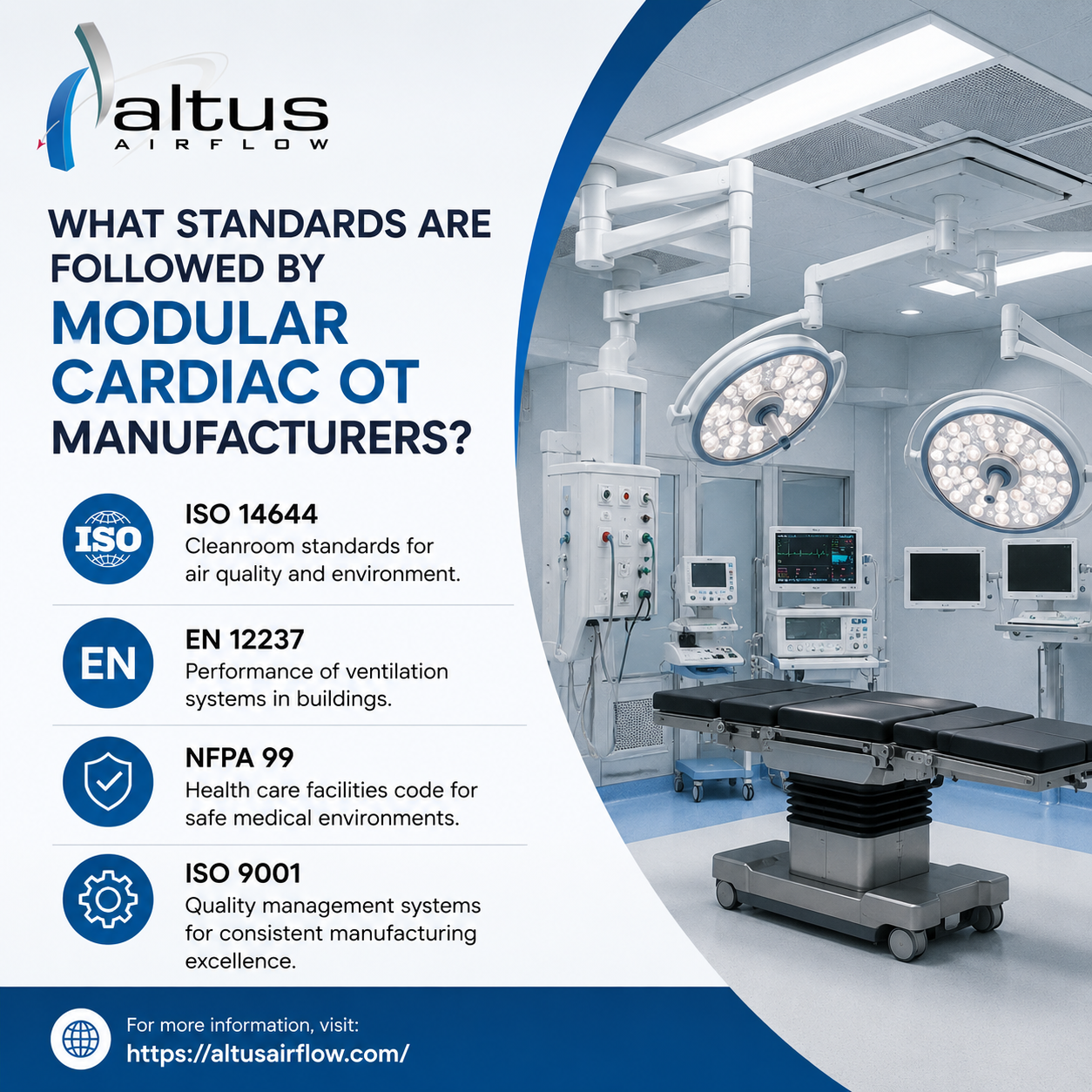
What Standards Are Followed by Modular Cardiac OT Manufacturers?
Introduction
Healthcare infrastructure has evolved significantly over the years, especially in highly sensitive areas such as cardiac surgery departments. Modern hospitals require operation theatres that maintain superior levels of sterility, air quality, safety, and operational efficiency. This has increased the importance of specialized Modular Cardiac OT Manufacturers that design and develop advanced cardiac operation theatres using international healthcare engineering standards and cleanroom technologies. Companies like Altus Airflow help hospitals create modern modular cardiac operation theatres equipped with HVAC systems, HEPA filtration, laminar airflow, electrical integration, and environmental monitoring systems that comply with strict healthcare regulations and performance standards.
Cardiac operation theatres are among the most critical spaces in any hospital because they handle complex and life-saving surgeries. Even minor contamination or environmental instability can lead to serious complications. To minimize risks and maintain patient safety, modular cardiac OT manufacturers follow multiple national and international standards related to cleanroom engineering, air quality, infection control, electrical safety, ventilation systems, and healthcare construction.
These standards ensure that modular cardiac OTs provide reliable, safe, and contamination-free environments suitable for advanced surgical procedures.
Importance of Standards in Cardiac Operation Theatres
Standards play a major role in ensuring:
- Patient safety
- Infection prevention
- Equipment reliability
- Environmental stability
Experienced Modular Cardiac OT Manufacturers strictly follow these standards to deliver safe and compliant operation theatres.
NABH Standards for Operation Theatres
NABH (National Accreditation Board for Hospitals & Healthcare Providers) standards are widely followed in healthcare infrastructure projects.
These standards focus on:
- Patient safety
- Infection control
- Healthcare quality
- Facility management
NABH compliance improves hospital accreditation and operational reliability.
ISO Standards for Cleanroom Environments
ISO cleanroom standards are essential for maintaining controlled operation theatre environments.
ISO 14644 standards regulate:
- Air cleanliness
- Particle concentration
- Environmental control
These standards help ensure sterile surgical conditions.
HVAC Standards in Modular Cardiac OTs
HVAC systems are critical in cardiac operation theatres.
Manufacturers follow HVAC standards related to:
- Air changes per hour
- Temperature control
- Humidity management
- Ventilation efficiency
Proper HVAC design maintains stable surgical environments.
HEPA Filtration Standards
HEPA filtration systems must comply with filtration efficiency standards.
HEPA filters are designed to remove microscopic airborne particles from operation theatre air.
These standards ensure:
- High air purity
- Reduced contamination risks
- Improved surgical sterility
HEPA filtration is essential in cardiac OTs.
Laminar Airflow Standards
Laminar airflow systems must maintain:
- Uniform airflow velocity
- Controlled airflow direction
- Minimal turbulence
These systems are tested to ensure effective contamination control in surgical environments.
Air Changes Per Hour Requirements
Cardiac OTs require specific air change rates to maintain air cleanliness.
Standards define:
- Minimum ventilation rates
- Air circulation frequency
Proper air exchange reduces airborne contamination.
Positive Pressure Standards
Positive pressure systems are important in preventing contaminated air from entering the OT.
Manufacturers design systems that maintain:
- Controlled pressure gradients
- Continuous outward airflow
Positive pressure improves infection prevention.
Temperature Control Standards
Temperature control standards ensure stable operation theatre conditions.
Typical cardiac OT temperature ranges are maintained for:
- Patient comfort
- Equipment stability
- Surgical efficiency
Stable temperatures improve overall OT performance.
Humidity Control Standards
Humidity levels inside operation theatres are carefully regulated.
Proper humidity control helps:
- Prevent microbial growth
- Reduce static electricity
- Improve staff comfort
Environmental balance supports safe surgeries.
Electrical Safety Standards
Cardiac OTs require highly reliable electrical infrastructure.
Manufacturers follow standards for:
- Isolated power systems
- UPS integration
- Backup generators
- Grounding systems
Electrical safety is critical during surgeries.
Medical Gas Pipeline Standards
Medical gas systems must comply with strict safety standards.
These standards regulate:
- Gas purity
- Pipeline safety
- Pressure control
Reliable medical gas systems support surgical operations.
Fire Safety Standards
Modern cardiac OTs include fire safety systems that comply with healthcare regulations.
These systems include:
- Smoke detectors
- Fire alarms
- Emergency evacuation systems
Fire protection improves healthcare safety.
Antimicrobial Surface Standards
Modular OT surfaces are designed using antimicrobial materials that meet hygiene standards.
These surfaces help:
- Prevent bacterial growth
- Simplify cleaning
- Improve sterility
Surface hygiene is essential in cardiac OTs.
Lighting Standards in Cardiac OTs
Surgical lighting systems must comply with illumination standards.
These standards ensure:
- Shadow-free lighting
- Proper brightness levels
- Reduced glare
Accurate lighting supports surgical precision.
Noise Control Standards
Operation theatres should maintain controlled noise levels to support concentration and communication.
Manufacturers design systems that minimize:
- HVAC noise
- Equipment noise
- Airflow disturbances
Noise reduction improves staff performance.
Cleanroom Classification Standards
Cardiac OTs often follow cleanroom classifications based on particle concentration levels.
These classifications determine:
- Air cleanliness requirements
- Filtration performance
- Environmental monitoring standards
Cleanroom classifications improve infection control.
Validation and Testing Standards
Before operation theatres become operational, manufacturers conduct testing and validation.
Validation procedures include:
- Airflow testing
- Particle count testing
- Pressure verification
- HVAC performance testing
Testing ensures compliance and system reliability.
Environmental Monitoring Standards
Modern operation theatres use monitoring systems to track:
- Air quality
- Temperature
- Humidity
- Pressure levels
Monitoring systems maintain consistent environmental conditions.
Sterility Standards
Cardiac surgeries require highly sterile conditions.
Manufacturers follow sterility standards that focus on:
- Air cleanliness
- Surface hygiene
- Contamination prevention
Sterile environments reduce surgical complications.
Workflow and Ergonomic Standards
Efficient OT layouts are designed according to workflow and ergonomic guidelines.
These standards improve:
- Staff movement
- Equipment accessibility
- Surgical coordination
Better workflow improves operational efficiency.
Infection Control Guidelines
Infection control standards are among the most important healthcare requirements.
These guidelines focus on:
- Airborne contamination control
- Surface disinfection
- Environmental hygiene
Proper infection control improves patient safety.
Energy Efficiency Standards
Modern modular cardiac OTs follow energy-efficient building practices.
Energy-saving systems include:
- Smart HVAC controls
- LED lighting
- Automated monitoring systems
Energy efficiency reduces operational costs.
Data and Communication Standards
Digital integration systems follow healthcare communication standards for:
- Data transfer
- Equipment connectivity
- Monitoring systems
Reliable communication improves OT management.
Accessibility and Safety Regulations
Operation theatres must comply with accessibility and workplace safety regulations.
These standards improve:
- Staff safety
- Emergency access
- Equipment handling
Safe working conditions improve healthcare operations.
Importance of Regulatory Compliance
Regulatory compliance ensures that operation theatres meet legal and healthcare safety requirements.
Compliance helps hospitals:
- Achieve accreditation
- Improve patient trust
- Reduce operational risks
Professional manufacturers prioritize compliance.
Role of Experienced Manufacturers
Experienced manufacturers understand the technical complexities involved in cardiac OT engineering.
Their expertise ensures:
- Proper system integration
- Accurate environmental control
- Reliable performance
Professional expertise improves project quality.
Future Trends in OT Standards
Healthcare engineering standards continue evolving with technological advancements.
Future trends may include:
- AI-based environmental monitoring
- Smart airflow management
- Advanced automation systems
Modern manufacturers continuously adapt to new standards.
Why Hospitals Choose Standard-Compliant Manufacturers
Hospitals prefer manufacturers that follow international standards because they provide:
- Safer surgical environments
- Better infection control
- Long-term reliability
Standard compliance directly impacts patient care quality.
Conclusion
Professional Modular Cardiac OT Manufacturers play a vital role in helping hospitals establish high-performance surgical infrastructure that meets modern healthcare requirements. Companies like Altus Airflow specialize in designing and developing advanced modular cardiac operation theatres equipped with intelligent environmental control systems, cleanroom engineering technologies, and integrated healthcare infrastructure solutions. By partnering with trusted providers such as Altus Airflow, hospitals can build future-ready cardiac OTs that deliver enhanced safety, operational efficiency, and long-term healthcare excellence.
FAQs
1. What are Modular Cardiac OT Manufacturers?
Modular Cardiac OT Manufacturers are specialized companies that design and build advanced cardiac operation theatres following healthcare engineering and cleanroom standards.
2. Which standards are followed in modular cardiac OTs?
Manufacturers follow NABH, ISO cleanroom standards, HVAC regulations, electrical safety standards, and infection control guidelines.
3. Why are HEPA filters important in cardiac OTs?
HEPA filters remove airborne contaminants and maintain sterile air quality.
4. What is the role of laminar airflow in cardiac OTs?
Laminar airflow provides controlled clean airflow that reduces contamination risks during surgeries.
5. Why is HVAC important in modular cardiac OTs?
HVAC systems regulate temperature, humidity, air quality, and ventilation.
Read Our Previous Blog ---------------> What is the difference between laminar airflow and turbulent airflow?

 English