


 SPARK Website
Packaging Ultrasonic Welder Market CAGR and Revenue Insights 2025–2034
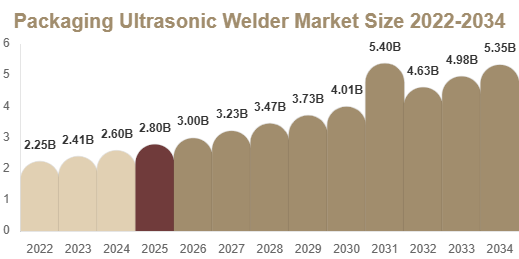
Packaging Ultrasonic Welder Market
Market Size
The global packaging ultrasonic welder market size was valued at approximately USD 2.8 billion in 2025 and is estimated to reach USD 3.0 billion in 2026. By 2034, the market is forecast to attain nearly USD 5.4 billion, registering a CAGR of 7.5% during 2025–2034.
Get Your Sample Report Here: https://packagingmarketinsights.com/report/packaging-ultrasonic-welder-market/request-sample
Introduction
The packaging ultrasonic welder market is experiencing steady growth due to increasing demand for efficient, precise, and environmentally friendly sealing technologies across packaging industries. Ultrasonic welding is widely used in packaging applications to join materials using high-frequency ultrasonic vibrations without the need for adhesives or heat-based sealing.
This technology is gaining traction in industries such as food and beverage, pharmaceuticals, personal care, and electronics packaging due to its ability to provide strong, clean, and contamination-free seals. It also supports sustainable packaging by reducing material waste and eliminating chemical adhesives.
With the increasing adoption of automation and smart manufacturing systems, ultrasonic welding technology is becoming an essential part of modern packaging production lines.
Explore Full Market Report Here: https://packagingmarketinsights.com/report/packaging-ultrasonic-welder-market
Market Drivers
Rising Demand for Sustainable Packaging Solutions
The growing focus on eco-friendly packaging is a major driver of the packaging ultrasonic welder market. Ultrasonic welding eliminates the need for adhesives and solvents, making it a cleaner and more sustainable sealing method.
Growth of Food and Beverage Industry
The increasing demand for packaged food products, beverages, and ready-to-eat meals is driving the adoption of ultrasonic welding technology for hygienic and secure packaging.
Expansion of Pharmaceutical Packaging
Pharmaceutical companies are increasingly using ultrasonic welding for sterile packaging of medical devices, blister packs, and sealed drug containers.
Increasing Automation in Manufacturing
The rise of Industry 4.0 and automated production lines is boosting demand for ultrasonic welding systems due to their compatibility with high-speed, automated packaging systems.
Market Challenges
High Initial Investment Costs
Ultrasonic welding equipment requires significant upfront investment, which can be a challenge for small and medium-sized manufacturers.
Technical Limitations with Certain Materials
Ultrasonic welding is not suitable for all packaging materials, limiting its application scope in some industries.
Need for Skilled Operators
Operating and maintaining ultrasonic welding systems requires technical expertise, which can increase operational complexity.
Packaging Ultrasonic Welder Market Segmentation
By Product Type
Handheld Ultrasonic Welders
Handheld welders are widely used for small-scale packaging applications and repair operations due to their portability and flexibility.
Bench-Top Ultrasonic Welders
Bench-top systems are commonly used in controlled manufacturing environments for precision welding applications.
Automated Ultrasonic Welding Systems
Automated systems are integrated into production lines for high-speed, large-scale packaging operations.
By Application
Food Packaging
Food packaging is a major application segment due to increasing demand for hygienic, airtight, and contamination-free sealing solutions.
Pharmaceutical Packaging
Ultrasonic welding is widely used in pharmaceutical packaging to ensure sterile sealing of medical products and drug containers.
Personal Care Packaging
Personal care products such as cosmetics and hygiene items rely on ultrasonic welding for secure and attractive packaging.
Electronics Packaging
Electronics packaging applications use ultrasonic welding for assembling delicate components without heat damage.
By Material Type
Thermoplastics
Thermoplastics are the most commonly used materials in ultrasonic welding due to their ability to melt and bond under vibration.
Non-Woven Materials
Non-woven materials are widely used in medical and hygiene packaging applications.
Foil-Based Materials
Foil-based packaging materials are increasingly used for advanced sealing requirements in pharmaceutical and food packaging.
Regional Analysis
North America
North America holds a strong position in the market due to advanced manufacturing technologies and high adoption of automated packaging systems.
Europe
Europe is witnessing steady growth driven by sustainability initiatives and strict packaging regulations.
Asia Pacific
Asia Pacific dominates the market due to rapid industrialization, growing packaging industries, and strong electronics and food manufacturing sectors.
Latin America and Middle East & Africa
These regions are emerging markets with increasing adoption of modern packaging technologies.
Top Players Analysis
- Herrmann Ultrasonics GmbH
- Emerson Electric Co.
- Dukane Corporation
- Sonics & Materials Inc.
- Branson Ultrasonics Corporation
- Telsonic AG
- Herrmann Engineering GmbH
- Schunk Sonosystems GmbH
- Mecasonic
- Seidensha Electronics Co. Ltd.
These companies are focusing on advanced ultrasonic welding technologies, automation integration, energy-efficient systems, and precision control solutions. Many players are investing in R&D to improve welding efficiency, expand material compatibility, and enhance production speed.
The competitive landscape is characterized by technological innovation, increasing automation, and growing demand for sustainable packaging solutions.
Future Outlook
The packaging ultrasonic welder market is expected to witness strong growth during the forecast period due to rising demand for sustainable packaging, increasing automation in manufacturing, and expansion of food, pharmaceutical, and electronics industries.
Technological advancements such as AI-enabled welding systems, smart sensors, and energy-efficient ultrasonic devices are expected to enhance production efficiency and reduce operational costs.

 English