


 SPARK Website
Understanding Hydration in Modern Frontend Apps
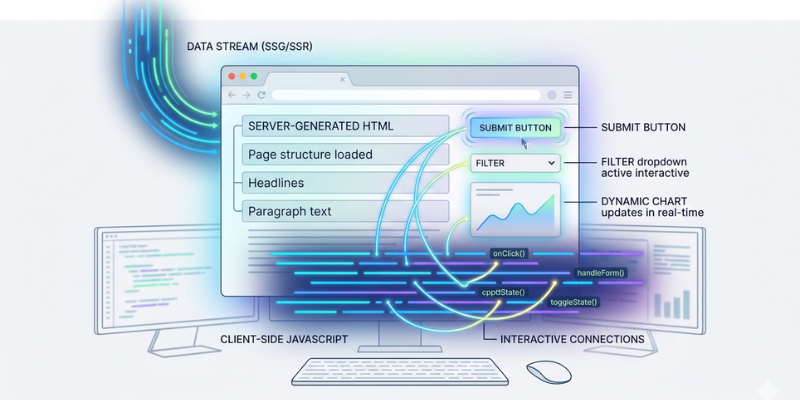
Hydration is an important concept in modern frontend development that helps websites load faster and become interactive smoothly. It is widely used in applications built with frameworks like React and Next style architectures where server rendering is combined with client-side behavior. Hydration refers to the process where static HTML sent from the server is turned into a fully interactive application in the browser by attaching JavaScript logic to it. If you want to build strong fundamentals in this area, consider enrolling in a Full Stack Developer Course in Mumbai at FITA Academy, where you can explore these concepts in a structured way for real-world application development.
What Hydration Really Means
When a user opens a modern web page, the server often sends a ready-made HTML page first. This page looks complete, but it does not yet respond to user actions like clicks or input changes. Hydration is the step where JavaScript takes over this static HTML and makes it interactive by connecting event listeners and application logic to the existing structure. This helps users see content quickly while still getting full interactivity after scripts load.
In traditional web apps, everything is rendered in the browser from scratch. Hydration improves this by splitting the work between server and client, which results in faster perceived performance and better user experience.
Why Hydration is Important in Modern Web Development
Hydration plays a key role in improving performance and search engine visibility. Since the server sends a fully rendered page first, search engines can easily read the content. This improves indexing and helps pages rank better. At the same time, users do not need to wait for JavaScript to fully load before seeing meaningful content.
However, hydration also adds complexity because the browser must match the server-generated HTML with client-side logic. If there is any mismatch, it can cause unexpected behavior or performance issues. Understanding this balance is important for developers who work on modern frontend systems.
For learners who want to strengthen their understanding of such architecture patterns, exploring a Full Stack Developer Course in Kolkata can help you build hands-on experience with project-based learning and industry-relevant tools.
How Hydration Works Behind the Scenes
Hydration starts when the browser receives HTML content generated by the server. This HTML is displayed immediately, so the user sees the page without delay. After this, JavaScript files are downloaded and executed in the background. Once the scripts are ready, the framework scans the existing HTML and attaches event handlers and internal state management to it.
This process avoids re-rendering the entire page from scratch. Instead, it enhances the already visible content and turns it into a fully dynamic application. This is why hydration is often described as making a static page come alive.
Challenges Developers Face with Hydration
Although hydration improves performance, it is not without challenges. One common issue is the mismatch between server-rendered content and client-rendered content. This can lead to warnings or unexpected UI behavior. Another challenge is performance cost because large applications may take time to hydrate fully, especially on slower devices.
Developers also need to manage complexity when deciding what should be rendered on the server and what should be handled on the client. Making the wrong decision can lead to slower applications or unnecessary processing.
Best Practices for Using Hydration Effectively
To use hydration efficiently, developers should focus on reducing unnecessary JavaScript on initial load. Splitting code and loading only what is needed can improve performance. It is also important to keep server-rendered content consistent with client logic to avoid mismatches.
Another helpful approach is optimizing components so that only interactive parts are hydrated while static parts remain untouched. This reduces processing time and improves user experience significantly.
As you move toward advanced frontend and full-stack development roles, building a deeper understanding of these optimization strategies becomes essential for real-world applications.
Hydration is a core concept in modern frontend development that bridges the gap between server-rendered content and client-side interactivity. It improves performance, enhances SEO, and creates a smoother user experience when implemented correctly. At the same time, it requires careful design to avoid performance issues and inconsistencies.
If you are planning to build a strong career in web development and want to master such advanced concepts in a practical environment, you can take the Full Stack Developer Course in Delhi to gain structured learning and hands-on experience that prepares you for real industry challenges.
Also check: Basic Database Design Principles for Full Stack Developers

 عربي
عربي