Automotive Acoustic Materials Market Research Report
The Automotive Acoustic Materials Market is witnessing steady growth due to increasing demand for enhanced cabin comfort, stricter vehicle noise regulations, and rising adoption of electric vehicles globally. According to Redline Pulse, acoustic materials are widely used across modern vehicles to reduce noise, vibration, and harshness (NVH), improving overall passenger experience and driving comfort.
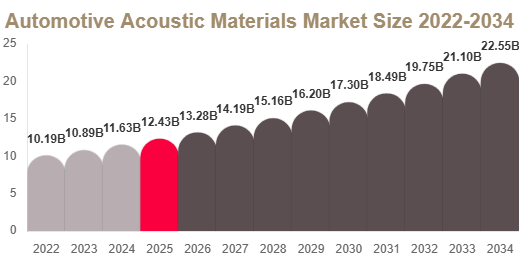
The Automotive Acoustic Materials Market size was valued at USD 12.46 billion in 2025 and is estimated to reach USD 13.28 billion in 2026. The market is projected to reach USD 22.84 billion by 2034, registering a CAGR of 6.84% during 2025–2034.
One of the primary drivers of the Automotive Acoustic Materials Market is the increasing consumer preference for premium in-cabin comfort. Modern vehicle buyers demand quieter interiors, which has led automakers to integrate advanced foam-based, rubber-based, and composite acoustic materials in doors, dashboards, floors, and roofs.
Growth of Electric Vehicles
Electric vehicles significantly influence the demand for acoustic materials. Since EVs generate minimal engine noise, road and wind noise become more noticeable, increasing the need for advanced NVH solutions to maintain cabin refinement and comfort.
Strict Noise Pollution Regulations
Governments across major regions are implementing strict noise control standards for vehicles. This is pushing automotive manufacturers to adopt high-performance acoustic insulation materials to comply with regulatory requirements.
Expansion of Global Automotive Production
Rising vehicle production across both developed and emerging economies is directly increasing demand for acoustic materials. Growing automotive manufacturing activity ensures consistent integration of NVH solutions in mass production vehicles.
Market Challenges
High Cost of Advanced Materials
The Automotive Acoustic Materials Market faces challenges due to the high cost of advanced composite and multi-layer acoustic materials, which limits adoption in low-cost vehicle segments.
Raw Material Price Volatility
Fluctuations in the cost of polymers, foams, and rubber-based materials impact manufacturing costs and create pricing pressure for suppliers.
Limited Adoption in Entry-Level Vehicles
Due to cost constraints, advanced acoustic solutions are primarily used in premium and mid-range vehicles, restricting penetration in budget vehicle segments.
Segments Analysis of Automotive Acoustic Materials Market
By Material Type
Foam-based acoustic materials dominate the market with a 41.28% share in 2025 due to their lightweight nature, cost efficiency, and high sound absorption capability. These materials are widely used in dashboards, doors, roofs, and flooring systems.
Fiberglass materials are used for high-performance insulation applications requiring strong sound dampening properties.
Rubber-based materials are commonly used for vibration damping and sealing applications in automotive assemblies.
Composite acoustic materials are the fastest-growing segment due to increasing demand for multi-functional, lightweight, and high-performance NVH solutions.
By Vehicle Type
Passenger vehicles hold the largest share of 62.15% in 2025 due to high production volumes and rising demand for comfort-focused driving experiences.
Commercial vehicles use acoustic materials to reduce engine and road noise for long-distance driving efficiency and driver comfort.
Electric vehicles are the fastest-growing segment due to their need for advanced insulation to control road and wind noise in the absence of engine sound.
By Application
Interior insulation dominates the market with a 38.74% share in 2025, including dashboards, door panels, and roof linings designed to enhance cabin quietness.
Engine noise reduction remains a key application in ICE vehicles to improve comfort and reduce vibration.
Floor and door panel applications are widely used to minimize road noise and vibrations inside the cabin.
Underbody acoustic shielding is the fastest-growing application due to increasing demand for road noise reduction, especially in EV platforms.
Regional Analysis
North America leads the market with a 34.62% share in 2025, driven by strong demand for premium vehicles and advanced NVH solutions.
Asia Pacific is the fastest-growing region with a CAGR of 8.12% due to rising automotive production and rapid EV adoption in China, India, and Southeast Asia.
Europe is supported by strict noise regulations and strong demand for sustainable and lightweight acoustic materials.
Middle East & Africa is growing steadily due to increasing luxury vehicle imports and rising demand for comfort-enhancing automotive technologies.
Latin America is expanding gradually with rising vehicle production and increasing consumer preference for improved cabin comfort.
Competitive Landscape
The Automotive Acoustic Materials Market is moderately competitive, with companies focusing on lightweight materials, sustainability, and advanced NVH solutions.
Autoneum Holding AG Autoneum is a leading player in automotive acoustic solutions, offering advanced NVH systems and sustainable insulation materials widely used in global vehicle platforms.
3M Company 3M provides high-performance acoustic materials designed for noise reduction, vibration control, and thermal insulation across automotive applications.
Adient plc Adient focuses on interior automotive solutions, including acoustic systems integrated into seating and cabin structures.
Saint-Gobain S.A. Saint-Gobain develops advanced materials for automotive insulation, emphasizing lightweight and high-performance acoustic solutions.
BASF SE BASF produces innovative polymer-based acoustic materials designed for durability, efficiency, and noise reduction performance.
Sumitomo Riko Company Limited Sumitomo Riko specializes in rubber-based NVH solutions used for vibration damping and acoustic insulation in vehicles.
Market Outlook
The Automotive Acoustic Materials Market is expected to grow steadily through 2034, driven by increasing EV production, rising demand for premium comfort, and stricter noise regulations. Continuous material innovation and lightweight engineering will further strengthen market expansion.



 SPARK Website

 English