


 SPARK Website
Vietnam Fertilizer Industry Growth Insights for Producers and Suppliers 2026-2034
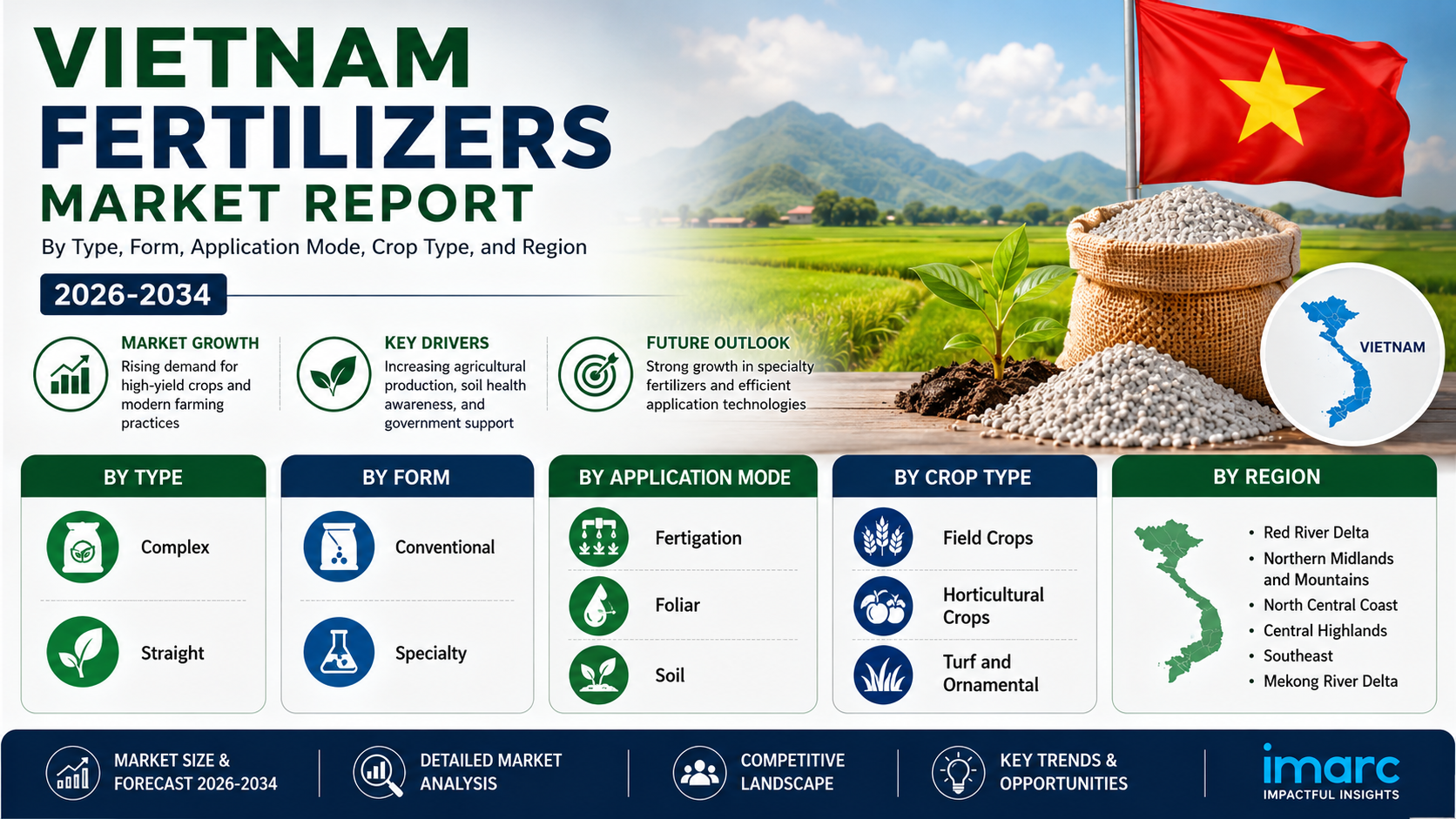
Fertilizers are any chemical or natural substances added to soil or land to increase its fertility and‚ as a result‚ plant productivity․ Fertilizers contain essential macro and micronutrients for plants․ Major nutrient elements provided by fertilizers include nitrogen (N) that supports vegetative leafy growth and plant vigor‚ phosphorus (P) that promotes root system development and flowering‚ and potassium (K) that promotes disease resistance‚ cellular processes‚ and final fruit quality and quantity․ Fertilizers can be granular‚ liquid‚ conventional‚ or specialty․ Crop fertilizers are agricultural plant nutrients used to aid plant growth‚ and are a basic building block of food‚ high yield cropping systems and modern agrarian economies‚ providing plant nutrients both in the soil where crops grow and on the leaves‚ to provide for food‚ feed‚ fiber and biofuel․
Vietnam fertilizers market would be USD 14․53 billion by 2030‚ increasing at a CAGR of 7․7%․
IMARC Group has estimated the Vietnam fertilizer market to be valued at USD 758․7 Million in 2025․ The market is projected to reach USD 1‚065․8 Million by 2034‚ exhibiting a CAGR of 3․85% during the forecast period (2026-2034)․ Insights on the market are tracked and analyzed using IMARC Group's proprietary model․
The market's 3․85% compound annual growth rate (CAGR) acts as a signal to corporate CFOs‚ institutional agricultural investors and overseas chemical manufacturers that this is a resilient‚ nondiscretionary enterprise commodity market with over USD 1 Billion forecast in potential demand‚ domestically‚ increasing steadily with population growth․ Such economic growth assures that multi-year investments in local blending plants‚ precision chemical distribution networks and regional storage facilities will find an ever-expanding institutional market․
Why is the Demand for Advanced Fertilizer Products Growing Quickly in Vietnam?
Factors accelerating the market include rapid agricultural growth‚ shrinking arable land per capita due to urbanization‚ a pivot towards higher value cash crops‚ as well as sustainability and global export standards․
The key macro drivers that dictate the consumption of these products by supply chain planners and agricultural policy advisors can be divided into the following operating areas:
• Agricultural land per capita diminished: Rampant urbanization and the establishment of industrial estates across Vietnam has transformed customary rural farmland into urban real estate‚ thereby leaving less land per capita for the farmers‚ who must thus adopt intensive farming methods․ Intensive farming on smaller and closer-laying farms requires the use of fertilizers with a high efficiency and specific balance․
• Transitioning Toward High-Value Commercial Crop Diversification: Vietnamese farmers are making the transition from subsistence farmers to high-value commercial farmers at a rapid rate‚ so while rice remains a staple food‚ farmers are switching to cash crops such as coffee‚ rubber‚ cashew‚ and high-value fruits‚ which require a specialized nutrient mix․
• Extending Exposure to Global Food Exports: Foreign demand for Asian food products and the global health-oriented trend provide an opportunity for agricultural exports of Vietnam․ However‚ to meet the import requirements of foreign markets and maintain product quality‚ the soil management system is moving toward greater use of agrochemicals and specialized crops․
What Technical Chemical Segments and Material Forms Make Up the Local Market?
Market segmentation‚ by type‚ is into Complex fertilizers and Straight fertilizers․ Market segmentation‚ by form of material‚ is into Conventional fertilizers and Specialty fertilizers․ Specialty fertilizers are Controlled-Release Fertilizers (CRFs)‚ Liquid Fertilizers‚ Slow-Release Fertilizers (SRFs) and Water-Soluble fertilizers․
For technical agronomy directors and wholesale inventory managers‚ a good regional product mix matches certain products to the prevailing conditions in the field:
Complex vs․ Straight Fertilizers
Straight fertilizers contain single primary nutrients․ Nitrogenous fertilizers include urea; phosphatic fertilizers include di-ammonium phosphate (DAP)‚ mono-ammonium phosphate (MAP)‚ single superphosphate (SSP)‚ and triple superphosphate (TSP); potassic fertilizers are MOP and SOP․ Complex fertilizers contain two or more primary nutrients in a compound‚ such as urea ammonium nitrate․ Complex variants are also growing in appeal among local growers who wish to balance nutrient content in a single application and avoid soil oversaturation‚ especially for agriculture on smaller farms where labor cost is at a premium․
The Innovation Shift: Conventional to Specialty Formulations
Granular products remain the lowest-cost choices for most seasonal applications‚ but specialty products are transforming precision farming:
Controlled-Release (CRF) and Slow-Release (SRF) Fertilizers: Innovative coated granules designed to release nutrients over an extended period‚ coinciding with precise crop growth stages․ The fertilizers considerably minimize nutrient loss to environmental runoff and soil leaching during peak monsoon periods․
• Liquid and Water Soluble: Using liquid fertilizers‚ agriculture teams can quickly adjust the chemistry of their fields in time for farmers' peak growing seasons․
What Application Modes and Crop Types Have the Highest Operational Share?
In the United States‚ fertilizer usage is broken up by type of application: Soil‚ Foliar‚ and Fertigation‚ and by plant type: Field Crops‚ Horticultural Crops‚ and Turf and Ornamental․
Field logistics planning can benefit farm management teams‚ corporate cooperatives and agricultural service providers by finding the best suitable form of delivery for a particular crop:
Modern Application Methodologies
The customary method‚ applying solid formulations directly onto‚ or into‚ the soil is still used as the baseline method of crop production in the field‚ but farms using modern technology widely use Foliar spraying (liquid application) and Fertigation․ Fertigation is the injection of water-soluble fertilizers into an active irrigation system at specific rates into the plant root zone during irrigation․
Crop Consumption Trajectories
• Field Crops: Bulk crops such as rice or corn‚ which require a steady supply of conventional nitrogenous and complex fertilizers that are essential for achieving national food security․
• Horticultural Crops: Fruits‚ vegetables‚ and cash crops like coffee‚ cashew‚ and cocoa foster demand for custom fertilizers‚ specific nutrient mixes‚ and sustainable enhancements․
Sample Request For Your Business
The market is segmented into Northern Vietnam‚ Central Vietnam and Southern Vietnam․ The market is witnessing a trend of digital precision agriculture‚ the development of eco-friendly organic launches‚ and major corporate joint ventures․
To international trade partners and corporate expansion managers alike‚ the geographic shifts and corporate transformations pointed to emerging new markets:
Structural analysis of regional corridors․
• Northern Vietnam: balance between the intensive production of field crops and sustainable intensification․
• Central Vietnam: A geophysical catchment‚ key for mass cash crop plantations and developing agri-logistics supply chains․
• South Vietnam: That agricultural engine ran in the fertile Mekong Delta‚ with heavy demand for commercial fertilizers and pumping and water management technology․
Corporate Milestone Innovations:
Although the above example is small-scale‚ large commercial companies continue to offer new products promoting sustainable farming․ In late 2023‚ Yara‚ a large global fertilizer company‚ released YaraSuna organic fertilizer in Vietnam‚ distributing more than 1‚000 metric tons for immediate soil regeneration and nutrient recycling․
In October 2024‚ Bayer established its agricultural program Better Life Farming Alliance in Vietnam‚ providing precision fertilizer knowledge to local farmers of durian and coffee․ In the same month‚ Vinhthinh Biostadt signed a cooperation agreement with UPL Vietnam and the two sides jointly produced a series of high-tech NPK fertilizers combined with growth regulators‚ providing important savings on production costs for local farmers․
Conclusion:
Vietnam's agricultural supply chain is still modernizing‚ moving gradually and definitively toward precision farming‚ high productivity‚ and more sustainable soil health management methods․ Based on IMARC Group Report - a market on path to reach USD 1‚065․8 Million by 2034‚ Vietnam is considered a key farm for target agribusiness investments․ Future success for companies in this sector will rest upon scaling up specialty complex mixtures‚ controlled-release technology‚ and adapting to the environmentally sustainable social requirements of commercial farming networks emerging across Vietnam‚ continuing from the most recent CAGR growth trend of 3․85%․

 عربي
عربي