


 SPARK Website
Russia Alcoholic Drinks Market Size 2034: Distribution and Branding Insights For Alcohol Beverage and FMCG Companies
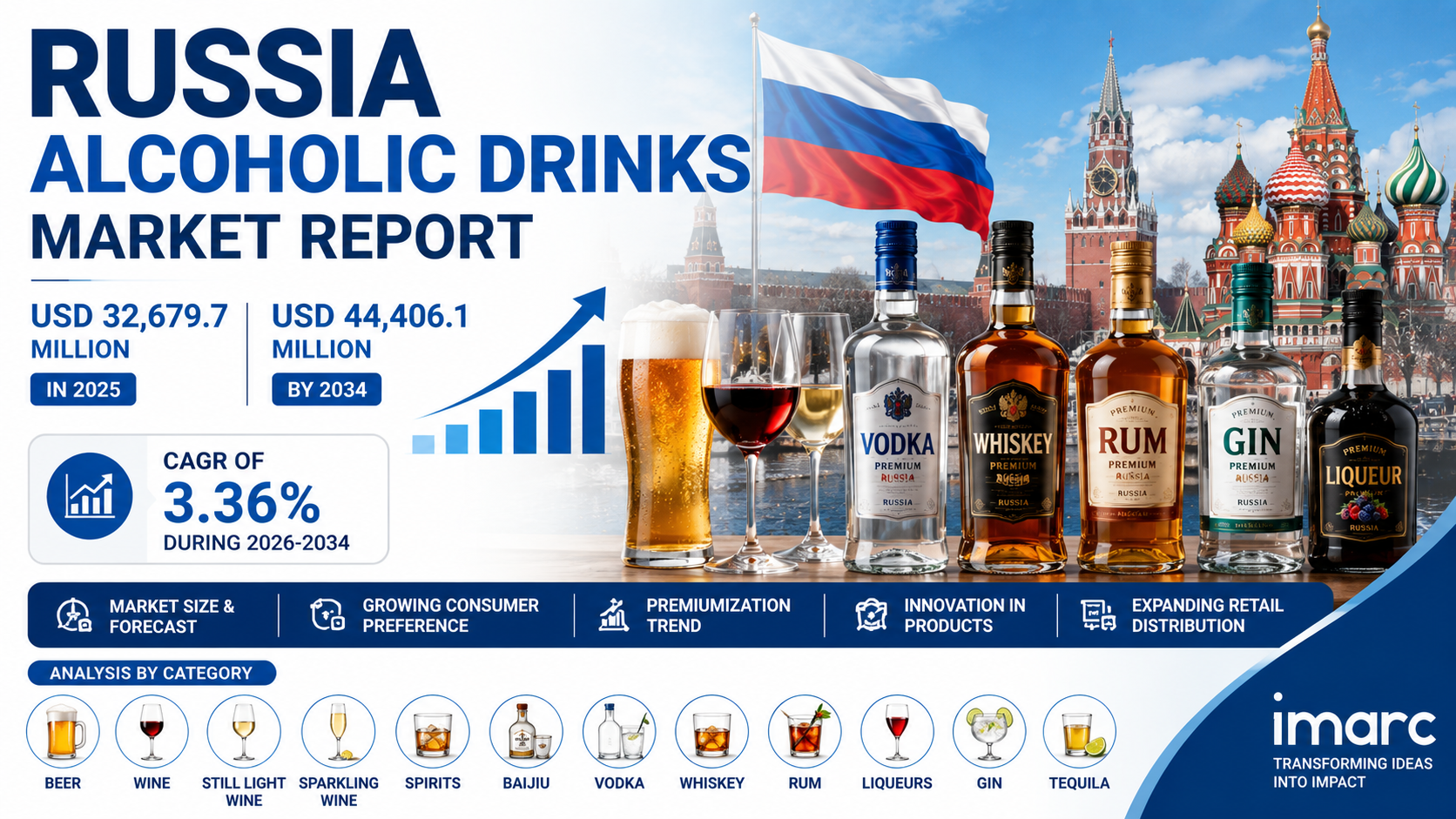
The Russia alcoholic drinks market refers to the comprehensive commercial ecosystem, manufacturing infrastructure, and distribution networks involved in the production, importing, and retail of beverages containing ethyl alcohol across the Russian Federation. This extensive sector of the food and beverage industry is classified into distinct categories, including spirits (such as vodka, whiskey, gin, and liqueurs), beer, and wine (including still light and sparkling varieties). These products vary across a wide spectrum of alcohol content levels - categorized as high, medium, and low - and are made available in unflavored or fruit-infused configurations. Packaged predominantly in glass or plastic bottles, these beverages cater to deep-rooted cultural drinking traditions and social gatherings, serving as a significant economic driver within Russia's domestic retail and hospitality industries.
Why Is the Russian Beverage Sector Growing for Beverage Product Developers?
For beverage product developers, flavor chemists, and master distillers, the shifting landscape of the Russia alcoholic drinks market represents an exceptional landscape for product formulation and market entry. According to the comprehensive industry data published by IMARC Group, the total market size reached a massive valuation of USD 32,679.7 Million in 2025.
Product innovators are utilizing these data-driven insights to restructure their manufacturing setups. The primary drivers accelerating interest for this professional audience include:
- The Premiumization Movement: Wealthier urban consumers are actively moving away from low-cost, mass-market options toward high-quality, crafted, and long-aged alcoholic beverages.
- The Rise of Craft and Alternative Flavors: Younger demographics are increasingly seeking out craft breweries and domestic whiskey distilleries that offer unique, complex flavor profiles.
- Substantial Industry Expansion: The market is projected to reach an impressive USD 44,406.1 Million by 2034, maintaining a steady compound annual growth rate (CAGR) of 3.36% during the 2026–2034 forecast period, which provides long-term stability for corporate capital investments.
How Do E-Commerce and Digital Delivery Platforms Benefit Tech-Savvy Urban Consumers?
For tech-savvy urban consumers and busy working professionals in Russia's major metropolitan areas, purchasing dynamics are undergoing a rapid digital transformation. The acceleration of specialized e-commerce networks and online alcohol delivery services provides direct, practical benefits that align with modern lifestyles.
The integration of digital platforms into the purchasing journey allows everyday buyers to enjoy unique shopping conveniences:
- Unprecedented Product Accessibility: Online channels allow consumers to scan and discover a vast array of domestic craft beers, rare wines, and specialized spirits that are rarely stocked on physical neighborhood retail shelves.
- Personalized Digital Shopping: Advanced e-commerce apps offer customized product suggestions, exclusive digital-only promotions, and subscription-based delivery options tailored to individual taste preferences.
- Influencer-Driven Discovery: Younger legal-age shoppers rely heavily on social media marketing and collaborations with digital influencers to discover upcoming brands, cocktail recipes, and product reviews right from their smartphones.
What Key Product Categories Drive Strategy for Supermarket Category Managers?
Supermarket category managers, corporate inventory buyers, and retail procurement officers rely on precise market segmentation to optimize shelf allocation and maximize retail margins. The IMARC Group report outlines clear structural categories, allowing retail managers to tailor their inventory to specific buyer profiles:
The Dominant Spirits Category
Spirits continue to hold the largest presence within the Russian market, with traditional unflavored vodka serving as a foundational cultural mainstay. However, category managers are increasingly expanding shelf space for premium whiskey, gin, and liqueurs to capture higher discretionary spending from younger urban consumers.
The Evolving Beer Segment
Beer commands a massive volume share of daily retail traffic. While standard mass-market lagers dominate total volume, category managers are optimizing their layouts to include premium local microbreweries alongside non-alcoholic and low-alcohol beers to satisfy wellness-oriented shoppers.
The Fast-Growing Wine Market
Driven by a growing consumer perception of wine as a healthier alcoholic option, this segment is expanding rapidly. Category managers are prioritizing domestic wines produced in the agricultural regions of Crimea and Krasnodar, with red wine driving the highest volume sales and sparkling wine seeing significant spikes during social celebrations.
Which Distribution Channels Maximize Market Penetration for Commercial Brand Operators?
For marketing directors, corporate sales teams, and commercial beverage brand operators, choosing the right mix of distribution channels is essential to achieving widespread market share. The Russia alcoholic drinks market utilizes several distinct retail pathways to move products from production lines to consumers:
- Supermarkets and Hypermarkets: These extensive retail formats represent the primary distribution channel. They offer the necessary floor space to showcase a diverse range of international and domestic brands at competitive prices, encouraging bulk household purchasing.
- The On-Trade Sector (HoReCa): Comprising bars, restaurants, and nightclubs, this channel is vital for shaping modern drinking habits. It serves as the primary testing ground for the growing mixology culture, premium spirits, and artisanal cocktails.
- Specialist Retailers: Dedicated liquor boutiques cater to connoisseurs seeking rare vintages, premium aged spirits, and expert, personalized recommendations that foster long-term brand loyalty.
Sample Request For Your Business
How Do Import Substitutions Benefit Domestic Distillary Investors?
Institutional investors, agricultural venture capitalists, and local distillery owners are experiencing a highly profitable era due to structural changes in international trade. Government policies favoring domestic manufacturing have opened up massive vacuums in the marketplace.
Domestic production groups are successfully scaling up operations to capture market share through several avenues:
- Filling the Import Vacuum: The reduction in foreign imports of Western alcohol has created a major opening for local companies to scale up domestic whiskey, brandy, and gin production.
- Leveraging Regional Agriculture: Local wine producers are capitalizing on excellent agricultural conditions in southern districts. A prime example of regional production strength is seen in the Volga Federal District, which produced over 229.2 thousand decaliters of wine between January and October 2020 alone, leading all federal districts.
- Thriving under Regulatory Support: Government policies focusing on strict quality control and import substitution have enabled domestic brands to flourish, protecting local investments from foreign competition.
Where Are the Primary Regional Hubs for Corporate Logistics Coordinators?
For logistics managers, supply chain directors, and distribution coordinators, understanding geographic demand patterns across the Russian Federation is critical for maintaining efficient supply lines. The market displays distinct regional characteristics:
- The Central District: Anchored by the massive population and high disposable income of Moscow, this district represents the primary hub for premium spirits, imported wines, and high-end on-trade nightlife establishments.
- The Volga District: Positioned as a premier agricultural and manufacturing zone, this region serves as a core production engine for domestic wines and traditional beverages.
- The Urals District: Driven by a robust industrial economy, cities like Yekaterinburg present a highly stable consumer base with steady disposable income, fueling a rising demand for local craft beers and regional spirits.
How Do Shifting Alcohol Content Levels Influence Health-Conscious Consumers?
A fast-growing segment of the population is completely re-evaluating their relationship with alcohol, directly altering volume demand across different product formulations. Health-conscious shoppers and female demographics are steering the market toward lighter alternatives.
Brewing companies and beverage manufacturers are adapting to this wellness trend by adjusting their portfolios:
- The Growth of Low and Non-Alcoholic Options: Light beers, ciders, hard seltzers, and completely alcohol-free beers are seeing rapid adoption among younger demographics who prioritize social experiences without the heavy health impacts of high-potency spirits.
- Government Alignment: This shift toward low-alcohol alternatives aligns with long-term government anti-alcohol initiatives and strict excise taxes designed to discourage excessive consumption, creating a favorable regulatory environment for wellness-focused product launches.
What Is the Future Revenue Forecast for the Russia Alcoholic Drinks Industry?
The long-term financial trajectory of the alcoholic beverages market in Russia points toward a highly lucrative and stable expansion. From its solid baseline valuation of USD 32,679.7 Million in 2025, the total market size is forecasted to reach an estimated USD 44,406.1 Million by 2034.
This reliable expansion represents a healthy CAGR of 3.36% throughout the 2026–2034 forecast period. This financial momentum is firmly supported by the dual forces of domestic premiumization and the rapid growth of localized manufacturing. As Russian distillers continue to refine their aging techniques, supermarkets expand their digital e-commerce ordering networks, and flavor developers introduce innovative ready-to-drink options, the market is perfectly positioned to deliver premium, culturally resonant beverages to consumers nationwide.
Conclusion:
The Russia alcoholic drinks market is undergoing a profound structural evolution, successfully shifting from an import-dependent structure to a highly self-reliant, premiumized domestic industry. Driven by a projected 3.36% CAGR that points toward a USD 44,406.1 Million valuation by 2034, the sector provides robust opportunities across multiple consumer and industrial landscapes. For product developers introducing craft flavors, domestic distillery investors filling import gaps, or supermarket category managers expanding e-commerce and low-alcohol selections, the market heavily rewards innovation and premium quality. By capitalizing on local production strengths and leveraging digital sales channels, the Russian beverage industry ensures excellent long-term resilience and steady commercial growth.

 English