


 SPARK Website
Vietnam E-Bike market Analysis 2026-2034: Growth Opportunities for Component Producers
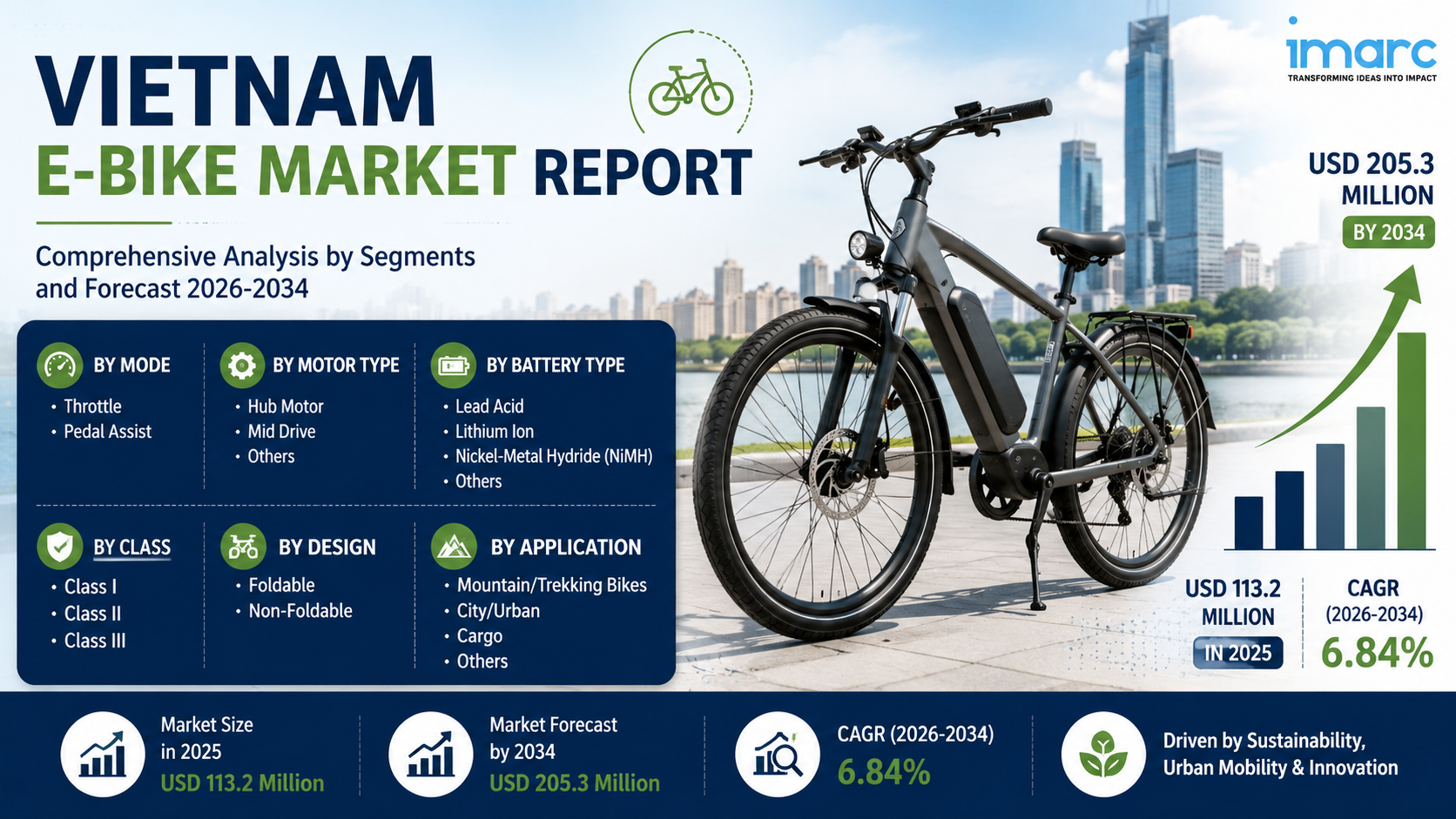
The Vietnam e-bike market refers to the burgeoning industry involved in the design, manufacturing, and sale of electric bicycles - vehicles integrated with an electric motor to assist or replace manual pedaling. These eco-friendly transportation solutions are categorized by their propulsion modes, such as throttle or pedal assist, and are powered by various battery technologies including lithium-ion and lead-acid. As of 2025, the market has reached a valuation of USD 113.2 Million, driven by a national shift toward sustainable mobility and the urgent need to mitigate urban pollution.
Why is the Vietnam E-Bike Market Growing for Eco-Conscious Commuters?
For commuters looking to reduce their carbon footprint, the primary driver for market expansion is the rising environmental consciousness across the country. Vietnam faces significant air pollution challenges, particularly in major metropolitan hubs. The Vietnam e-bike market is projected to reach USD 205.3 Million by 2034, growing at a CAGR of 6.84%.
This growth for eco-conscious audiences is fueled by:
- Zero Emissions: E-bikes produce no tailpipe emissions, making them a direct alternative to gasoline-powered motorbikes.
- National Climate Goals: Vietnam is a signatory to the Paris Agreement and aims for net-zero emissions by 2050.
- Stricter Standards: The implementation of Euro 5 emission standards in 2022 has encouraged a move toward electric alternatives.
How are Government Incentives Making E-Bikes More Affordable for Families?
For budget-conscious households, the Vietnamese government is actively lowering the barrier to entry through financial support and regulatory changes. Families can benefit from:
- Direct Subsidies: Municipalities like Ho Chi Minh City have announced plans to assist residents in switching from gas motorbikes to electric vehicles by offering subsidies.
- Tax Exemptions: Import duties and value-added tax (VAT) on e-bikes and components are frequently reduced. Specifically, EV excise tax rates were lowered by up to 12% in early 2022.
- Public Awareness: Collaborative workshops with organizations like the UNDP promote electric vehicle-sharing models, making families more aware of the long-term cost savings.
What are the Best Motor and Battery Types for Performance-Driven Riders?
For riders who prioritize technical efficiency and range, the choice of components is critical. The market offers several specialized options:
- Lithium-Ion Batteries: These are the gold standard for performance, offering high energy density, lightweight design, and a longer lifespan compared to traditional lead-acid options.
- Mid-Drive Motors: Ideal for those navigating hilly terrains or off-road trails, as these motors provide better balance and utilize the bike's existing gears for superior climbing.
- Hub Motors: A favorite for urban riders seeking a budget-friendly and low-maintenance solution for flat city streets.
Why is Infrastructural Development Vital for Urban E-Bike Users?
For the daily urban traveler, the "range anxiety" of electric travel is being solved through massive infrastructure investments. Recent developments that support urban users include:
- Dedicated Bike Lanes: Hanoi recently launched its first bike-only lane - a 4km stretch along the To Lich River - to ensure safer and faster travel.
- Public Charging Networks: The launch of companies like V-Green by Vinfast is rapidly expanding the availability of public charging stations.
- Public Rental Stations: The integration of e-bike stations at major transport hubs, such as Transportation University and Lang Station, makes "last-mile" commuting seamless.
Sample Request For Your Business
Which Regions are Seeing the Highest Demand for Electric Two-Wheelers?
For regional stakeholders and investors, the demand is geographically diverse across Vietnam:
- Northern Vietnam: Cities like Hanoi and Haiphong show high demand due to severe traffic congestion where maneuverability is a top priority.
- Southern Vietnam: Ho Chi Minh City (Saigon) is a massive hub for e-bikes because of its large population and limited parking space in central districts.
- Central Vietnam: Tourism-heavy areas like Hoi An and Danang are seeing a rise in e-bike rentals as visitors seek sustainable ways to explore ancient towns and countryside.
How Do Foldable vs. Non-Foldable Designs Impact Modern Living Spaces?
For apartment dwellers and students, the design of the e-bike is a major purchasing factor. The market caters to these different lifestyle needs through:
- Foldable E-Bikes: These offer ultimate portability, allowing users to store their bikes in small apartments, under office desks, or take them on public transport.
- Non-Foldable E-Bikes: These typically offer more power, larger batteries, and better suspension, making them the preferred choice for those with dedicated parking and longer commute distances.
Conclusion:
The Vietnam e-bike market is transitioning from a niche category to a mainstream transportation staple. With a projected valuation of USD 205.3 Million by 2034, the industry is successfully addressing the needs of eco-conscious commuters, urban families, and performance-driven riders. Driven by a 6.84% CAGR and supported by significant government subsidies and infrastructural milestones - like the launch of V-Green and new bike-only lanes - the future of Vietnamese mobility is undeniably electric. As technology continues to improve and charging networks expand, e-bikes will remain the leading solution for cost-effective and sustainable urban transit.

 English