In today’s manufacturing and industrial landscape, many businesses face a common challenge: critical mechanical parts exist physically, but the original engineering drawings are missing, outdated, or unusable. This issue is especially common in legacy manufacturing plants, aerospace maintenance facilities, automotive workshops, industrial machinery operations, and infrastructure projects across the USA and UK.
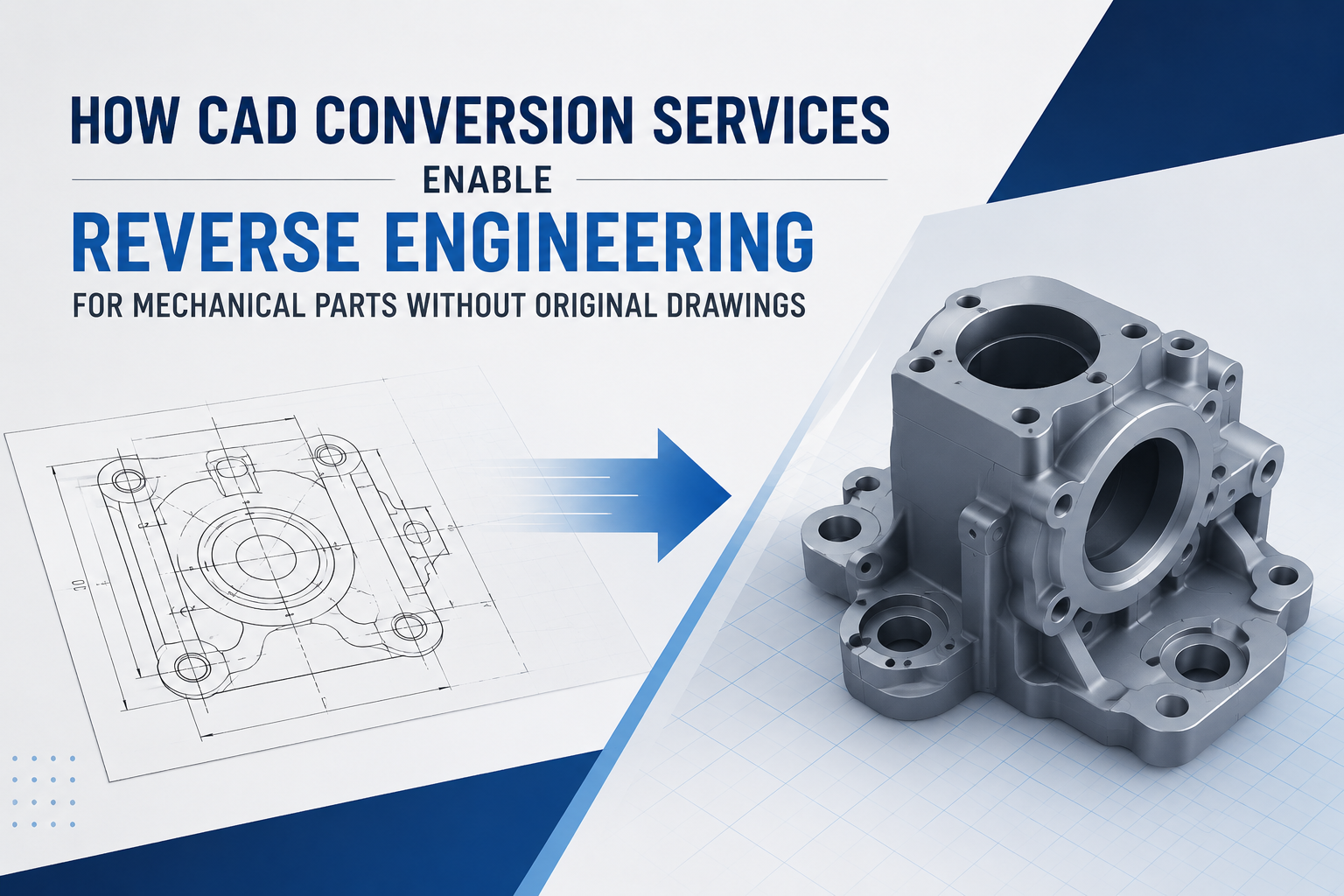
When production depends on an obsolete component and there is no digital documentation available, companies often turn to reverse engineering supported by modern CAD technologies. This is where professional CAD Conversion Services become essential.
By combining 3D scanning, intelligent modeling, and engineering expertise, a reliable 2D to 3D conversion company can help businesses recreate accurate digital models from physical components or paper drawings. These models can then be used for redesign, manufacturing, maintenance, simulation, prototyping, or modernization.
As industries continue embracing Industry 4.0, digital twins, and smart manufacturing, reverse engineering through CAD conversion is becoming a strategic advantage rather than just a technical solution.
Why Are Original Mechanical Drawings Often Missing?
Many industrial facilities still rely on machinery installed decades ago. Over time, engineering records may become:
- Lost during company mergers or relocations
- Damaged due to aging paper archives
- Incompatible with modern CAD software
- Incomplete after repeated manual modifications
- Unavailable because the OEM no longer exists
According to the U.S. National Institute of Standards and Technology (NIST), outdated engineering documentation and interoperability issues cost manufacturers billions annually in inefficiencies and production delays.
Source: NIST Manufacturing Interoperability Research
This problem is particularly significant in sectors such as:
- Aerospace
- Automotive
- Oil and gas
- Shipbuilding
- Industrial equipment manufacturing
- Rail transportation
- Heavy engineering
- Medical equipment manufacturing
Without accurate digital models, replacing or modifying mechanical parts becomes difficult, expensive, and time-consuming.
What Is Reverse Engineering in Mechanical Design?
Reverse engineering is the process of analyzing an existing physical component to recreate its digital design data.
The process typically involves:
- Capturing the geometry of the physical part
- Measuring dimensions and tolerances
- Creating accurate CAD models
- Generating manufacturing-ready drawings
- Improving or redesigning the component if necessary
Modern reverse engineering no longer depends solely on manual measurements. Today, advanced technologies such as:
- Laser scanning
- Structured light scanning
- Coordinate Measuring Machines (CMM)
- Photogrammetry
- 3D CAD modeling software
allow engineering teams to recreate highly detailed models with impressive precision.
This is where an experienced accurate cad conversion service plays a critical role by transforming raw scan data or old documentation into production-ready CAD files.
How Do CAD Conversion Services Support Reverse Engineering?
CAD conversion acts as the bridge between physical components and modern digital manufacturing workflows.
A professional CAD conversion workflow typically includes:
1. Physical Part Analysis
The mechanical component is inspected for:
- Surface wear
- Material properties
- Manufacturing defects
- Missing geometries
- Functional tolerances
This step helps engineers understand how the part was originally designed and manufactured.
2. 3D Scanning and Data Collection
Advanced scanners capture millions of measurement points to create a point cloud or mesh representation of the part.
Industries increasingly rely on 3D scanning because it significantly improves accuracy compared to manual drafting.
According to a report from MarketsandMarkets 3D Scanning Industry Research, the global 3D scanning market continues growing rapidly due to demand from manufacturing, automotive, aerospace, and healthcare industries.
3. CAD Reconstruction
Once the scan data is collected, engineers rebuild the geometry into editable CAD models using software such as:
- AutoCAD
- SolidWorks
- CATIA
- Siemens NX
- Fusion 360
- Inventor
At this stage, companies often need to Convert 2D drawing to 3D model formats for modern manufacturing compatibility.
The recreated model may include:
- Parametric features
- Assemblies
- Surface models
- Sheet metal details
- GD&T annotations
- Manufacturing tolerances
4. Validation and Quality Checking
After modeling, the CAD file is validated against the original component using:
- Dimensional analysis
- Tolerance verification
- Surface comparison tools
- Functional testing
This ensures the final model is manufacturing-ready.
Why Is Reverse Engineering Becoming More Important in 2026?
Several major trends are accelerating demand for reverse engineering and CAD conversion services.
Aging Industrial Infrastructure
Many factories across the USA and UK still operate legacy equipment that lacks digital records. Replacing entire systems is often far more expensive than recreating individual parts.
Supply Chain Disruptions
Global supply chain instability has pushed manufacturers to locally reproduce discontinued or hard-to-source components.
According to McKinsey Manufacturing Supply Chain Insights, manufacturers are increasingly investing in digital manufacturing resilience and localized production strategies.
Growth of Additive Manufacturing
3D printing and rapid prototyping depend heavily on accurate digital models. Reverse engineering enables businesses to manufacture replacement parts even when no CAD files exist.
Smart Manufacturing and Digital Twins
Modern factories increasingly use digital twins for predictive maintenance and operational optimization.
A recreated CAD model becomes the foundation for:
- Simulation
- IoT integration
- Performance monitoring
- Lifecycle management
What Industries Benefit Most From CAD-Based Reverse Engineering?
Aerospace Industry
Aircraft components often require strict tolerance accuracy. Reverse engineering helps recreate obsolete parts for older fleets while meeting modern compliance standards.
Automotive Manufacturing
Automotive restoration, aftermarket customization, and performance engineering frequently rely on CAD reconstruction.
Manufacturers can:
- Reproduce discontinued components
- Improve existing designs
- Create lightweight alternatives
- Optimize part performance
Industrial Machinery
Heavy machinery downtime can cost thousands of dollars per hour. Reverse engineering enables rapid replacement of unavailable components.
Medical Equipment Manufacturing
Hospitals and medical manufacturers often need custom components or replacements for aging systems where OEM documentation is unavailable.
Energy and Oil & Gas
Legacy infrastructure in energy sectors frequently depends on outdated mechanical systems. Reverse engineering reduces operational disruptions and maintenance risks.
How Does a 2D to 3D Conversion Company Improve Engineering Accuracy?
Traditional paper drawings are limited in today’s digital manufacturing environment.
A specialized 2D to 3D conversion company provides several advantages:
Better Visualization
3D models help engineers understand:
- Internal geometries
- Assembly relationships
- Motion interactions
- Structural behavior
Faster Design Changes
Parametric CAD models allow rapid updates without redrawing entire assemblies.
Improved Manufacturing Compatibility
Modern CNC machining and additive manufacturing require accurate digital geometry.
Enhanced Collaboration
3D files can easily integrate into:
- BIM platforms
- PLM systems
- CAM software
- Simulation tools
Reduced Human Error
Manual drafting increases the risk of dimensional inconsistencies. Digital conversion improves consistency and repeatability.
What Challenges Exist in Reverse Engineering Mechanical Parts?
Although reverse engineering offers major benefits, the process still involves several technical challenges.
Damaged or Worn Components
A part may have experienced years of wear, corrosion, or deformation, making it difficult to determine original dimensions.
Complex Organic Geometry
Curved or freeform surfaces require advanced surfacing expertise.
Tight Tolerances
Industries like aerospace and medical manufacturing demand micron-level accuracy.
Large Assembly Management
Complex machinery may contain hundreds or thousands of interconnected components.
Data Cleanup Requirements
Point cloud scans often require extensive processing before CAD reconstruction begins.
This is why companies increasingly rely on experienced providers offering accurate cad conversion service solutions rather than attempting reverse engineering internally.
How AI and Automation Are Changing CAD Conversion Services
Artificial intelligence is transforming the CAD industry faster than ever before.
Modern CAD workflows increasingly use AI for:
- Automated feature recognition
- Intelligent geometry reconstruction
- Error detection
- Parametric prediction
- Scan optimization
- Generative design recommendations
According to Deloitte Smart Manufacturing Research, AI-powered manufacturing technologies are becoming central to digital transformation strategies.
Future-ready CAD conversion providers are now integrating:
- Machine learning algorithms
- Cloud collaboration
- Digital twin frameworks
- AI-assisted drafting
- Automated tolerance analysis
This significantly reduces project turnaround time while improving accuracy.
What Should Businesses Look for in a CAD Conversion Partner?
Choosing the right CAD conversion provider directly impacts engineering quality, manufacturing efficiency, and project timelines.
Here are key factors to evaluate:
Industry Experience
Look for providers with experience in:
- Mechanical engineering
- Manufacturing workflows
- Reverse engineering
- Industrial standards
Software Expertise
The company should support major CAD platforms and compatible file formats.
Quality Assurance Process
Reliable providers use:
- Validation checks
- GD&T verification
- Dimensional comparisons
- Engineering reviews
Scalability
Large enterprises often require conversion of thousands of legacy drawings and components.
Data Security
Engineering files contain sensitive intellectual property and must be protected.
Turnaround Time
Fast project delivery minimizes production delays and operational downtime.
Why Are UK and US Companies Increasingly Outsourcing CAD Conversion Services?
Many organizations in the USA and UK now outsource reverse engineering and CAD conversion tasks because of:
- Rising labor costs
- Shortage of skilled CAD engineers
- Faster project delivery requirements
- Growing demand for digital transformation
- Need for specialized software expertise
Outsourcing also enables businesses to access global engineering talent without investing heavily in internal infrastructure.
How Does CAD Conversion Improve Sustainability?
Reverse engineering contributes to sustainable manufacturing by extending the life of existing machinery instead of replacing entire systems.
Benefits include:
- Reduced industrial waste
- Lower material consumption
- Extended equipment lifespan
- Reduced downtime
- Lower carbon footprint
This aligns with growing ESG and sustainability goals across global manufacturing industries.
According to World Economic Forum Sustainable Manufacturing Insights, digital engineering and smart manufacturing technologies are increasingly supporting sustainable industrial operations.
The Future of Reverse Engineering in the CAD Industry
The future of reverse engineering is closely tied to advancements in:
- AI-driven CAD automation
- Real-time scanning
- Cloud collaboration
- Digital twin ecosystems
- Augmented reality engineering
- Smart manufacturing
As manufacturing becomes increasingly digital, companies that modernize their legacy engineering data will gain stronger operational flexibility and competitive advantages.
The role of CAD conversion will continue expanding beyond simple drafting support into a core function of industrial innovation.
Conclusion
Mechanical reverse engineering without original drawings is no longer a major obstacle for modern industries. Through advanced scanning technologies, intelligent modeling workflows, and professional CAD expertise, businesses can recreate highly accurate digital assets from physical components.
Whether it involves restoring legacy equipment, enabling smart manufacturing, supporting rapid prototyping, or modernizing industrial infrastructure, CAD Conversion Services have become a critical part of engineering transformation across the USA and UK.
An experienced 2D to 3D conversion company can help organizations digitize outdated engineering information, improve manufacturing efficiency, reduce downtime, and extend equipment lifecycles with confidence.
For businesses seeking scalable and reliable engineering support, partnering with a trusted UK-based CAD design and drafting company with expertise in reverse engineering and accurate CAD workflows can provide long-term operational and technological advantages.
FAQs
Can CAD conversion recreate missing mechanical drawings?
Yes. Modern CAD conversion workflows can recreate accurate engineering drawings from physical components, scanned data, PDFs, or legacy blueprints.
Is reverse engineering accurate enough for manufacturing?
Professional reverse engineering can achieve extremely high accuracy levels suitable for CNC machining, additive manufacturing, and industrial production.
Can old paper drawings be converted into modern 3D CAD files?
Absolutely. Many companies now routinely Convert 2D drawing to 3D model formats to support modern manufacturing workflows.
What file formats are commonly delivered?
Common formats include:
- DWG
- DXF
- STEP
- IGES
- STL
- SolidWorks
- CATIA
- Revit-compatible formats
How long does a CAD conversion project take?
Project timelines depend on:
- Complexity of geometry
- Number of components
- Accuracy requirements
- Data quality
- Assembly size
Simple projects may take days, while large industrial assemblies can take several weeks.



 SPARK Website

 English