


 SPARK Website
How Air Duct Cleaning in Salt Lake City Keeps Your Filters Lasting Longer
Introduction: The Hidden Cost of Dirty Ducts
There is a quiet problem hiding inside the walls and ceilings of homes across the Wasatch Front, and most homeowners never think about it until their energy bills spike, their allergies worsen, or their HVAC system breaks down without warning. That problem is dirty ductwork, and it is costing people far more than they realize, not just in comfort, but in the lifespan of one of the most frequently replaced components in any heating and cooling system: the air filter.
Air filters are designed to catch dust, pollen, pet dander, mold spores, and other airborne particles before they reach your HVAC equipment. They are the first line of defense for your system and for your indoor air quality. But when the duct network behind those filters is already packed with years of accumulated debris, filters lose their effectiveness at an accelerated rate. They clog faster, restrict airflow sooner, and force homeowners into a cycle of premature replacements and unnecessary costs.
In a city like Salt Lake, where geography creates a natural basin that traps pollution, where dry desert conditions keep dust perpetually airborne, and where wildfire smoke has become a seasonal reality, the burden placed on residential air filters is genuinely significant. Understanding the relationship between duct cleanliness and filter performance is one of the most practical things a homeowner can do to protect both their HVAC investment and their household's health.
This article walks through exactly how that relationship works, what the science says about particle accumulation in duct systems, and why scheduling professional air duct cleaning salt lake city residents can rely on is one of the smartest maintenance decisions you can make this year.
Section 1: Understanding How Air Filters Work and Why They Fail Prematurely
Before exploring how dirty ducts affect filter life, it helps to understand what an air filter is actually doing inside your HVAC system.
Air filters used in residential HVAC systems operate on a deceptively simple principle: they force moving air through a fibrous or pleated medium that physically traps particles too large to pass through the gaps. The density of that medium, measured by a rating called the MERV score (Minimum Efficiency Reporting Value), determines how fine a particle the filter can capture. A MERV 8 filter, which is standard in most residential systems, catches particles between 3 and 10 microns in size, including dust mites, mold spores, and some forms of pollen. Higher-rated filters catch smaller particles, but they also create more resistance to airflow, which is an important consideration we will return to shortly.
Filters do not fail all at once. They fail gradually, in a process driven almost entirely by particle load. As more particles accumulate on the filter surface, two things happen simultaneously. First, the filter becomes more efficient at catching even smaller particles, because the existing layer of debris acts as an additional filtration medium. Second, and more critically for your system, the filter becomes increasingly restrictive to airflow. As resistance builds, your HVAC blower has to work harder to push the same volume of air through the system. This leads to higher energy consumption, more wear on the blower motor, and in extreme cases, heat exchanger damage caused by restricted airflow.
The rate at which a filter reaches this point of excessive restriction depends almost entirely on how much particulate matter is present in the air passing through it. If your duct system is clean, the air arriving at the filter is relatively clean, and the filter captures ambient particles at a predictable, manageable rate. But if your duct system is loaded with years of accumulated dust, fiberglass particles, skin cells, pet hair, and insulation debris, every cycle of your HVAC system dislodges a portion of that material and sends it directly toward your filter.
The result is a filter that might last three months under normal conditions but must be replaced after just three to four weeks because it is fighting two battles at once: the ambient air load and the duct-sourced load. In Salt Lake's dusty, dry climate, this double burden is not a hypothetical scenario. It is a practical reality for thousands of households that have not had their ducts professionally inspected or cleaned in several years.
Section 2: Salt Lake City's Unique Environmental Pressures on HVAC Systems
Salt Lake City sits in a geographical valley surrounded by the Wasatch and Oquirrh mountain ranges. This topography creates a well-documented inversion effect, particularly during winter months, where cold air becomes trapped beneath a layer of warmer air, preventing the natural mixing that normally disperses pollutants. The result is some of the worst air quality readings in the Western United States during inversion events, with fine particulate matter (PM2.5) concentrations regularly exceeding federal health standards.
For HVAC systems and the filters protecting them, this environmental context matters enormously. During inversion events, outdoor air drawn into a home through the HVAC system carries a heavier-than-average load of fine particulates. Even when windows are closed and the system is operating in recirculation mode, the cumulative infiltration of outdoor air over weeks and months adds meaningfully to the particle load inside the home and inside the ducts themselves.
Beyond inversions, Salt Lake's dry climate keeps dust perpetually airborne. The Great Salt Lake, situated just west of the city, has experienced significant reduction in water surface area over the past several decades. As the lake recedes, it exposes lakebed sediment that contains arsenic, mercury, and other trace minerals. That sediment becomes dust, and that dust travels across the valley on prevailing winds. For homeowners, this translates into a constant, fine-particulate challenge that standard filters and dusty ducts are poorly equipped to handle together.
Wildfire smoke, which has become a near-annual presence in the Salt Lake valley during late summer and early fall, adds another layer of pressure. Wildfire smoke particles are extremely fine, often smaller than 1 micron, and while high-MERV filters can capture many of them, dirty duct systems dramatically accelerate filter loading during these events. Homeowners who noticed their filters turning dark gray or black within just a few days during a smoke event were witnessing exactly this compounded loading effect.
New construction and renovation activity in the fast-growing Salt Lake metro area also generates drywall dust, wood particles, and construction debris that frequently enter HVAC systems through open registers during the building process. In many newer developments, ducts are never cleaned before occupancy, meaning new homeowners begin their residence with a duct system that is already contaminated with construction particulates.
All of these factors combine to make proper duct maintenance not just a nice-to-have but a genuine necessity for households in the Salt Lake valley seeking to protect their HVAC equipment and extend the usable life of their air filters.
Section 3: The Direct Relationship Between Duct Cleanliness and Filter Lifespan
The mechanics connecting duct cleanliness to filter longevity are both straightforward and well-supported by field observation. When a professional duct cleaning is performed using negative pressure extraction methods, the interior surfaces of supply and return ducts are swept clean of accumulated debris. What remains is a duct network that contributes far less particulate load to the air circulating through your system.
The immediate effect on filter performance is measurable. Homeowners who have had their ducts professionally cleaned consistently report that their filters stay visually clean longer after the service than they did before it. This is not a coincidence or a placebo effect. It is a direct consequence of removing the reservoir of loose material that would otherwise be continually agitated and transported by airflow.
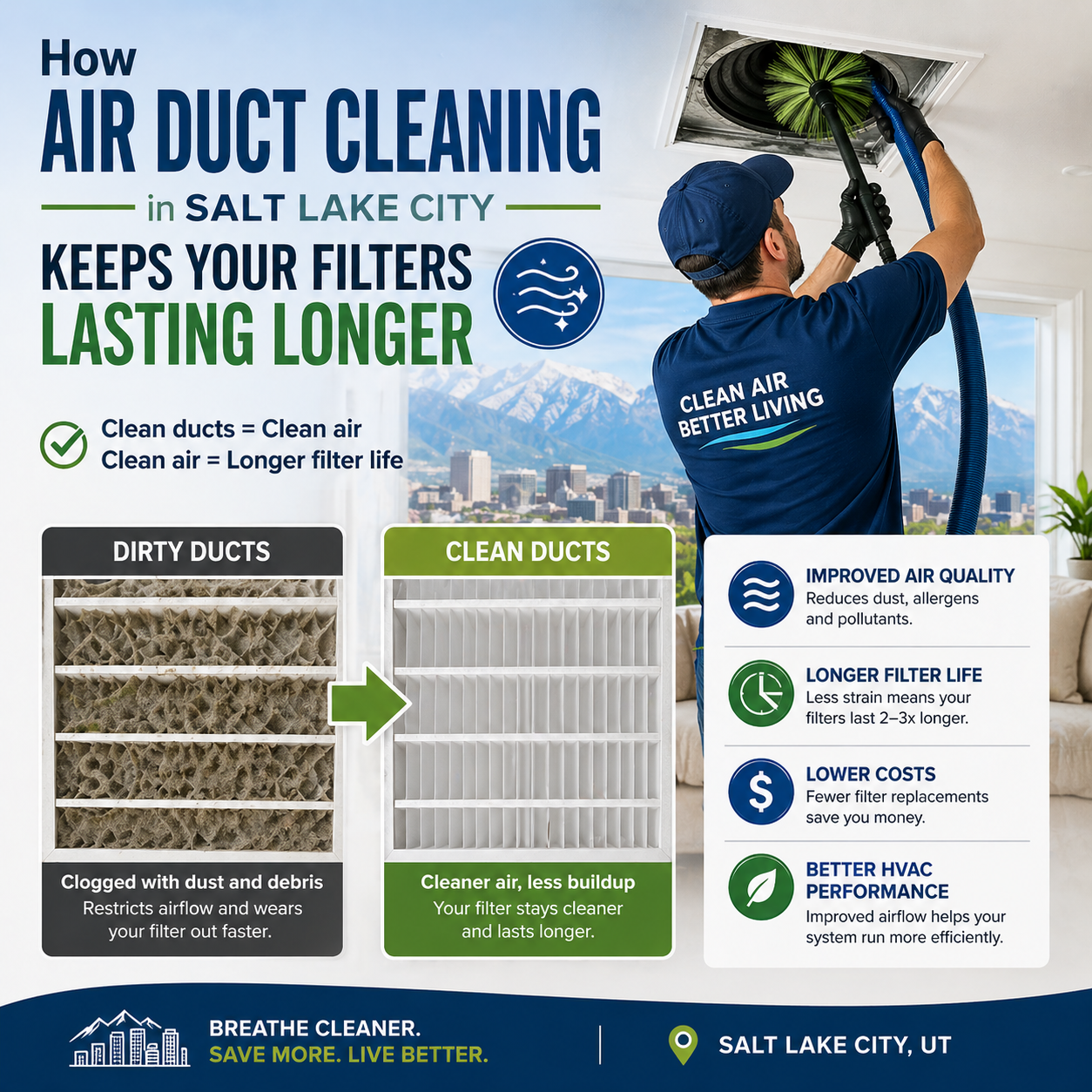
From a financial perspective, the savings compound over time. Consider a household in a mid-sized Salt Lake home with a standard 1-inch MERV 8 filter. Before a duct cleaning, the homeowner is replacing that filter every four to six weeks due to rapid loading. At a cost of $12 to $20 per filter, that amounts to $100 to $200 per year on filters alone, not counting the incremental energy costs associated with running a system with a partially clogged filter. After a professional duct cleaning, the same filter may last three to four months, reducing annual filter costs by more than half and simultaneously reducing the energy burden on the blower motor.
According to research covered in Forbes on home maintenance ROI, regular HVAC maintenance, including duct care, can meaningfully reduce both energy costs and the frequency of system repairs, making it one of the higher-return maintenance investments available to homeowners. The combination of lower filter costs, lower energy bills, and reduced wear on the blower motor and heat exchanger creates a financial case for duct cleaning that extends well beyond the immediate service cost.
There is also an indoor air quality dimension to this relationship that deserves attention. A clean duct system does not just help filters last longer; it reduces the total particulate load in the indoor air regardless of filter condition. Dust, mold spores, and allergens that settle inside dirty ducts can become airborne and reach living spaces even when a filter is in place, particularly if the filter is already partially loaded and its efficiency has declined. For households with asthma patients, allergy sufferers, or young children, this secondary benefit of cleaner ducts can be as important as the cost savings on filters.
Section 4: What a Professional Duct Cleaning Actually Involves (And What to Expect)
One of the reasons homeowners hesitate to schedule duct cleaning is a lack of clear understanding about what the process entails, how long it takes, and how to evaluate whether a contractor is doing the job properly. There is also, unfortunately, a history of low-quality "duct cleaning" services that involve little more than vacuuming register covers and charging a fee. Understanding the difference between a legitimate service and a superficial one is essential to getting actual value from the investment.
A thorough professional duct cleaning performed to industry standards established by the National Air Duct Cleaners Association involves the use of powerful vacuum equipment, typically truck-mounted or large portable units, that creates negative pressure throughout the duct system. This negative pressure prevents dislodged debris from escaping into the living space during the cleaning process. Technicians use agitation tools, including rotary brushes and compressed air whips, to loosen material adhered to duct surfaces before the vacuum extraction removes it.
The process addresses not just the main trunk lines but also the branch ducts leading to individual registers, the return air plenum, the supply plenum, and, when accessible, the interior of the air handler itself. A quality contractor will also inspect for signs of mold growth, duct damage, or pest activity that could be contributing to air quality problems. The entire process for a mid-sized residential system typically takes three to five hours.
When evaluating a duct cleaning contractor, there are several markers of quality to look for. Proper negative pressure containment is non-negotiable; if a contractor does not use vacuum equipment creating at least negative 0.5 inches of water column pressure in the duct system, dislodged debris will simply redistribute rather than being removed. Technicians should be willing to show you before-and-after photos taken with a duct camera, confirming that interior surfaces have actually been cleaned. Contracts should clearly specify which components are included in the service, and pricing should be based on the number of vents and system size rather than a suspiciously low flat rate.
Following a professional cleaning, homeowners should also consider whether their duct system has any leaks at joints or connections. Leaky ducts allow unconditioned attic or crawlspace air to enter the system, bringing with it dust, insulation particles, and humidity that will rapidly re-contaminate a freshly cleaned system. Sealing duct leaks in conjunction with a cleaning maximizes the longevity of both the cleaning results and the filters that benefit from them.
Conclusion: Make Your Filters, Your System, and Your Budget Work Smarter
The connection between clean ducts and long-lasting air filters is not a marketing invention. It is a logical consequence of how particulate loading works inside a closed HVAC system. Dirty ducts act as a continuous source of airborne debris, overwhelming filters far faster than ambient air alone ever would. In Salt Lake's challenging environment, where inversions, dust, wildfire smoke, and rapid development all contribute to elevated particulate conditions, the case for maintaining clean ductwork is especially compelling.
Clean ducts mean filters that last longer, blower motors that work less hard, energy bills that trend downward, and indoor air that is genuinely cleaner rather than just technically filtered. These are not marginal improvements. For many households, the cumulative financial benefit over a two to three year period exceeds the cost of the professional service several times over, to say nothing of the health and comfort gains that are harder to put a dollar figure on.
If you cannot remember the last time your home's duct system was professionally inspected or cleaned, that alone is a strong indicator that the time has come. Start by requesting a camera inspection from a reputable local HVAC service provider. Ask about their equipment, their process, and their certification through the National Air Duct Cleaners Association. Get a written scope of work before any service begins, and ask to see photographic documentation of the results afterward.
Your air filters are working harder than they should be. Giving them a cleaner system to protect is one of the simplest, most cost-effective steps you can take to keep your home comfortable, your air healthy, and your HVAC investment protected for years to come.

 English