


 SPARK Website
Latin America Defense Market Size, Share & Segment Analysis by Type and Country (2026–2034)
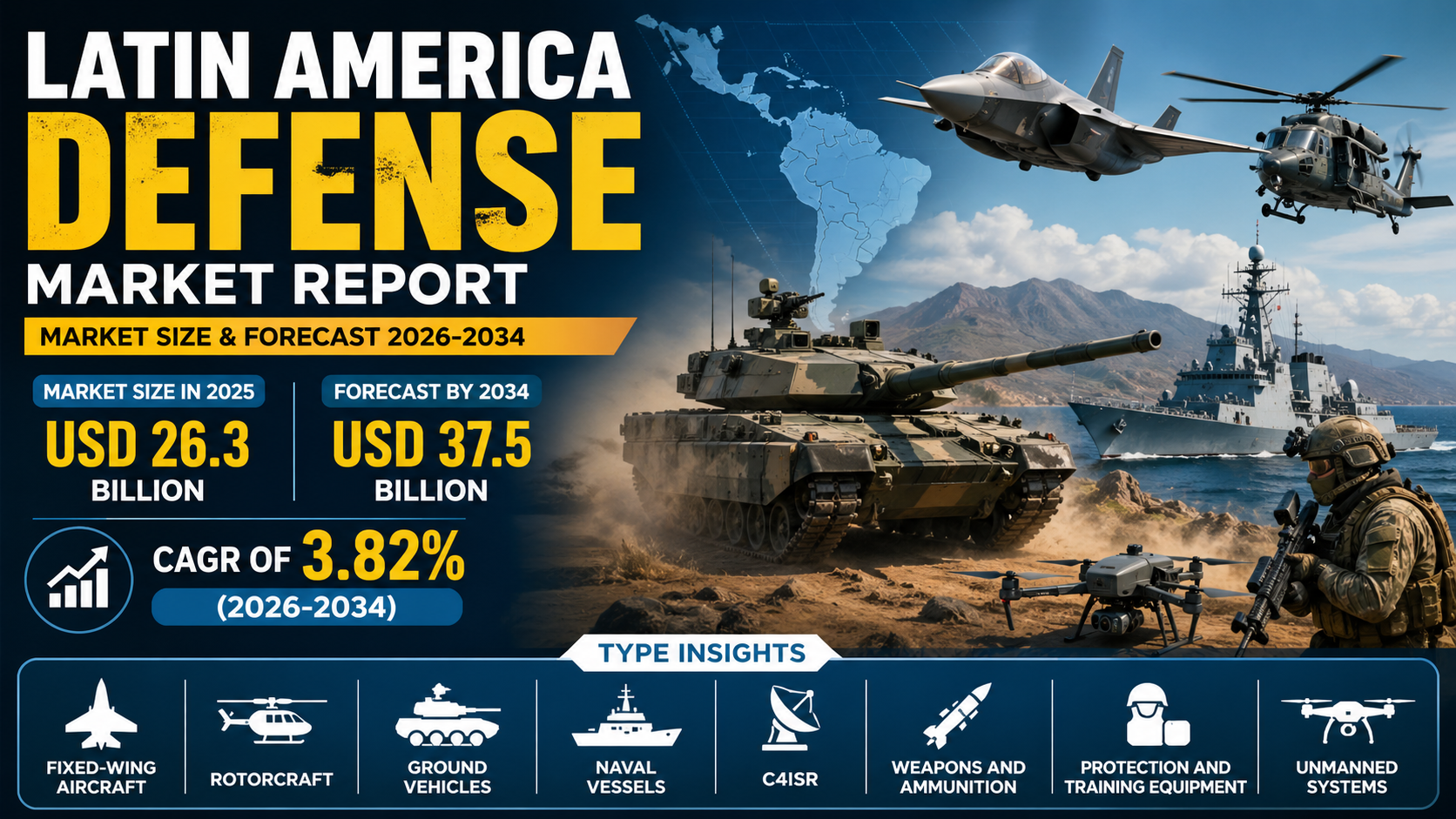
The Latin America Defense Market is the regional defense market comprising the national initiatives of procuring‚ developing and maintaining the platforms‚ systems‚ subsystems‚ services and software required to defend a country's sovereignty and territorial integrity and to provide domestic security․ It is defined by national governments allocating defense budgets to the Army‚ Navy‚ Air Force and other services of each country to procure fixed-wing aircraft‚ naval platforms‚ ground combat vehicles‚ unmanned aerial vehicles‚ and other defense systems․ Facing disputes over borders and everything from drug trafficking to organized crime‚ the Latin America defense market has become a multi-billion dollar one focused on modernization‚ technological self-sufficiency‚ and international collaboration․
How large is the Latin America defense market‚ and how is it expected to grow?
As per IMARC Group‚ the Latin America defense market reached a value of USD 26․3 Billion in 2025‚ and the industry is expected to grow at a healthy rate‚ reaching USD 37․5 Billion by 2034․
This equates to a compound annual growth rate of 3․82% from 2026 to 2034‚ largely driven by countries gradually increasing their defense budgets as well as the process of updating antiquated land‚ air‚ and naval platforms and a shift away from analog defense systems to digital-first security systems․
Why Are Government Budgets for Military Capabilities Increasing Across the Region?
National defense budgets drive the military expenditure market․ However‚ major increases in the military budget in Brazil‚ Mexico‚ and Colombia to defend their borders and combat regional instability may also have a meaningful impact on the market․
• Investment by the Government of Brazil: President Luiz Inácio Lula da Silva sent a proposed 5․9 percent increase in defense spending to the National Congress for 2025 that included targeted increases for high priority projects such as nuclear-powered submarines‚ helicopters and armored vehicles․
• National Sovereignty: Countries will increasingly need to devise defenses to protect their critical infrastructure and natural resources from threats․
• Economic stimulus: The domestic production of defense systems can generate jobs and grow local industries‚ and reduce long-term dependence on foreign imports․
How is Technological Modernization Reshaping Regional Defense Hardware?
Modernization is also a part of the technological evolution of the Latin America defense industry and is not only hardware but also software-oriented․
2․ Unmanned Systems: The number of procurements of Unmanned Aerial Vehicles (UAV) has increased․ For example‚ the Brazilian Army has recently procured the Nauru 500C UAV which is in operation by CENSIPAM (Amazon Protection System Management and Operations Center) to map areas of interest in the Amazon rainforest․
2․ Cyber defense: The modern battlefield extends to cyberspace‚ and cybersecurity has emerged as a domain of increasing interest to nations around the world․ In 2023‚ Argentina launched its second national cybersecurity strategy to protect federal infrastructure and combat cybercrime․
3․ Advanced C4ISR: Command‚ Control‚ Communications‚ Computers‚ Intelligence‚ Surveillance and Reconnaissance (C4ISR) systems provide real-time situational awareness‚ enabling quick reactions and decision-making for improved operational effectiveness․
What Role Does Internal Security Play in Driving Defense Demand?
Whereas in most of the world defense acquisition focuses mainly on state-on-state military threats‚ in Latin America the defense industrial base mainly responds to internal security challenges‚ such as narcotic trafficking and other manifestations of organized crime․
• Counter-Narcotics Applications: Governments are using thermal imaging cameras and AI-based analytics platforms to gather evidence of illicit activities in real time․
• Capacity Building: Most recently‚ Brazil participated in INCB organized workshops aimed at supporting law enforcement agencies in the area of seizures of synthetic opioids and psychoactive substances․
• Colombian Upgrades: Colombia has continued to improve its defense structure‚ including expanding its ability to monitor internal threats and security along the borders․
Which Segments Represent the Largest Consumption from the Armed Forces?
The market is categorized based on the different branches of military seeking specialized defense solutions:
The Army is by far the largest segment‚ focusing mainly on ground vehicles and equipment for internal security and counter-insurgency․
• Navy: High-value procurements are being observed in naval vessels‚ coastal intelligence monitoring‚ and Brazil's submarine programs․
• Air Force: Demand is mainly driven by the requirement for modern fixed wing aircraft‚ rotorcraft and unmanned systems for combat and reconnaissance․
How is the Competitive Landscape Changing with International Collaborations?
The commercial marketplace in Latin America contains a mix of long-established domestic competitors and foreign conglomerates who seek to expand their business in the region․
• International Expansion: The UAE defense conglomerate Edge Group opened a new office in Brazil in April 2023 to present advanced technology and establish partnerships in the region․
• Emerging Technologies: Companies such as Milrem Robotics have developed ground robots that can assist with combat and firefighting in all weather conditions in the infantry battle spaces․
• Page has worked‚ for example‚ with U․S․ National Guard leaders and their counterparts in Central and South America at headquarters of U․S․ Southern Command (SOUTHCOM) in 2025‚ to develop their countries' defense capacities through Calculated Alliances․
Sample Request For Your Business
What are the key geographic trends among major Latin American countries?
There are different regional markets across the continent‚ with hubs in several countries:
• Brazil: The largest regional defense spender‚ with the largest projects in aerospace and naval capabilities․
• Mexico: Defensive tools for internal and border security‚ and counter-narcotics․
• Argentina: Progressing towards cybersecurity self-sufficiency and the protection of the national digital infrastructure․
• Colombia: Major market for tactical gear and surveillance due to long-running internal security operations․
• Chile and Peru: Steady demand for military hardware due to continuing modernization and regional stability․
Conclusion:
As the Latin America Defense Market evolves from a legacy arms acquisition cycle to a new technology acquisition cycle‚ a sizable industry of USD 37․5 Billion by 2034‚ defense modernization tends to balance between legacy platforms like Naval ships‚ Armored Vehicles‚ Aircrafts‚ and emerging technologies like Unmanned Aerial Vehicles (UAVs)‚ Cyber Security‚ and AI-enabled surveillance systems․ Strong government budgets and an agenda to eliminate organized crime build a promising future through partnership and technological self-reliance for the defense market in Latin America․

 English