


 SPARK Website
South Africa Real Estate Market Growth, Share, and Trends Report 2025-2033
Market Overview
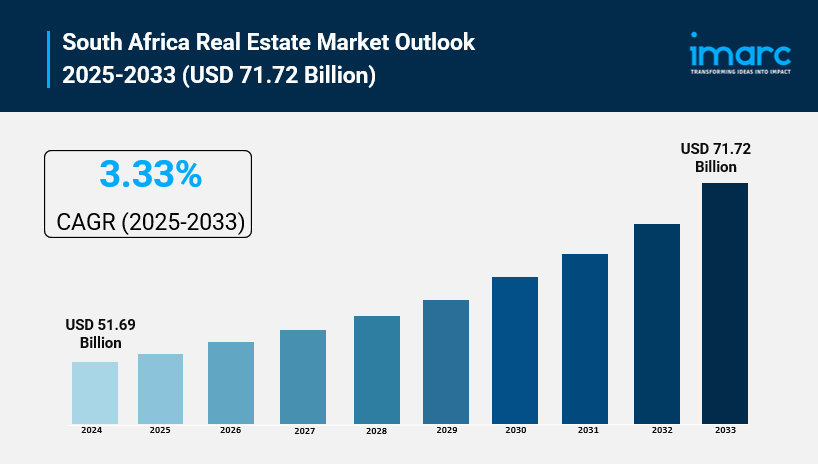
The South Africa real estate market size reached USD 51.69 Billion in 2024. The market is projected to reach USD 71.72 Billion by 2033, exhibiting a growth rate (CAGR) of 3.33% during 2025-2033. Key factors influencing this market include urbanization, economic conditions, and government policies. Urban migration in major cities such as Johannesburg, Cape Town, and Durban is driving demand for affordable housing and mixed-use developments. Economic indicators like GDP growth, inflation, and interest rates affect property affordability and investor confidence, while government schemes on land reform, housing subsidies, and infrastructure development further impact property value and market strength.
How AI is Reshaping the Future of South Africa Real Estate Market
- AI-driven data analytics optimize property valuation and investment decision-making, enhancing market efficiency.
- Smart urban planning powered by AI helps manage urban sprawl and congestion by predicting growth in satellite towns and gated estates.
- AI-enabled platforms improve buyer and renter experiences with virtual tours, personalized recommendations, and seamless transactions both online and offline.
- Government policies supported by AI analytics can enable targeted land reform and housing subsidy programs to maximize impact and stimulate affordable housing development.
- AI adoption in property management reduces operational risks and improves tenant satisfaction through predictive maintenance and automated workflows.
Grab a sample PDF of this report: https://www.imarcgroup.com/south-africa-real-estate-market/requestsample
Market Growth Factors
Urbanization and Population Growth is a primary growth driver for the South Africa real estate market, with rapid urban migration to cities like Johannesburg, Cape Town, and Durban increasing demand for residential properties, especially affordable homes, rentals, and mixed-use developments. Government-supported urban renewal and infrastructure upgrades boost city living appeal, driving residential and commercial investments. However, urban congestion and service delivery shortfalls have led to the rise of satellite towns and gated estates on city outskirts, creating new market opportunities in suburban and peri-urban regions catering to an expanding urban population.
Economic Performance and Interest Rates significantly impact the real estate landscape through GDP growth, inflation, and interest rates that determine property affordability and investment sentiment. Economic instability, exacerbated by issues such as load-shedding and unemployment, dampens consumer confidence and weakens demand. Conversely, stable economic conditions and low interest rates enhance access to property finance and stimulate both residential buying and commercial investments. The monetary policy of the South African Reserve Bank directly influences mortgage affordability, affecting homeownership and rental markets, and the broader economy's health dictates demand for retail, office, and industrial space.
Government Policy and Land Reform are critical in shaping market dynamics. The politically sensitive land reform, especially issues surrounding land expropriation without compensation, has affected investor confidence, particularly in undeveloped land and agriculture. Simultaneously, government initiatives such as the Reconstruction and Development Programme (RDP) and first-time buyer subsidies promote affordable housing and renew low-income areas. Regulations including zoning, building codes, and environmental plans influence property supply and prices, while large public infrastructure projects and special economic zones enhance property values and development opportunities. Clarity and consistency in land rights and urban planning remain essential for continued market growth. Real estate trends South Africa continue to be shaped by these interconnected factors, influencing both short-term market movements and long-term investment strategies in the sector.
Market Segmentation
Property Insights:
- Residential
- Commercial
- Industrial
- Land
Business Insights:
- Sales
- Rental
Mode Insights:
- Online
- Offline
Regional Insights:
- Gauteng
- KwaZulu-Natal
- Western Cape
- Mpumalanga
- Eastern Cape
- Others
Recent Developement & News
- February 2026: PropTech adoption accelerates across development firms, with AI-driven valuations, virtual leasing platforms, and smart building management systems streamlining operations and enabling remote decision-making for commercial, retail, and residential projects.
- March 2026: Green building certification delivers clear performance gains, as certified properties achieve 31.4% higher gross income before vacancies and 67.1% higher net operating income compared to non-certified buildings, driven by lower vacancy rates and energy efficiency premiums.
- January 2026: Commercial property trends strengthen with REITs showing improved valuations and balance sheets, while industrial real estate leads as the top-performing asset class amid rising rentals and declining vacancy rates across key sectors.
If you require any specific information that is not covered currently within the scope of the report, we will provide the same as a part of the customization.
About Us
IMARC Group is a global management consulting firm that helps the world’s most ambitious changemakers to create a lasting impact. The company provide a comprehensive suite of market entry and expansion services. IMARC offerings include thorough market assessment, feasibility studies, company incorporation assistance, factory setup support, regulatory approvals and licensing navigation, branding, marketing and sales strategies, competitive landscape and benchmarking analyses, pricing and cost research, and procurement research.
Contact Us
IMARC Group,
134 N 4th St. Brooklyn, NY 11249, USA,
Email: sales@imarcgroup.com,
Tel No: (D) +91 120 433 0800,
United States: +1-201971-6302

 English