


 SPARK Website
Vendor KYC in the Digital Age: Mitigating Third-Party Risk and Strengthening Compliance Frameworks
The Third-Party Risk Imperative
Modern businesses do not operate in isolation. They are embedded in networks of vendors, suppliers, contractors, service providers, and technology partners whose actions, financial health, and compliance behaviour directly affect the risk profile of the organisations that engage them. A vendor who is breached by cybercriminals becomes a vector for attacks on their clients. A supplier who violates anti-money laundering regulations can expose their customers to regulatory liability. A technology provider who fails financially can disrupt the operational continuity of the businesses that depend on their platform. Third-party risk is no longer a peripheral concern for risk professionals — it is a central and growing dimension of enterprise risk management.
In the digital age, this risk has both intensified and become more manageable simultaneously. Intensified, because the digital integration between businesses and their vendors is deeper than ever — shared systems, API connections, data flows, and cloud dependencies create attack surfaces and failure points that did not exist in more transactional supply chain relationships. More manageable, because the digital infrastructure that creates these risks also enables the vendor KYC processes that identify and mitigate them at a scale and speed that manual approaches could never achieve.
What Vendor KYC Encompasses in 2025
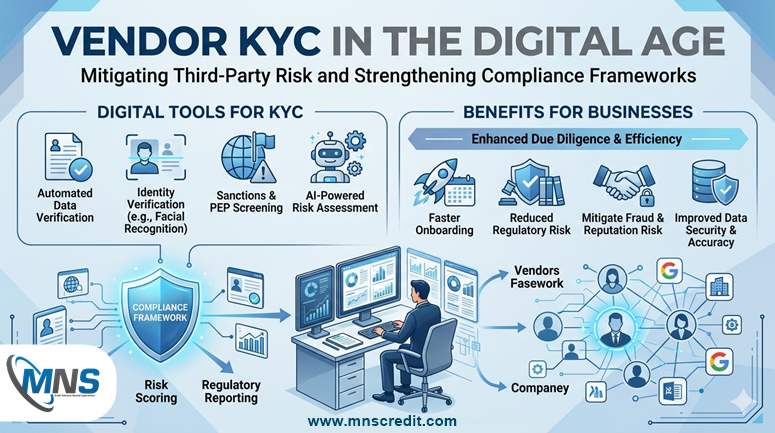
Vendor KYC — Know Your Business applied to the vendor relationship — encompasses the processes through which an organisation verifies the identity, legitimacy, compliance status, and risk profile of the vendors it engages or proposes to engage. In the digital age, this is a multi-layered process that goes significantly beyond the paper-based document collection that characterised vendor due diligence a decade ago.
Identity and legal verification confirms that the vendor is a legitimately registered entity, currently active and in good standing with the relevant regulatory authorities. For Indian vendors, this means cross-referencing stated corporate details against MCA Master Data — confirming registration numbers, checking active status, reviewing director history, and verifying that filing compliance is current. For international vendors, it requires access to equivalent registry data across the relevant jurisdictions, supported by global corporate verification platforms that can query multiple registries simultaneously.
Financial health assessment evaluates whether the vendor has the financial stability to fulfil their obligations reliably over the duration of the engagement. A vendor that is financially distressed — as revealed by deteriorating Financial Ratios in their filed accounts, adverse payment behaviour in trade credit data, or early warning signals in their corporate filing patterns — represents an operational risk that no contractual protection can fully mitigate. A Business Information Report that consolidates financial performance, payment behaviour, and corporate compliance data provides the most efficient foundation for this assessment.
Compliance and sanctions screening checks the vendor and its principal individuals against global sanctions lists, politically exposed persons databases, adverse media sources, and sector-specific regulatory watchlists. In an era of rapidly expanding sanctions programmes and increasingly extraterritorial enforcement of AML and anti-bribery regulations, this screening layer is not optional for any organisation with international supply chain exposure.
Technology as the Enabler of Scalable Vendor KYC
The fundamental challenge of vendor KYC at scale — managing verification requirements across hundreds or thousands of vendor relationships without creating operational bottlenecks or compliance gaps — has been transformed by digital technology. Automated verification platforms can process identity and registry checks, sanctions screening, and financial health assessments in minutes rather than days, at any volume, with a consistency and comprehensiveness that manual processes cannot match.
Risk-tiered automation further optimises the process: vendors are scored on a risk model that considers factors such as the value of the engagement, the degree of data or system access involved, the vendor's jurisdiction, and their business type — with lower-risk vendors processed through streamlined automated pathways and higher-risk relationships routed to enhanced due diligence workflows that incorporate manual review and additional verification steps. This tiering ensures that due diligence intensity is proportionate to actual risk rather than uniform across all vendor relationships regardless of their materiality.
Ongoing Monitoring: KYC as a Continuous Obligation
Vendor KYC is not a one-time onboarding exercise — it is a continuous obligation that must track changes in vendor risk profiles throughout the life of the relationship. A vendor whose compliance record was clean at onboarding may subsequently appear on a sanctions list, experience financial deterioration, or undergo ownership changes that would have triggered enhanced scrutiny if present at the time of initial assessment. Without ongoing monitoring, these changes accumulate undetected — creating the kind of third-party risk exposure that due diligence was supposed to prevent.
Digital monitoring platforms that apply automated screening to the existing vendor population on a continuous basis — updating risk scores when new adverse information emerges and triggering review workflows for significant changes — convert vendor KYC from a point-in-time compliance exercise into a genuinely dynamic risk management capability. This continuous dimension of vendor KYC is what distinguishes organisations that genuinely manage third-party risk from those that simply document their initial due diligence.
Building a Compliance Framework That Regulators Respect
Regulators across financial services, government contracting, and other regulated sectors are raising their expectations for third-party due diligence. A vendor KYC service that is documented, systematic, risk-tiered, and continuously monitored — and that can be evidenced to regulators through audit trails and compliance reports — demonstrates the organisational seriousness about third-party risk that regulatory and contractual frameworks increasingly require. The reputational and legal cost of a third-party compliance failure that occurs in the absence of adequate due diligence is consistently far greater than the investment in building a programme that prevents it.
Conclusion
Vendor KYC in the digital age is the frontline defence against the third-party risks that are increasingly central to enterprise risk management. Identity verification, financial health assessment, compliance screening, and continuous monitoring — executed through digital platforms that scale without sacrificing rigour — give organisations the confidence to build the extended enterprise relationships that modern business requires, without the unacceptable risk exposure that inadequate vendor due diligence creates. In a world where your vendors' risks are your risks, knowing your vendors has never mattered more.

 عربي
عربي