




 SPARK Website
 Opportunities
The supplier can ship part of the order today. Who pays for the second delivery?
Your shop needs 240 units. The supplier has 200 ready and offers to send the last 40 next week. That sounds like progress. Before you say yes, find the line in the quote that tells you what happens to the freight charge when one shipment becomes two.
Put both offers on the same line
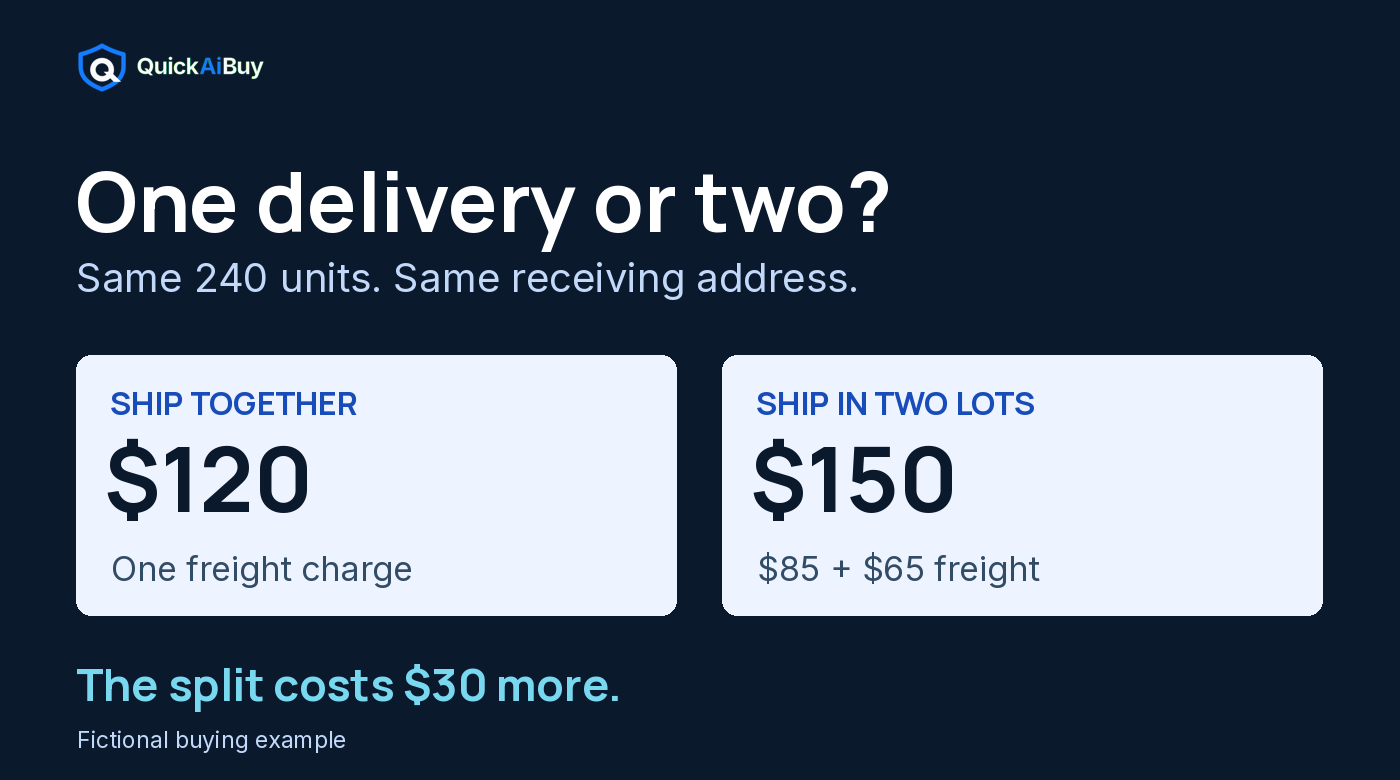
In this fictional exercise, sending all 240 units together costs $120 in freight to the shop. The split offer lists $85 for the first 200 units. The second freight line is blank. A buyer looking only at the first invoice might see a $35 saving. At this point, $35 is simply the most the second shipment can cost before the split becomes more expensive than the original arrangement.
Now the supplier comes back with $65 for the second leg, to the same address and with the same charge coverage. The split costs $150 in freight, or $30 more than the single shipment. That is 12.5 cents more per ordered unit. Keep the goods price separate so a change in freight is visible.
Find out what the extra $30 buys
The first 200 units may arrive in time for a committed order. They may also sit in the stockroom while an incomplete assortment delays the launch. The deciding evidence is the date those units can be received and used. A promise to dispatch on Friday gives the buyer a different planning date from a promise to arrive on Friday.
Ask the person receiving the goods how many units they can actually use early. If only 60 will go into committed orders, the additional freight is 50 cents per unit used early. The rest of the order still matters, but this second calculation helps the buyer judge the value of accelerating delivery.
Write the decision so another person can check it
A useful reply is short. “Please quote the 200-unit and 40-unit shipments separately, to the same receiving address. For each, confirm the expected arrival date, the freight amount and who pays it. We will confirm the split after reviewing both lines.” Keep the supplier’s reply with the original quote so the buyer can approve a specific revision.
For an international shipment, the U.S. International Trade Administration explains how agreed Incoterms allocate transport responsibilities and costs. Use the named term and location when comparing the two offers. The dollar amounts and delivery options above are teaching examples. Read the ITA guide to freight responsibilities.


 عربي
 French


This website is funded by the European Union, within the framework of the Green Forward programme, implemented at the meso level by SPARK in Jordan, Lebanon, Palestine, Morocco, Tunisia, and Egypt. Its contents are the sole responsibility of SPARK and do not necessarily reflect the views of the European Union.