




 SPARK Website
 Opportunities
Before You Pay the Supplier: What Would Make You Walk Away?
A practical decision card for founders buying their next batch
By Mohammad Maani, Founder of QuickAIBuy
The quotation is in your inbox. The supplier is following up. You have already pictured the product on your shelf, in your online store or inside your next customer order.
Before paying, try one uncomfortable question: what finding would make you change your mind?
If nothing comes to mind, your research may be collecting reasons to proceed rather than testing the purchase. A useful buying review should leave room for three outcomes: proceed within agreed conditions, change the commitment, or stop.
The takeaway
Write your purchase conditions before the deadline becomes urgent. Separate a missing answer from an unfavorable answer. Give each important uncertainty a specific next check.
Define the point of commitment
A purchase becomes harder to change at different moments: paying a deposit, approving a custom production run, accepting a delivery arrangement, or promising a customer a launch date.
Choose the moment that matters for your business. Then finish this sentence:
“Before we commit to ______, we need evidence that ______.”
Make the second blank testable. “The supplier seems reliable” is difficult to act on. “The written offer identifies the exact item and pack quantity we intend to order” gives someone a concrete document to check.
This is a working decision aid, not a supplier certification or a guarantee that an order will succeed.
Choose your conditions while you still have options
A good condition connects a fact to an action.
If the quoted pack size differs from the sample, pause the order until the difference is explained.
If delivery depends on an estimate, do not describe the arrival date to your customer as confirmed.
If a material charge remains unknown, keep the comparison open rather than filling the blank with zero.
If the evidence establishes a restriction that conflicts with your intended selling route, reconsider that route; another reassuring document does not erase the restriction.
These conditions should reflect the decision you are actually making. A small trial and a large custom order may warrant different commitments, but neither should quietly inherit evidence from a different product or destination.
A fictional case: the order that changed before payment
Imagine a small retailer preparing to buy 300 reusable fabric bags for a seasonal launch. This scenario is invented for education. It is not a QuickAIBuy customer case or a claim of savings.
The founder has a sample photograph, a quotation and a message saying delivery is “normally two weeks.” The quoted batch looks attractive.
Before paying, the founder writes three conditions: the quoted bags must match the sample specification; delivery assumptions must fit the launch plan; and the business must understand which charges are included.
The review reveals three different situations.
First, the quotation names a different fabric weight from the sample description. That is a conflict to reconcile, not a reason to choose whichever document feels more convincing.
Second, the delivery message does not identify whether the two weeks starts at payment, production completion or dispatch. That is an unanswered question.
Third, the supplier confirms that a requested customization is unavailable for this batch. That is an unfavorable answer for the original plan, not missing evidence.
The founder now has choices: revise the specification, move the launch date, seek a differently scoped offer, or decline this order. A smaller order might reduce the amount committed, but it would not resolve the specification conflict by itself.
No outcome is guaranteed. The value of the exercise is that the decision changes in response to evidence while the founder can still choose.
Keep three situations separate
A missing answer calls for a focused evidence request. Ask who can provide it, what it must cover and when you need it.
Conflicting answers call for reconciliation. Keep both sources visible and ask the relevant issuer to explain the difference. A newer date alone does not tell you that the older obligation or condition has disappeared.
An established unfavorable condition calls for a business decision. More research may clarify its scope, but it should not be used to wish the condition away.
These distinctions matter because “we need to check” is an inadequate response to every problem. Sometimes you need a document. Sometimes you need corrected terms. Sometimes you need a different plan.
Build a one-page decision card
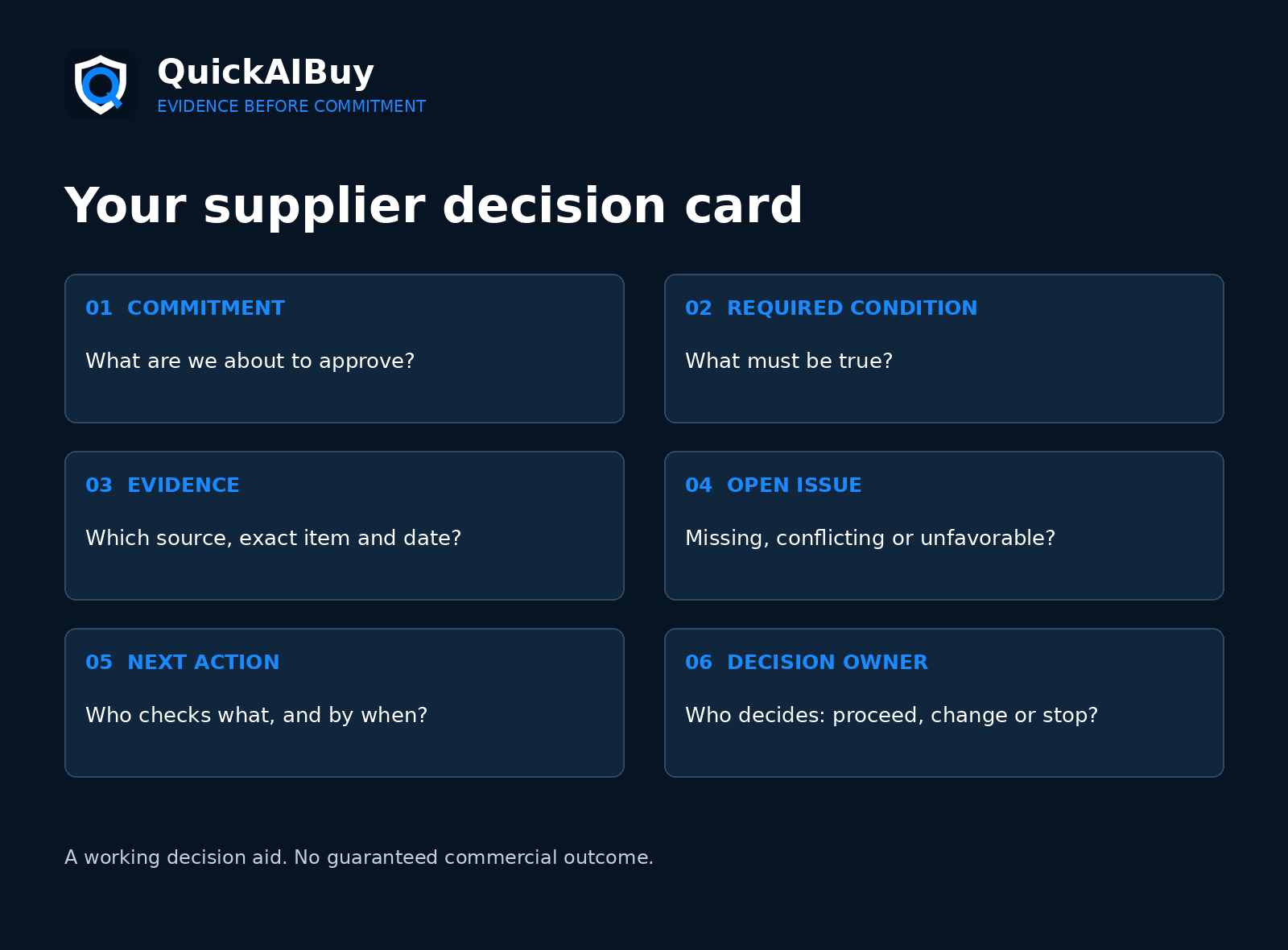
Keep the card short enough to discuss with a colleague before the payment decision.
Commitment: What exactly are we about to approve?
Required condition: What needs to be true for that commitment to make sense?
Evidence: Which source supports it, for which exact item and date?
Open issue: Is the answer missing, conflicting or unfavorable?
Next action: Who will obtain the answer or revise the plan, and by when?
Decision owner: Who decides whether to proceed, change or stop?
You can begin with the free “Before you order” worksheet on our Hub page, then add these commitment conditions beside the relevant questions.
Keep confidential quotes, account details and supplier documents in your own controlled records. A community discussion can share the lesson without exposing the transaction.
Use sustainability as a condition you can explain
If your business depends on a product’s environmental characteristic, write that characteristic precisely. What evidence would you need before relying on it in your purchase or repeating it in your own marketing?
For the fictional bags, fabric composition, expected use and the evidence behind any supplier claim are separate questions. Buying fewer items or choosing a reusable design does not, by itself, establish a measured environmental benefit.
This keeps sustainability connected to the actual purchase rather than using it as a reassuring label.
Know when the card needs updating
A decision card records a particular opportunity. Revisit it if the supplier changes the item, quantity, route, quotation validity or selling context.
Record what changed and which conclusion needs another check. There is no need to restart every piece of research, but there is a need to stop an old answer from silently approving a new commitment.
QuickAIBuy’s evidence methodology explains why source, exact subject, authority and freshness matter when evaluating a claim.
Bring the decision into focus
QuickAIBuy’s available External Product Review examines one defined B2B opportunity and provides a human-reviewed Decision Brief. It explains supported findings, material gaps or conflicts, and the checks that matter next. The broader platform remains in development.
If you are weighing a specific product or supplier offer, explore the External Product Review and its illustrative sample. Scope and timing are confirmed before paid work. The service does not guarantee savings, sales, supplier legitimacy or marketplace approval.
Before your next supplier payment, write one sentence: “We will change this purchase if ______.”
What would you put in that blank?

 عربي
 French


This website is funded by the European Union, within the framework of the Green Forward programme, implemented at the meso level by SPARK in Jordan, Lebanon, Palestine, Morocco, Tunisia, and Egypt. Its contents are the sole responsibility of SPARK and do not necessarily reflect the views of the European Union.