


 SPARK Website
Dental Disinfectants Market Size, Share & Growth Forecast Report 2026–2036
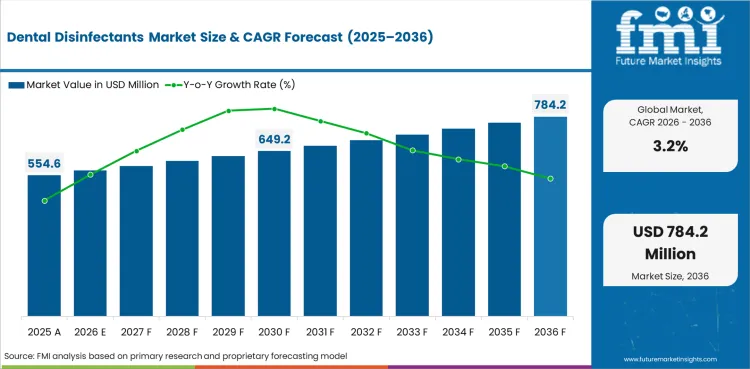
The global Dental Disinfectants Market, according to Future Market Insights, is witnessing steady growth, driven by increasing infection prevention requirements, stricter sterilization regulations, and rising demand for advanced dental hygiene solutions across clinics and hospitals. The market is projected to grow from USD 572.3 million in 2026 to USD 784.2 million by 2036, registering a CAGR of 3.2% during the forecast period.
The market is evolving as dental practices increasingly prioritize comprehensive infection control protocols to reduce cross-contamination risks during procedures. Advanced disinfectant solutions are becoming essential for surface sanitation, equipment sterilization, and hand hygiene across modern dental environments.
Request a Sample Report: https://www.futuremarketinsights.com/reports/sample/rep-gb-22306
Demand growth is being supported by expanding dental infrastructure, rising awareness of infection control, regulatory compliance requirements, and increasing adoption of specialized disinfectant formulations designed for dental applications.
As procurement becomes increasingly quality-driven, manufacturers with validated antimicrobial efficacy, regulatory compliance, reliable distribution, and cost-efficient formulations are expected to secure long-term competitive advantage.
Market Overview
The dental disinfectants market has become a strategically important segment within dental consumables and infection prevention products. Market value is increasingly driven by products that provide broad-spectrum antimicrobial protection, fast action, material compatibility, and operational efficiency.
The market is expected to rise from USD 572.3 million in 2026 to USD 784.2 million by 2036, supported by expanding dental treatment volumes and stricter sanitation standards.
Unlike general cleaning agents, dental disinfectants are specifically formulated to eliminate bacteria, viruses, fungi, and biofilm contaminants from clinical surfaces and instruments. As a result, market leadership increasingly depends on suppliers capable of combining high efficacy with safety and workflow convenience.
Key Growth Drivers
A major growth catalyst is the increasing emphasis on infection prevention and sterilization compliance across dental practices.
The rising volume of dental procedures, including restorative, cosmetic, and surgical interventions, is another major driver, increasing the need for effective disinfection protocols.
Growing awareness around cross-contamination risks in dental settings is accelerating adoption of specialized disinfectants for equipment and surface sanitation.
Expanding dental infrastructure in emerging economies is also supporting market growth as new clinics and hospitals implement modern hygiene protocols.
Technology & Innovation Trends
Innovation in the dental disinfectants market is centered around rapid-action formulations, material compatibility, and workflow efficiency.
Hydrogen peroxide-based and chlorhexidine-based solutions are gaining traction due to strong antimicrobial performance and broad clinical applicability.
Advanced enzymatic detergents are improving cleaning efficiency by targeting biofilm and organic residue on dental instruments.
Ready-to-use disinfectant wipes and sprays are becoming increasingly popular because they reduce preparation time and improve compliance with infection control protocols.
Manufacturers are also developing eco-friendly and low-residue disinfectants that minimize equipment corrosion while maintaining sterilization performance.
Market Challenges & Restraints
Despite stable growth potential, the market faces several structural challenges.
One major restraint is price sensitivity among institutional buyers, particularly in cost-sensitive healthcare markets.
Competition from low-cost general disinfectants continues to pressure specialized dental disinfectant adoption in certain segments.
Regulatory compliance, certification requirements, and formulation validation increase commercialization complexity.
Procurement consolidation among large dental chains and hospitals is also intensifying pricing pressure.
Explore the Latest Healthcare Industry Analysis Now: https://www.futuremarketinsights.com/industry-analysis/healthcare
Segment Analysis
The dental disinfectants market is segmented by product type, application, form, end user, and region.
By Product Type
Dental Cleaners & Disinfectants are projected to account for 55.5% market share in 2026, supported by broad adoption across major dental hygiene applications.
Other major product segments include:
- Isopropyl Alcohol-Based Products
- Hydrogen Peroxide-Based Solutions
- Glutaraldehyde-Based Agents
- Chlorhexidine-Based Disinfectants
- Ethyl Alcohol
- Dental Detergents
- Enzymatic Detergents
- Neutral Detergents
By Application
Surface Disinfection is expected to dominate with 40.4% market share in 2026, driven by stringent hygiene requirements for treatment areas.
Other key applications include:
- Equipment Cleaning
- Hand Hygiene
By Form
Major product forms include:
- Liquid Solutions
- Wipes
- Gels
- Sprays
- Foams
- Tablets
Regional Analysis
Regional growth increasingly depends on healthcare hygiene regulations, dental infrastructure expansion, and procurement modernization.
- India remains the fastest-growing major market and is expected to grow at 6.5% CAGR through 2036, supported by expanding dental infrastructure and rising infection control awareness.
- China is projected to grow at 6.1% CAGR, driven by rapid healthcare modernization and increasing dental service capacity.
- Japan is expected to grow at 3.6% CAGR, supported by high clinical hygiene standards and replacement demand.
- United States is forecast to expand at 2.0% CAGR, driven by stable procurement from dental chains and institutional buyers.
- Germany is projected to grow at 1.8% CAGR, supported by strong compliance requirements and mature dental care infrastructure.
Europe remains the largest regional market due to strict disinfection protocols and advanced dental healthcare systems.
Competitive Landscape
Competition is intensifying among global infection-control manufacturers and specialized dental hygiene suppliers.
Competitive advantage increasingly depends on:
- Antimicrobial efficacy
- Product safety
- Material compatibility
- Distribution strength
- Cost efficiency
As dental procurement becomes increasingly performance-driven, manufacturers must deliver value beyond basic sanitation.
Leading Companies Analysis
Key market participants include STERIS plc, Getinge AB, and Hu-Friedy, all of which maintain strong infection-control portfolios and global market presence.
Other important participants include:
Investment & Strategic Developments
Investment activity is accelerating in advanced disinfectant formulations, biofilm-targeting chemistries, and eco-friendly sanitation products.
Strategic focus is increasingly shifting toward improving cleaning efficiency, reducing workflow disruption, and minimizing material degradation.
Long-term investment is also focused on ready-to-use solutions that improve compliance and reduce operational complexity.
Investors are paying close attention to regulatory approvals, formulation innovation, and emerging market expansion, as these factors strongly influence long-term commercial success.
Read Full Report: https://www.futuremarketinsights.com/reports/dental-disinfectants-market
Future Outlook
The dental disinfectants market is expected to become increasingly innovation-driven over the next decade.
Future growth will be shaped by:
- Expansion of advanced disinfectant chemistries
- Rising infection-control standards
- Growth in dental treatment volumes
- Increased adoption of wipes and sprays
- Stronger emerging-market demand
The industry is likely to continue shifting toward premium hygiene solutions with improved antimicrobial efficacy, safety, and workflow convenience.
Conclusion
The Dental Disinfectants Market is transitioning from a conventional hygiene consumables category into a high-value infection-control segment.
With the market projected to grow from USD 572.3 million in 2026 to USD 784.2 million by 2036, long-term growth remains steady.
Demand is increasingly tied to sterilization efficiency, compliance, and operational reliability rather than traditional cleaning solutions alone. Companies capable of combining formulation innovation with strong distribution and regulatory compliance will be best positioned to lead the next phase of market growth.
Related Reports:
· Demand for Dental Floss in USA - https://www.futuremarketinsights.com/reports/united-states-dental-floss-market
· Demand for Dental Floss in Japan - https://www.futuremarketinsights.com/reports/japan-dental-floss-market
· Bladder Cancer Array Market - https://www.futuremarketinsights.com/reports/bladder-cancer-array-market
· Dental Oral Microbiome Market - https://www.futuremarketinsights.com/reports/dental-oral-microbiome-market
· Denture Care Market - https://www.futuremarketinsights.com/reports/denture-care-market
About Future Market Insights (FMI)
Future Market Insights is a leading provider of market intelligence and consulting services, serving clients in over 150 countries. Headquartered in Newark, with a global delivery center in Pune and offices in the United Kingdom and United Arab Emirates, FMI delivers actionable insights across industries including agriculture, chemicals, healthcare, and consumer goods.
Contact Us
Future Market Insights Inc.
Christiana Corporate, 200 Continental Drive, Suite 401
Newark, Delaware – 19713, USA
T: +1-347-918-3531
For Sales Enquiries: sales@futuremarketinsights.com

 عربي
عربي