


 SPARK Website
How Digital Product Design Speeds Up Manufacturing Success
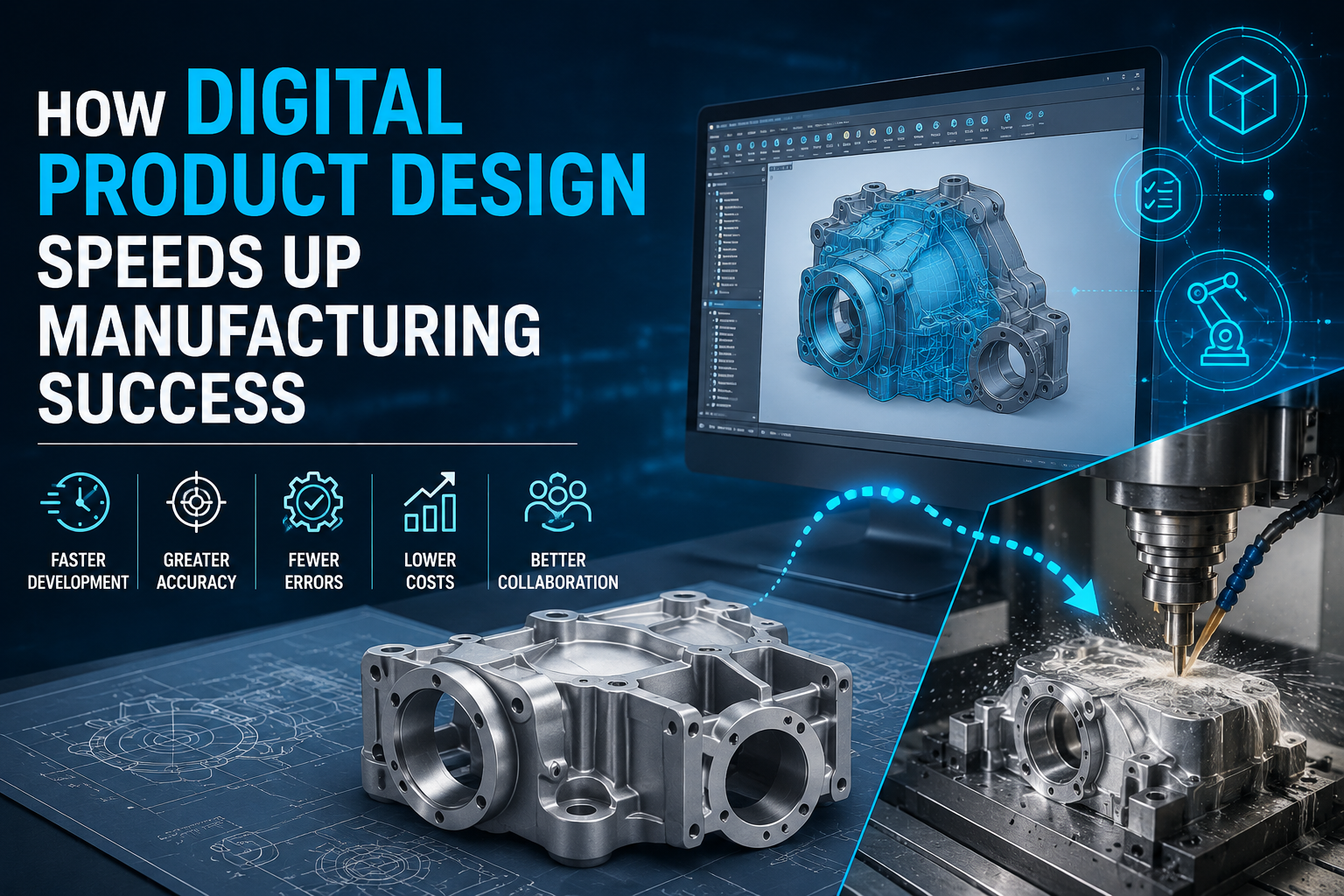
In today's competitive manufacturing landscape, speed and precision are no longer optional—they're essential. Companies that can move from concept to production faster gain a significant competitive advantage. This is where digital product design plays a transformative role.
By leveraging advanced design technologies such as 3D CAD modeling, simulation, and virtual prototyping, manufacturers can reduce development time, minimize costly design errors, and improve collaboration across teams. As industries continue embracing digital transformation, digital product design has become the foundation for faster, smarter manufacturing.
What Is Digital Product Design?
Digital product design is the process of creating, testing, and refining products using computer-aided technologies before any physical manufacturing begins. Instead of relying on traditional sketches and multiple physical prototypes, engineers create detailed digital models that accurately represent the final product.
These models allow manufacturers to:
- Visualize complex components
- Validate product performance
- Detect design flaws early
- Optimize manufacturability
- Improve collaboration between engineering and production teams
According to Goodwin University, Computer-Aided Design (CAD) enables engineers to create detailed 2D drawings and 3D models that significantly improve visualization before fabrication begins.
Source: https://www.goodwin.edu/enews/why-is-computer-aided-design-cad-important/
Faster Product Development Through Digital Design
Traditional product development often involves several rounds of physical prototyping, testing, redesign, and manufacturing adjustments. Each iteration increases costs and extends the production timeline.
Digital product design shortens this cycle by allowing engineers to:
- Test ideas virtually
- Modify designs instantly
- Simulate real-world performance
- Share updates across departments in real time
Virtual design iterations take hours instead of weeks, enabling products to reach the market much faster.
Reducing Manufacturing Errors
Manufacturing defects frequently originate from design inaccuracies. Even minor dimensional errors can lead to expensive production delays or product recalls.
Digital product design dramatically reduces these risks by enabling:
- Accurate dimensional control
- Automated interference detection
- Assembly validation
- Material analysis
- Stress and performance simulations
By identifying issues before production begins, manufacturers avoid unnecessary tooling modifications and production downtime.
Research from CAD Crowd highlights that 3D CAD modeling allows companies to identify defects and improve designs without producing multiple physical prototypes.
The Importance of 3D CAD Modeling
One of the most valuable components of digital product design is 3d cad modeling services High-quality CAD models serve as the digital blueprint for manufacturing, ensuring every component is accurately represented before production begins.
Professional CAD modeling provides benefits such as:
- Precise engineering drawings
- Parametric design flexibility
- Easy design revisions
- Improved communication between stakeholders
- Compatibility with CNC machining and 3D printing
- Better documentation for manufacturing teams
Whether developing consumer products, industrial equipment, or automotive components, accurate CAD models create a smoother transition from design to production.
Improved Collaboration Across Teams
Modern manufacturing involves multiple departments, including:
- Industrial designers
- Mechanical engineers
- Electrical engineers
- Manufacturing specialists
- Suppliers
- Quality assurance teams
Digital product design creates a centralized source of product information, ensuring everyone works from the same updated model.
Cloud-based CAD platforms also allow distributed teams to collaborate regardless of location, reducing communication delays and preventing costly version-control issues.
Virtual Prototyping Saves Time and Money
Building multiple physical prototypes is one of the most expensive stages of product development.
Digital product design replaces much of this process with virtual prototyping.
Engineers can evaluate:
- Structural integrity
- Assembly fit
- Motion analysis
- Thermal behavior
- Load distribution
- Manufacturability
Only after the design is fully validated does physical production begin.
According to Autodesk's Digital Prototyping overview, virtual testing significantly reduces the number of physical prototypes required while shortening product development cycles.
Source: https://en.wikipedia.org/wiki/Digital_prototyping
Better Manufacturing Planning
Manufacturing success depends on more than a good design—it also requires efficient production planning.
Digital product models help manufacturers:
- Estimate material requirements
- Plan machining operations
- Optimize tooling
- Improve assembly workflows
- Reduce production waste
Because production teams receive detailed digital information early in the process, they can prepare manufacturing operations before production officially begins.
Supporting Industry 4.0
Digital product design is a critical element of Industry 4.0, where connected manufacturing systems rely on accurate digital data throughout the product lifecycle.
Modern digital workflows integrate with:
- Digital twins
- Smart factories
- CNC machining
- Additive manufacturing
- Robotics
- Automated inspection systems
These technologies rely on accurate CAD data to automate production while maintaining consistent quality.
Enhancing Product Quality
Quality begins during design—not during inspection.
Digital design tools help engineers optimize products by:
- Improving component fit
- Eliminating unnecessary complexity
- Optimizing weight
- Improving durability
- Validating compliance requirements
The result is fewer manufacturing defects and more reliable products.
Reducing Costs Throughout Production
Every design change made after production begins can become extremely expensive.
Digital product design minimizes these late-stage revisions by validating designs early.
Manufacturers benefit from:
- Lower prototyping costs
- Reduced material waste
- Fewer engineering change orders
- Less machine downtime
- Shorter production cycles
- Lower overall development expenses
This improves profitability while allowing companies to respond more quickly to changing customer demands.
Future-Proofing Manufacturing
As manufacturing becomes increasingly digital, companies investing in digital product design position themselves for long-term success.
Emerging technologies such as AI-assisted design, generative engineering, simulation-driven optimization, and digital twins will continue making product development faster and more efficient.
Organizations that establish strong digital design workflows today will be better prepared to adopt these future innovations.
Conclusion
Digital product design has fundamentally transformed modern manufacturing by reducing development time, improving product quality, and minimizing production costs. From virtual prototyping and simulation to collaborative CAD workflows, digital tools allow manufacturers to identify problems early and move confidently into production.
Among these technologies, professional 3d cad modeling services remain one of the most valuable investments for companies seeking greater manufacturing efficiency. Accurate digital models create the foundation for streamlined production, better collaboration, and faster product launches—helping manufacturers stay competitive in an increasingly demanding marketplace.
References
- Goodwin University – Why is Computer-Aided Design (CAD) Important to Manufacturing?
https://www.goodwin.edu/enews/why-is-computer-aided-design-cad-important/ - CAD Crowd – How 3D CAD Modeling is Transforming Design and Manufacturing Industries
https://www.cadcrowd.com/blog/how-3d-cad-modeling-is-transforming-design-and-manufacturing-industries-at-design-companies/ - Autodesk/Digital Prototyping Overview
https://en.wikipedia.org/wiki/Digital_prototyping

 عربي
عربي