


 SPARK Website
Quick Guide to Your Best Website Choice
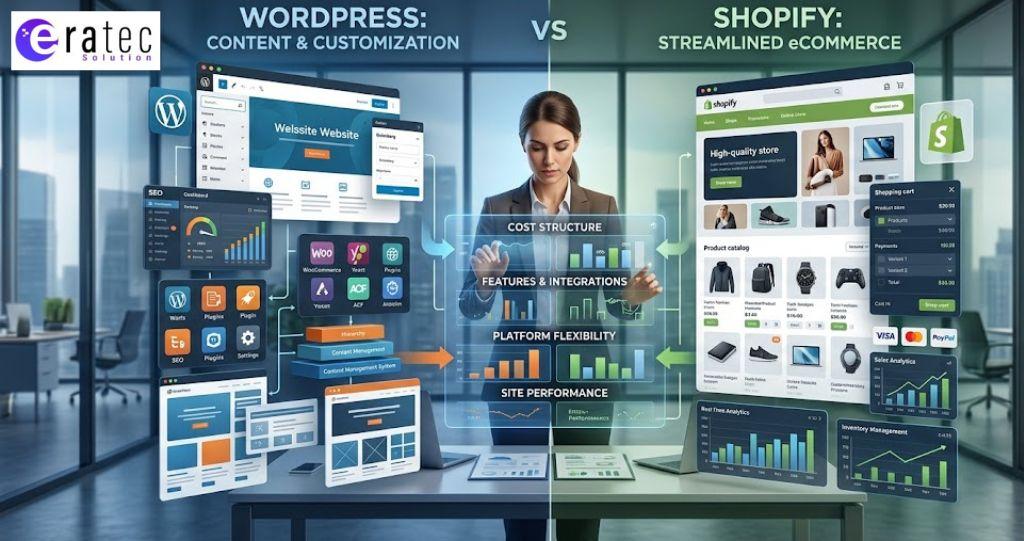
Building an online presence is no longer just an option for businesses—it is the foundation of growth. However, when you step into the world of web development, you are immediately confronted with a classic dilemma: Should you build your digital home on WordPress or Shopify? Both platforms are incredibly successful, but they treat web architecture in fundamentally different ways.
Choosing the right ecosystem dictates your monthly costs, your long-term search engine visibility, and how much control you have over your visual identity. Let’s break down how they stack up in a few critical areas.
The Financial Blueprint: Upfront vs. Recurring Costs
WordPress itself is an open-source software, meaning the core tool is entirely free. However, your actual expenses depend on your infrastructure. You will need to budget for custom domain registration, web hosting, premium templates, and advanced plugins. Because of this modular structure, you have full control over your spending.
Shopify, by contrast, operates on a predictable, all-inclusive software-as-a-service (SaaS) monthly subscription model. This fee covers your hosting and security features right out of the box. While this simplifies budgeting early on, the recurring costs can scale upward quickly as you add specialized applications to your storefront.
Freedom of Design and Functionality
If your business demands a unique visual identity, customization is where the platforms diverge drastically. WordPress provides total authority over the underlying source code. You can manipulate every pixel, create complex page layouts, and engineer bespoke user experiences. For brands wanting a highly specific digital footprint, partnering with premium WordPress Website Design & Shopify Website Design Services ensures that your aesthetic vision aligns perfectly with robust technical performance.
Shopify approaches design through structured efficiency. It features an intuitive, beginner-friendly drag-and-drop customizer tailored for retail. While it handles standard product grids and checkout funnels flawlessly, making deep changes to underlying core layouts requires navigating its proprietary coding language, Liquid.
The Verdict: Aligning with Your Goals
Ultimately, there is no single winner—only the system that mirrors your operations. If your primary objective is a content-rich business ecosystem, a custom corporate layout, or deep SEO scalability, WordPress is your ideal match. If you want a fast, secure, and hassle-free online store built explicitly for transactional retail, Shopify shines. Whichever path you choose, high-tier execution is what transforms a basic template into a conversion engine.

 English