


 SPARK Website
Best Machine Learning and Skill-Based Courses After 12th in 2026
Best Machine Learning and Skill-Based Courses After 12th in 2026 — What Nobody Actually Tells You
My younger brother gave me a call last month. Results were out, he got 78% in PCM, JEE didn't go well, and his entire friend group had scattered into different colleges. He asked me the same question half a million 12th pass students ask every June — "bhai, ab kya karoon?"
I told him the same thing I'm going to tell you here.
Stop chasing the plan your parents have been running since you were in Class 9. That plan was built for a job market that doesn't fully exist anymore. In 2026, the fastest-growing salaries belong to people who built skills early — not people who waited four years for a degree to do it for them.
This isn't motivational content. This is just what's actually happening out there.
First, Why Machine Learning Specifically?
Look, I'm not going to throw statistics at you and pretend that makes this personal. But think about it practically.
Every app you use right now—Swiggy telling you your food arrives in 20 minutes, YouTube knowing what you'll watch next, your spam folder somehow catching that sketchy email — all of that runs on machine learning. Healthcare, banking, logistics, and agriculture in India — all of it is being rebuilt around ML right now.
Companies need people who understand this stuff. And there aren't enough of them. That's the whole story.
The part people miss is that you don't need to be a topper or an IITian to get into this. Five years ago that was somewhat true. Today it isn't. The courses available for free or cheap in 2026 are genuinely good — better than what engineering students were getting in classrooms six years ago.
You just have to actually do them. Which, fair warning, most people don't.
The Courses Worth Your Time (And Which Ones Aren't)
There's a lot of garbage out there. "Learn ML in 7 days!" type content that teaches you nothing except how to copy-paste code without understanding it. Ignore all of that.
Here's what's actually worth your time:
Google's Machine Learning Crash Course — Start Here, It's Free
Don't let the word "crash course" fool you — this is a serious piece of content that Google originally built for their own engineers. It covers how models work, linear regression, classification, neural networks, and even touches on LLMs and production ML systems in its newer version. Interactive widgets, real diagrams, short lessons. Nothing flashy, just solid.
It won't make you job-ready alone, but it'll tell you within three weeks whether this subject clicks for you or bores you to death. That information is worth a lot.
Andrew Ng's Machine Learning Specialization — The One Everyone Mentions for a Reason
Andrew Ng is to ML what RD Sharma is to 11th math — not perfect, but the foundation almost everyone builds on. His Coursera specialization runs about eleven weeks and covers supervised learning, unsupervised learning, reinforcement learning, recommender systems — the core stuff.
What makes it work isn't just the content. It's that he explains why things work the way they do, not just how to run the code. That difference matters when you're actually trying to solve a real problem six months from now.
DataCamp's Supervised Learning with Scikit-Learn — Best for People Who Learn by Doing
If watching videos makes your attention wander, this one's different. You write actual code in the browser from the first lesson. No setup, no environment issues, just you and the exercises. Multiple independent rankings put it at the top of ML courses for 2026 specifically because of how much students actually retain versus just watching and nodding along.
The downside is it's subscription-based. Use the free trial well.
Fast.ai — If You're a Bit Impatient (Like Most People)
This one flips the usual approach completely. Day one, you train a working image classifier before they explain what a neural network is. Then they work backwards. Uses PyTorch and Hugging Face, which are what actual ML engineers use at work — not toy tools.
Some people hate this approach. Others love it. If you're someone who needs to see a thing working before you care about understanding it, try this one.
Kaggle's Free Intro Course — Seven Lessons, No Excuses
Kaggle is where data scientists compete using real datasets. Their beginner course is literally seven lessons — decision trees, random forests, model validation — and it dumps you right into a real competition at the end. Completely free. Takes maybe two weekends.
If you're not sure whether you want to commit to a longer program, do this first. It'll show you what the actual work feels like.
Udemy Bootcamps — When Budget Is Real
A 50-hour ML course on Udemy goes for under ₹500 on most sale days, which is basically every day if you know where to look. The Complete A.I. & Machine Learning, Data Science Bootcamp covers Python, TensorFlow, Pandas, and real datasets in one go.
Not as structured as Coursera. But if you're disciplined, you can get a lot out of it for a fraction of the cost.
The Skills That Actually Get You Hired Alongside ML
Here's something the course ads don't say: ML alone doesn't get you a job. What gets you a job is ML combined with one more thing.and skill based courses
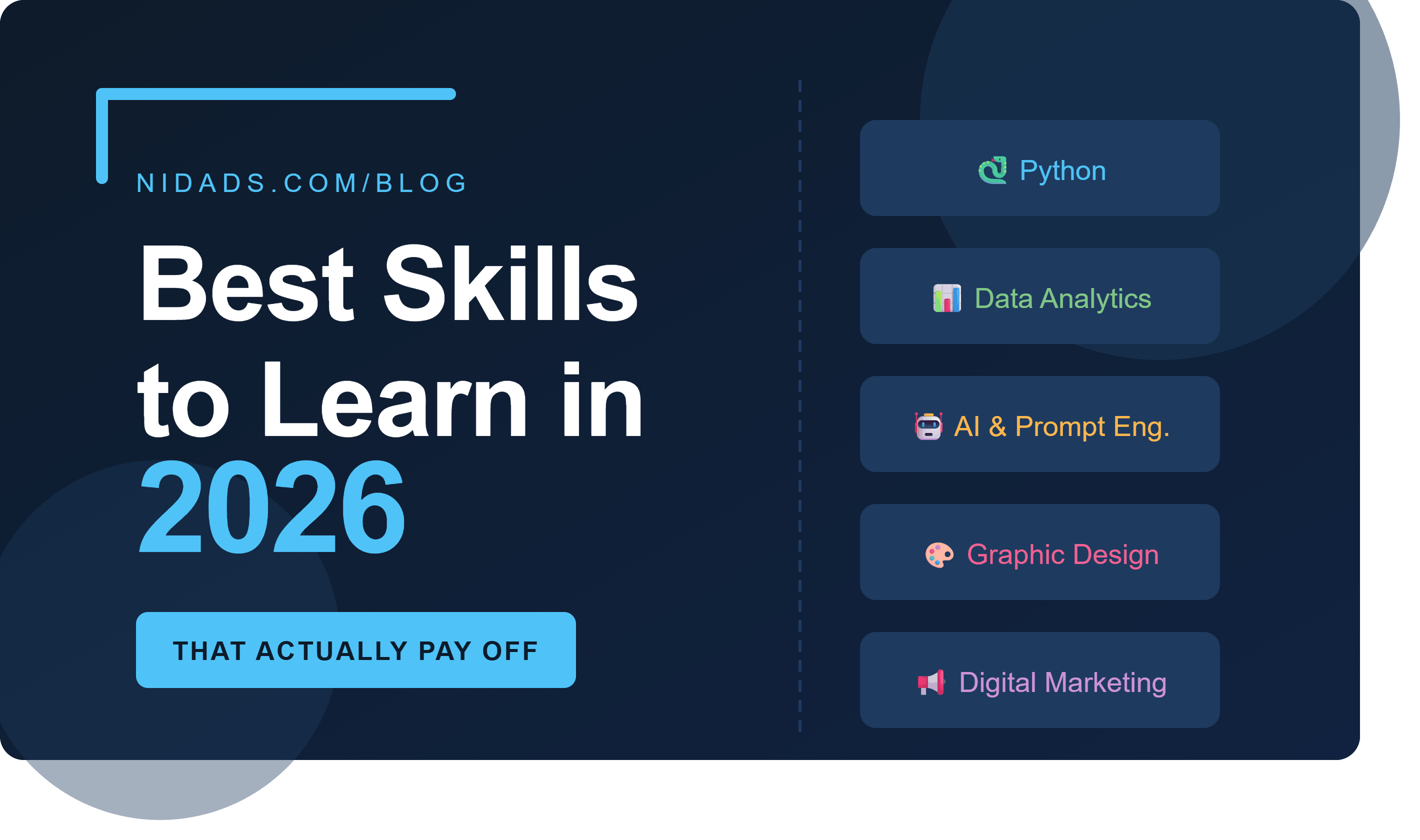
Python first, always. You can't meaningfully do ML without it. The good news — Python is the most beginner-friendly serious programming language out there. Two months, consistent practice, you'll be comfortable. YouTube, Kaggle, DataCamp all have free Python tracks. Pick one, stick to it.
Data literacy is underrated. Cleaning messy data, understanding what a dataset is actually telling you, knowing when a result looks wrong — this is 70% of what an ML job actually involves. Nobody glamourizes it but employers absolutely notice when you have it.
UI/UX with AI tools is a weird but real combo. AI-built products still need someone to think about how humans interact with them. If you have any design sense at all, this pairing — understanding ML outputs + designing how they're presented — is rare and companies will pay for it.
Digital marketing with AI tools is the path if code feels like too much right now. Modern digital marketing runs on AI for content, targeting, and SEO. Freelancers with this skill set are making decent money within 12 months of starting. Seriously.
Okay But What About a Proper Degree?
Valid question. A B.Tech in CS or AI/ML from a decent college still opens doors that certifications sometimes don't — certain government roles, some MNC hiring pipelines, and the general credential that your parents and relatives will stop asking about.
Realistic starting salary from a good CS program is 10–20 LPA. Top placements at colleges like Chandigarh University touched 54 LPA in 2024–25 with companies like Microsoft and Amazon. Those are real numbers, not made-up brochure figures.
But four years is four years. And a focused certification track plus real projects can get you into an entry-level role or stable freelance income in 12–18 months. Both paths work. Neither is automatically better.
What a lot of smart students are doing now is both at once — a BCA or B.Sc while building ML skills on the side. You graduate with a degree AND an actual portfolio. That combination is genuinely hard to ignore in an interview.
Stop Researching, Start Somewhere
The honest problem isn't that students don't know what to do after 12th. It's that they spend six months reading about it and doing nothing.
Month one and two: learn Python. Just Python. Free resources everywhere. Month three to five: pick one ML course from the list above and actually finish it. Month six onward: build one project with a real dataset from Kaggle. It doesn't have to be impressive. It has to be yours. Month eight or nine: put it on GitHub. Write two lines about what you learned. That's a portfolio.
That's the whole plan. No special talent required. No perfect conditions. Just doing the thing when you don't feel like it.
Where This Actually Goes
In 2026, the students who will look back and feel good about this decision aren't going to be the ones who picked the most prestigious-sounding course name. They're going to be the ones who started building things in their first year after school, figured out what they liked, and kept going.
Machine learning plus a skill that matches your personality — that combination puts you ahead of most graduates, not just most 12th pass students.
One course. This week. Everything else figures itself out once you start moving.
Which stream are you from, and what's confusing you the most right now? Drop it in the comments — happy to point you toward something specific.

 English