


 SPARK Website
EV Charging Infrastructure Market Trends 2026: Ultra-Fast Charging, AI-Powered Energy Management, and V2G Technology Drive Growth
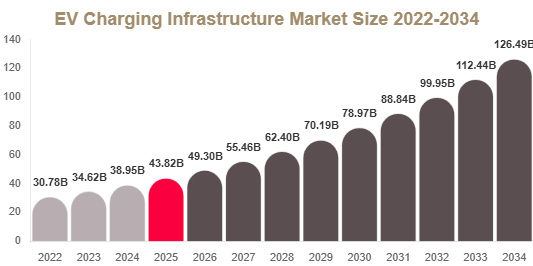
EV Charging Infrastructure Market Size, Share & Growth Analysis Report 2025–2034
Market Overview
The EV Charging Infrastructure Market is witnessing substantial growth as governments, automotive manufacturers, utilities, and private investors accelerate efforts to support global electric vehicle adoption. Charging infrastructure serves as the backbone of the electric mobility ecosystem by enabling reliable and convenient charging solutions across residential, commercial, and public locations. The increasing transition toward sustainable transportation and stricter emission reduction targets are creating strong demand for advanced charging networks worldwide.
Report Link: https://www.redlinepulse.com/report/ev-charging-infrastructure-market
As electric vehicle ownership continues to expand, the need for accessible and efficient charging facilities has become increasingly important. Charging infrastructure not only supports daily vehicle operations but also plays a critical role in reducing range anxiety among consumers. Investments in public charging stations, highway charging corridors, and workplace charging facilities are expanding rapidly, creating a strong foundation for future market growth.
Technological advancements in fast-charging systems, smart charging solutions, and energy management platforms are further transforming the industry. Infrastructure providers are focusing on improving charging speed, operational efficiency, and user experience while integrating renewable energy solutions and grid management capabilities. These developments are expected to strengthen the market throughout the forecast period.
Market Size and Forecast
The global EV Charging Infrastructure Market was valued at USD 42.6 billion in 2025 and is projected to reach USD 49.3 billion in 2026. The market is anticipated to reach USD 138.7 billion by 2034, expanding at a CAGR of 12.5% during the forecast period from 2025 to 2034.
The impressive growth trajectory reflects increasing electric vehicle sales, substantial public and private investments in charging networks, and continuous advancements in charging technologies. Governments across major economies are implementing supportive policies and infrastructure development programs to accelerate transportation electrification. These initiatives, combined with growing consumer demand for electric vehicles, are expected to generate sustained demand for charging infrastructure solutions globally.
Market Drivers
Rising Global Adoption of Electric Vehicles
The increasing adoption of electric vehicles remains one of the primary drivers of the EV Charging Infrastructure Market. Governments worldwide continue promoting vehicle electrification through incentives, environmental regulations, and fuel economy standards. Consumers are increasingly choosing electric vehicles due to lower operating costs and growing environmental awareness.
As electric vehicle sales rise, the demand for accessible and reliable charging infrastructure expands accordingly. Public and private stakeholders are investing heavily in charging networks to support growing vehicle populations. The direct relationship between EV adoption and charging demand ensures a strong growth outlook for the charging infrastructure sector throughout the forecast period.
Government Investments and Infrastructure Development Programs
Government-backed infrastructure initiatives are playing a vital role in market expansion. National and regional authorities are allocating significant funding toward charging station deployment to support transportation electrification goals. These programs include grants, subsidies, tax incentives, and public-private partnerships that encourage investment in charging infrastructure.
Governments are focusing on expanding charging accessibility across urban centers, residential communities, highways, and underserved regions. Such initiatives reduce investment risks and encourage broader participation from infrastructure providers, technology companies, and energy operators. As countries continue pursuing net-zero emission objectives, public investment in charging infrastructure is expected to remain a major market growth catalyst.
Market Challenges
High Infrastructure Deployment Costs
Despite strong growth prospects, high infrastructure deployment costs remain a significant challenge for the EV Charging Infrastructure Market. The installation of charging stations involves equipment procurement, grid connectivity upgrades, site preparation, permitting requirements, software integration, and ongoing maintenance expenses.
Fast-charging and ultra-fast charging stations often require substantial electrical infrastructure investments, increasing project complexity and capital requirements. Infrastructure operators may experience extended return-on-investment periods, particularly in regions where electric vehicle adoption is still developing. These financial considerations can limit deployment speed and create challenges for smaller operators seeking to expand charging networks.
Buy Now Link: https://www.redlinepulse.com/report/ev-charging-infrastructure-market/buy-now
Market Opportunities
Growth of Fleet Electrification Initiatives
Fleet electrification represents one of the most significant opportunities within the EV Charging Infrastructure Market. Logistics providers, public transportation agencies, delivery companies, and municipal organizations are increasingly transitioning toward electric fleets to reduce emissions and operating expenses.
These organizations require dedicated charging facilities capable of supporting large vehicle fleets and predictable charging schedules. Charging infrastructure providers are developing customized solutions that include fleet charging systems, energy management software, and operational optimization platforms. As commercial vehicle electrification accelerates globally, demand for specialized charging infrastructure is expected to increase substantially.
Development of Vehicle-to-Grid Ecosystems
Vehicle-to-grid technology is emerging as an important opportunity for the charging infrastructure sector. This technology enables electric vehicles to exchange electricity with the grid, transforming EV batteries into distributed energy storage assets that can support grid stability and energy management.
Infrastructure equipped with bidirectional charging capabilities can facilitate renewable energy integration, peak demand management, and energy balancing services. Utilities and energy providers are actively exploring vehicle-to-grid applications as part of broader energy transition strategies. As regulatory frameworks evolve and compatible vehicles become more widely available, demand for advanced charging infrastructure supporting bidirectional energy flows is expected to grow significantly.
Market Segmentation
By Charger Type
The DC Fast Charging segment dominated the EV Charging Infrastructure Market with a market share of 46.82% in 2025. These charging systems are widely deployed across highways, commercial facilities, and public charging hubs due to their ability to significantly reduce charging times. Increasing demand for convenient charging solutions and expansion of long-distance charging corridors continue supporting segment growth.
The Ultra-Fast Charging segment is projected to register the fastest CAGR of 15.2% through 2034. Rising demand for charging systems capable of delivering substantial vehicle range within a short period is driving growth. Investments from governments and charging network operators are accelerating deployment across multiple regions.
Other charger type segments include:
-
AC Charging
-
DC Fast Charging
-
Ultra-Fast Charging
By Installation Type
Public Charging Stations dominated the market with a revenue share of 58.64% in 2025. Public infrastructure plays a critical role in supporting EV adoption by providing accessible charging options for users without dedicated residential charging facilities. Governments and private operators continue expanding charging networks across cities, transportation hubs, retail centers, and highway corridors.
Commercial Charging Stations are expected to witness the fastest growth, expanding at a CAGR of 14.1% through 2034. Businesses are increasingly investing in charging facilities to support employees, customers, and fleet operations while advancing sustainability goals.
Installation type segments include:
-
Residential Charging Stations
-
Public Charging Stations
-
Commercial Charging Stations
By Connector Type
CCS Connectors accounted for the largest market share of 39.71% in 2025. The connector standard supports both AC and DC charging applications and is widely adopted across numerous electric vehicle models and charging networks. Regulatory support and industry standardization initiatives continue strengthening CCS adoption globally.
NACS Connectors are projected to record the fastest CAGR of 16.3% through 2034. Increasing vehicle compatibility and growing infrastructure deployment are supporting expansion. Charging operators are increasingly incorporating NACS-compatible solutions to enhance interoperability and improve customer accessibility.
Connector type segments include:
-
CCS Connectors
-
CHAdeMO Connectors
-
NACS Connectors
-
GB/T Connectors
Regional Analysis
North America
North America accounted for 24.67% of the EV Charging Infrastructure Market in 2025 and is projected to expand at a CAGR of 13.21% through 2034. Strong government incentives, rising electric vehicle adoption, and substantial investments from private companies are supporting regional growth. Charging operators continue expanding infrastructure across highways, urban centers, workplaces, retail locations, and residential communities.
The United States dominates the regional market due to extensive infrastructure funding programs and rapid electric vehicle deployment. The expansion of interstate fast-charging corridors designed to support long-distance EV travel is creating significant growth opportunities and improving charging accessibility nationwide.
Europe
Europe represented 27.84% of global market revenue in 2025 and is expected to grow at a CAGR of 12.4% through 2034. Strong environmental regulations, ambitious carbon reduction targets, and widespread electric vehicle adoption continue driving investments in charging infrastructure across the region.
Germany remains the leading country within Europe due to its advanced automotive sector and commitment to transportation electrification. The integration of renewable energy sources into charging infrastructure projects is creating unique growth opportunities while supporting sustainable mobility and grid decarbonization objectives.
Asia Pacific
Asia Pacific dominated the EV Charging Infrastructure Market with the largest market share of 44.18% in 2025 and is forecast to grow at a CAGR of 12.9% through 2034. Rapid urbanization, strong government support, and increasing electric vehicle production are driving large-scale infrastructure deployment across the region.
China leads the regional market and the China EV Charging Infrastructure Market was valued at USD 14.28 billion in 2025, reaching USD 16.65 billion in 2026. Coordinated infrastructure planning, strong government incentives, and significant investments in charging technologies continue strengthening the country's market leadership.
Middle East & Africa
The Middle East & Africa accounted for 1.92% of global market revenue in 2025 and is expected to grow at a CAGR of 11.8% during the forecast period. Increasing sustainability initiatives, clean transportation programs, and investments in electric mobility infrastructure are supporting market development across the region.
The United Arab Emirates leads the regional market due to its focus on smart city development and sustainable transportation. The integration of charging stations into large-scale urban development projects is creating favorable conditions for future market growth.
Latin America
Latin America held approximately 1.39% of market revenue in 2025 and is projected to expand at a CAGR of 11.5% through 2034. Growing environmental awareness, supportive policies, and increasing electric vehicle adoption are encouraging investments in charging infrastructure throughout the region.
Brazil dominates the regional market due to expanding electric mobility initiatives and growing adoption of electric buses within urban transportation networks. Investments in charging infrastructure supporting fleet electrification programs continue strengthening regional market opportunities.
Key Players
Tesla, Inc.
Tesla, Inc. remains one of the leading companies in the EV Charging Infrastructure Market due to its extensive charging network, vertically integrated ecosystem, and strong presence within the electric vehicle industry. The company continues expanding next-generation fast-charging stations to support higher charging speeds and broader vehicle compatibility.
ChargePoint Holdings, Inc.
ChargePoint Holdings, Inc. maintains a strong market position through continuous expansion of public and commercial charging infrastructure while developing advanced charging management software solutions.
ABB Ltd.
ABB Ltd. is a major participant focusing on advanced charging technologies, high-power charging systems, and integrated energy management solutions designed to improve charging efficiency.
Shell Recharge Solutions
Shell Recharge Solutions continues investing in charging network expansion, renewable energy integration, and customer-focused charging services across multiple markets.
EVgo Inc.
EVgo Inc. remains a significant charging network operator, focusing on fast-charging deployment and strategic partnerships to strengthen charging accessibility.
Blink Charging Co.
Blink Charging Co. continues expanding its charging station portfolio through infrastructure development initiatives and strategic collaborations.
Siemens AG
Siemens AG provides advanced charging technologies, smart grid solutions, and infrastructure systems supporting the development of modern EV charging networks.
Schneider Electric SE
Schneider Electric SE contributes through intelligent energy management platforms and charging infrastructure solutions that enhance operational efficiency and sustainability.
Conclusion
The EV Charging Infrastructure Market is positioned for substantial growth as electric vehicle adoption continues accelerating worldwide. The market is expected to expand from USD 42.6 billion in 2025 to USD 138.7 billion by 2034, reflecting strong demand for reliable, accessible, and technologically advanced charging solutions. Government investments, expanding charging networks, and advancements in smart charging technologies are expected to remain key growth drivers.
Request Sample Link: https://www.redlinepulse.com/report/ev-charging-infrastructure-market/request-sample
As public charging stations, commercial charging facilities, and ultra-fast charging networks continue expanding globally, the market will play a critical role in supporting transportation electrification. Asia Pacific is expected to maintain its leadership position, while North America and Europe continue experiencing strong growth driven by infrastructure investments and increasing electric vehicle adoption. The industry's long-term outlook remains highly positive as stakeholders continue investing in sustainable mobility solutions and next-generation charging technologies.

 عربي
عربي