


 SPARK Website
IPTV Service 2026: The Complete Guide to Streaming TV Online
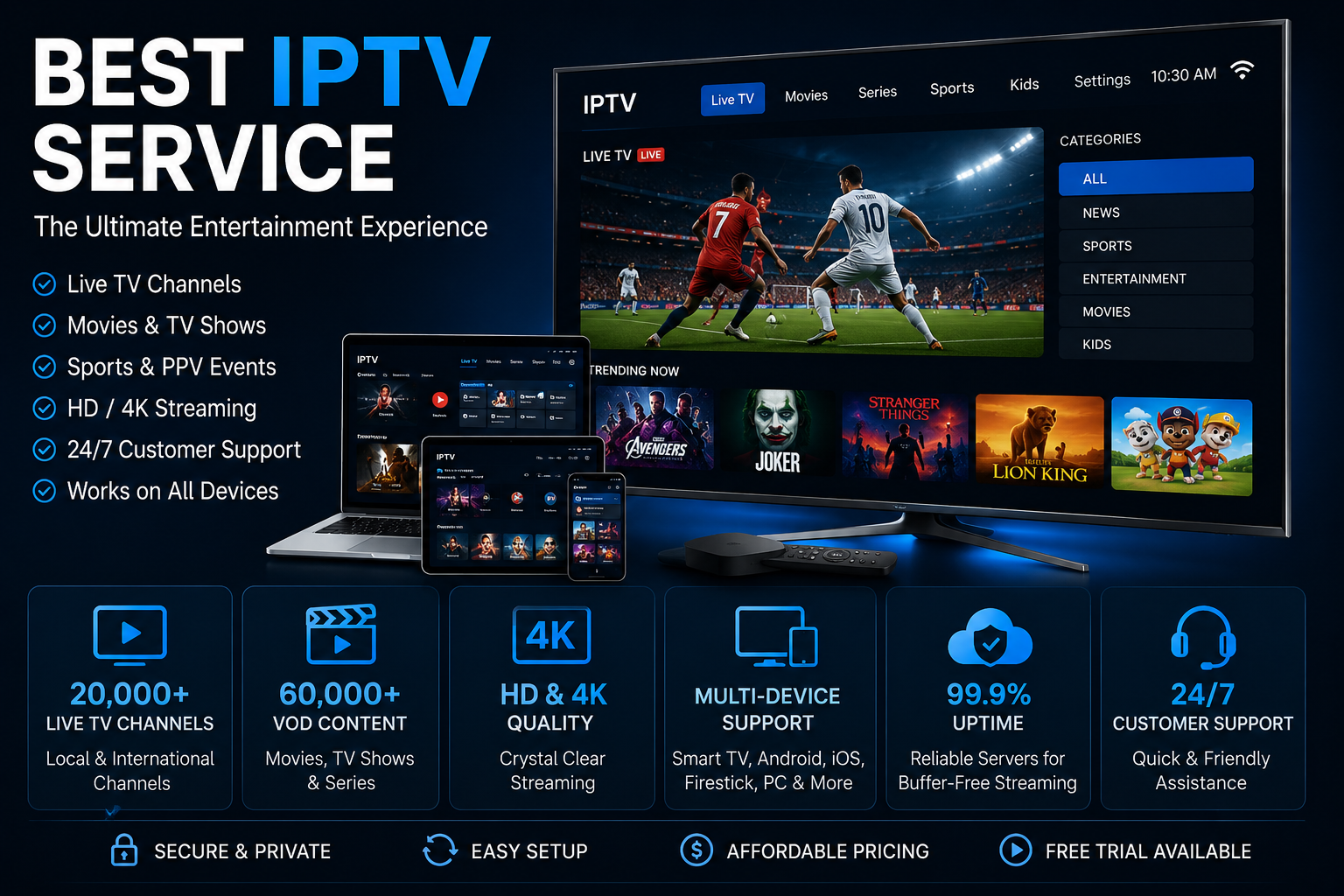
IPTV Service 2026: The Complete Guide to Streaming TV Online

Streaming has completely transformed how people watch television. At the center of this revolution is the IPTV service — a technology that delivers live TV, movies, sports, and on-demand content through your internet connection instead of cable or satellite. In 2026, IPTV is no longer a niche technology. It's the way millions of households around the world watch television every single day.
Whether you're cutting the cord for the first time, looking to upgrade your streaming setup, or just curious about what IPTV actually is, this guide covers everything you need to know — from the basics to choosing the right provider for your needs.
What Is an IPTV Service?
IPTV stands for Internet Protocol Television. Unlike traditional broadcasting that sends signals over the air or through a cable, an IPTV service transmits television content as data packets over the internet using the same protocols used for web browsing and email.
This approach has several major advantages. The content is delivered directly to your device on demand, meaning you're not tied to a broadcast schedule. IPTV also allows for two-way communication between the provider and viewer, which enables features like catch-up TV, video-on-demand libraries, and electronic program guides that update in real time.
How Does IPTV Work?
When you press play on an IPTV channel, here's what happens behind the scenes:
- Your device sends a request to the IPTV server.
- The server finds and streams the relevant content as a data packet.
- Your device's IPTV application decodes and displays the stream.
- The process is continuous and near-real-time, giving you live TV with minimal delay.
This entire process requires a stable internet connection — typically at least 10 Mbps for HD content and 25 Mbps or more for 4K Ultra HD streams.
Types of IPTV Services
There are several formats under the IPTV umbrella:
- Live IPTV: Real-time broadcast of live TV channels, sports, and news.
- Video on Demand (VOD): A library of movies and TV shows you can watch anytime.
- Time-Shifted TV: Watch previously aired content hours or days after broadcast.
- Catch-Up TV: Access programs you missed from the past 7 days.
Why IPTV Services Are Exploding in Popularity in 2026
The shift away from traditional cable and satellite has been building for years, but 2026 marks a tipping point. Research shows cord-cutting is at an all-time high, with tens of millions of households in North America, Europe, and Asia making the switch to internet-based TV solutions. Here's why:
Cost Savings
The average cable bill in the US exceeds $120 per month. A quality IPTV service typically costs between $10 and $30 per month, delivering more content at a fraction of the price. That's a saving of $1,000 or more per year for many households.
More Content, More Flexibility
Premium IPTV providers offer tens of thousands of live channels from around the world — sports, entertainment, news, kids' programming, international content — alongside massive VOD libraries. You're not stuck with a channel package designed by a cable company. You get everything.
Device Compatibility
IPTV works on virtually any screen: Smart TVs, Android boxes, Fire TV Sticks, iPhones, Android phones, tablets, PCs, and MACs. One subscription can cover your entire household across multiple devices simultaneously.
No Long-Term Contracts
Most IPTV providers offer monthly or annual plans with no long-term commitment. You can cancel, upgrade, or switch any time. Compare that to the 2-year contracts common with cable providers.
Key Features to Look for in an IPTV Service
Not all IPTV services are equal. Here's what separates a good provider from a great one:
Channel Count and Quality
Look for providers offering 10,000+ channels across multiple countries and genres. More importantly, check that those channels are available in HD and 4K — not just listed but actually streaming at high quality.
Server Uptime and Stability
Buffering is the number-one complaint about IPTV. The best services maintain 99.9% uptime with robust server infrastructure and multiple redundant streams for popular channels. Ask about their uptime guarantees and check independent reviews.
Electronic Program Guide (EPG)
A proper EPG lets you see what's on now and what's coming up — just like a traditional TV guide. This is essential for planning your viewing and navigating large channel libraries.
VOD Library
A strong on-demand library of movies and series — updated regularly with new releases — adds enormous value to any IPTV subscription. Look for providers with 10,000+ VOD titles.
Multi-Screen Support
If you have multiple TVs or family members on different devices, you'll want a plan that supports at least 2-3 simultaneous connections.
Customer Support
Good IPTV providers offer 24/7 support via live chat or ticket system. Before subscribing, test their response time with a pre-sales question.
Top Devices for IPTV Streaming in 2026
| Device | Best For | Notes |
|---|---|---|
| Android TV Box | Living room setup | Full app store, best app compatibility |
| Amazon Fire TV Stick 4K | Budget-friendly | Easy setup, Alexa integration |
| Smart TV (built-in) | Simple setup | Works with Samsung, LG, Sony apps |
| MAG Box | Dedicated IPTV users | Hardware optimized for IPTV |
| iPhone / Android Phone | Mobile viewing | Great for travel |
| PC / Mac | Desktop streaming | Use VLC or dedicated app |
How to Set Up an IPTV Service
Getting started with IPTV is simpler than most people expect. Here's the basic process:
Step 1: Choose a Provider
Research providers based on channel count, pricing, device support, and customer reviews. Look for one that offers a free trial so you can test the service before committing.
Step 2: Subscribe and Get Your Credentials
After subscribing, you'll receive a username, password, and server URL — or an M3U playlist file — depending on your provider.
Step 3: Install an IPTV App
Popular IPTV apps include IPTV Smarters Pro, TiviMate, GSE Smart IPTV, and Perfect Player. Most are free or low-cost.
Step 4: Enter Your Credentials
Open the app, enter your server details, and your channels will load within seconds. Most apps also automatically pull EPG data.
Step 5: Optimize Your Setup
For the best experience, connect via Ethernet rather than Wi-Fi where possible, and ensure your router can handle streaming speeds. A VPN is also recommended for privacy.
IPTV Service Pricing: What to Expect in 2026
Pricing varies widely across the IPTV market. Here's a general breakdown:
| Plan Type | Average Monthly Cost | Typical Features |
|---|---|---|
| Basic | $8–$12 | 5,000–10,000 channels, 1 connection |
| Standard | $13–$20 | 15,000+ channels, VOD, 2 connections |
| Premium | $20–$30 | 20,000+ channels, 4K, 4+ connections |
| Annual | $80–$150/year | All features, best value |
Be wary of services priced significantly below market rate. Extremely cheap providers often cut corners on server quality, resulting in constant buffering and outages.
IPTV vs. Cable vs. Satellite: 2026 Comparison
Cost
IPTV wins decisively. At $10–$30/month versus cable's $80–$150/month, the savings are substantial over any period of time.
Content Variety
IPTV offers the widest range of international channels, niche sports, and foreign-language content — far beyond what any cable or satellite package provides.
Installation
IPTV requires no technician visit, no satellite dish, and no cable box rental. You're up and running in 15 minutes on your existing devices.
Reliability
Cable and satellite have an edge on raw reliability for basic channels. However, top-tier IPTV providers have closed this gap significantly, and unlike satellite, IPTV isn't affected by weather conditions.
Common IPTV Myths Debunked
Myth 1: IPTV Is Complicated to Set Up
Reality: Setup takes less than 15 minutes. Most providers offer step-by-step guides for every device type.
Myth 2: IPTV Always Buffers
Reality: Buffering is a server quality issue, not an IPTV technology issue. Premium providers invest heavily in infrastructure to eliminate buffering entirely.
Myth 3: You Need a Special TV
Reality: Any TV with an HDMI port can become an IPTV screen with a $30–$50 streaming stick or box.
IPTV Service for Every Lifestyle: Who Benefits Most?
An IPTV service works for virtually every type of viewer, but certain groups get the most dramatic benefit from making the switch:
Sports Fans
Live sports was traditionally the last thing keeping cable subscribers locked in. Premium IPTV has solved this problem decisively. You get NFL, NBA, MLB, NHL, Premier League, Champions League, UFC, boxing, Formula 1, cricket, rugby, and virtually every major sport covered — often in HD and 4K — at a fraction of what cable sports packages cost. Many services even include PPV events like UFC numbered shows within the base subscription, potentially saving you hundreds of dollars per year.
International Communities and Expats
For anyone living away from their home country, IPTV is genuinely transformative. Want BBC News in the US? Pakistani drama channels in the UK? Indian cricket coverage in Canada? IPTV carries channels from dozens of countries, making it the only realistic way to access home-country content without expensive satellite setups or geo-blocked streaming services.
Families
Multi-connection IPTV plans let every family member watch something different simultaneously. Kids can watch cartoons on a tablet, parents can catch a live match on the TV, and someone else can browse the VOD library on a laptop — all on one subscription. The total cost is still less than a single cable package that no one fully uses.
Budget-Conscious Households
For households watching their spending, switching from cable to a quality IPTV service is one of the simplest ways to save $100+ per month without sacrificing any content. The savings are immediate, ongoing, and compound year over year.
IPTV Service and 4K Streaming: What You Need to Know
4K Ultra HD IPTV is one of the most exciting developments in streaming in 2026. Here's what makes a great 4K IPTV experience:
Resolution and Bitrate
True 4K is 3840x2160 pixels — four times the resolution of 1080p HD. But resolution alone doesn't determine picture quality. Bitrate matters just as much: 4K streams need at least 20–25 Mbps to look genuinely sharp without compression artifacts. Providers streaming "4K" at 8 Mbps are delivering a heavily compressed image that doesn't look significantly better than good HD.
HDR Support
The best IPTV 4K streams support HDR10 or Dolby Vision for expanded color range and contrast. This makes the biggest visible difference on OLED and QLED TVs. When evaluating 4K IPTV, ask specifically about HDR support.
Device Requirements
To fully enjoy 4K IPTV, you need: a 4K TV, a streaming device capable of decoding HEVC/H.265 (most 2022+ devices qualify), and a broadband connection of at least 25 Mbps stable speed. All of these are now affordable and widely available.
Frequently Asked Questions About IPTV Service
Conclusion: Is an IPTV Service Right for You in 2026?
If you're paying over $80 a month for cable TV, the answer is almost certainly yes. A quality IPTV service delivers more channels, more content, more flexibility, and dramatically lower costs than any traditional TV package. With the right provider, setup takes minutes, and the experience — especially for sports and live TV — rivals anything cable can offer.
The key is choosing a provider with quality infrastructure. Look for strong uptime records, responsive support, a proper EPG, and a free trial to test before you commit. In 2026, there are excellent options available at every price point.
The cord-cutting era is fully here. IPTV is leading the way.

 عربي
عربي