


 SPARK Website
IPTV Service Providers: The 2026 Buyer's Guide
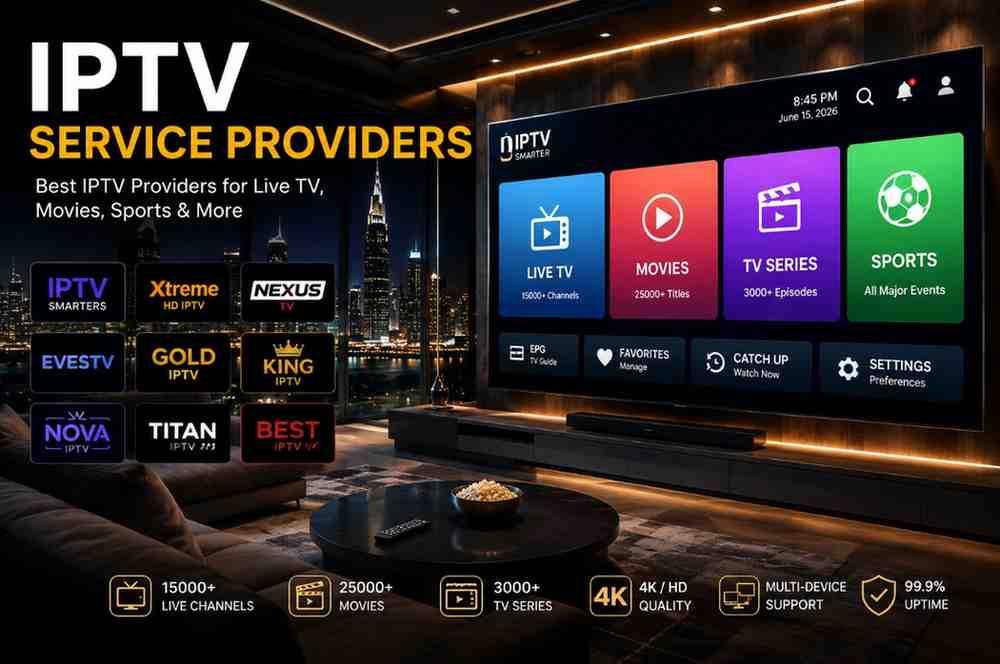
IPTV Service Providers: The 2026 Buyer's Guide
Who Are IPTV Service Providers and What Do They Offer?
IPTV service providers are companies or individuals that deliver television content over the internet using the IPTV protocol. Unlike traditional cable or satellite operators that require physical infrastructure installation at your home, IPTV service providers deliver all content digitally via your existing broadband connection. In 2026, the range of IPTV service providers spans from global telecommunications giants to small specialist operators catering to specific regional audiences or content niches.
What unites all premium IPTV service providers is their commitment to delivering a television experience that equals or surpasses cable and satellite in quality, while dramatically reducing cost and increasing flexibility. The best providers in 2026 offer not just more channels at a lower price, but genuinely superior features: 4K streams, accurate program guides, massive on-demand libraries, and multi-device support that cable simply cannot match.
The Market for IPTV Service Providers in 2026
The IPTV market has matured significantly. In previous years, the space was dominated by technically sophisticated early adopters willing to tolerate setup complexity and occasional unreliability. In 2026, the market has reached mainstream consumers. Apps have become user-friendly, setup takes minutes rather than hours, and the reliability of premium IPTV service providers is genuinely competitive with traditional pay TV.
Market research estimates over 150 million active IPTV subscribers globally in 2026, a number that has grown by more than 40% since 2023. This growth has been driven by cord-cutting trends in North America, the expansion of broadband infrastructure in emerging markets, and the growing popularity of international content consumption among diaspora communities worldwide.
What IPTV Service Providers Must Deliver in 2026
Channel Breadth and Depth
The baseline expectation for premium IPTV service providers in 2026 is 15,000+ live channels. The best providers exceed 20,000. This should include comprehensive coverage of major markets: all major US networks and cable channels, UK terrestrial and pay TV, Canadian broadcasting, major European national broadcasters, Arabic news and entertainment networks, South Asian channels, Latin American content, and more.
Beyond sheer numbers, channel quality matters. A provider with 20,000 channels where half are low-quality, rarely working, or redundant is inferior to a curated provider with 15,000 consistently reliable, high-quality streams.
Sports Coverage
Sports rights represent the most valuable and technically demanding content category for IPTV service providers. Premier League, La Liga, Champions League, NFL, NBA, MLB, NHL, UFC, Formula 1, boxing, cricket, tennis (Grand Slams), golf (Masters, US Open), rugby, and Australian sports all have dedicated fan bases that demand reliable, low-latency streaming with quality commentary options.
The best IPTV service providers invest in dedicated sports server capacity, launching additional server resources before and during major events to ensure stream stability. This infrastructure investment is one of the clearest differentiators between tier-one and tier-two providers.
International and Multilingual Content
One of the most compelling advantages of premium IPTV service providers over traditional cable is the depth of international content. For expat communities, diaspora households, and fans of international cinema and television, the ability to access content from 50+ countries in their original languages is transformative. Top providers offer dedicated category sections for Arabic, French, German, Spanish, Portuguese, Italian, Urdu, Hindi, Chinese, and many other language groups.
Video on Demand
VOD libraries have become a critical differentiator between IPTV service providers. Premium providers maintain libraries of 50,000 to 100,000+ titles, updated within 24–48 hours of new digital releases. Well-organized libraries with effective search functionality, curated collections, and accurate metadata transform the VOD experience from a browsing exercise into a genuinely enjoyable discovery platform.
How IPTV Service Providers Are Changing Television
The impact of IPTV service providers on the broader television industry has been profound. Traditional pay TV providers have been forced to respond to IPTV competition with more flexible packages, lower prices, and their own internet-delivered products. In many markets, the traditional cable operator is effectively becoming an IPTV provider itself — dropping satellite infrastructure in favor of internet delivery.
For consumers, this competition has been entirely positive. Prices have fallen, content variety has increased, and the technology has improved dramatically. The beneficiaries of this market transformation are the viewers who are now able to access more content, at higher quality, across more devices, for less money than ever before.
Questions to Ask Before Subscribing to an IPTV Service Provider
| Question | Why It Matters |
|---|---|
| Do you offer a free trial? | Confidence indicator; all quality providers do |
| What is your uptime guarantee? | Reveals infrastructure investment level |
| How many channels are in HD/4K? | Quality indicator beyond raw channel count |
| How many connections does my plan include? | Multi-viewer household planning |
| What apps are compatible? | Device compatibility verification |
| What is your support response time? | Service accountability indicator |
| Are there any setup fees? | Pricing transparency check |
| Can I upgrade or downgrade my plan? | Flexibility for changing needs |
The Future of IPTV Service Providers Beyond 2026
Several trends will shape the IPTV provider market over the next several years. AI-driven content recommendation is already appearing in the most advanced providers' apps, learning viewing habits to suggest live channels and VOD content that matches individual preferences. Personalized ad insertion for ad-supported tier services is another emerging trend, allowing providers to offer lower-cost plans while maintaining revenue.
Cloud DVR functionality — the ability to record live TV to cloud storage for later viewing — is increasingly standard among premium providers. True 8K streaming capability is on the horizon, though practical consumer demand for it will likely remain limited until 2028 or later given current TV and internet infrastructure constraints.
How IPTV Service Providers Handle Content Updates and New Channels
One differentiator that is often overlooked when comparing IPTV service providers is how quickly and reliably they update their channel lineup. Broadcasting is a dynamic industry — channels launch, rebrand, merge, and occasionally shut down. Sports rights change hands between broadcasters. Streaming URLs change when providers update their infrastructure. A quality IPTV service provider monitors these changes continuously and updates their channel list accordingly, often within hours of a change occurring.
This is operationally demanding work. Monitoring thousands of channel stream sources, detecting failures, sourcing replacement URLs, and deploying updates requires dedicated technical staff. Budget providers that lack this operational capability let channels go dark for days or weeks without updates, leading to the frustrating experience of finding your favorite channel listed but not working. Premium providers treat channel uptime as a core service metric with dedicated monitoring teams.
IPTV Service Providers and 4K Technology: The 2026 State of Play
4K IPTV has crossed the threshold from premium feature to standard offering among leading IPTV service providers in 2026. The enabling factors have been the widespread adoption of 4K TVs (now the majority of new TV purchases), improvements in HEVC (H.265) and AV1 compression that make 4K streaming practical at 15–25 Mbps, and the expansion of 4K broadcast production to cover major sports events and entertainment premieres.
For subscribers, 4K IPTV delivers a picture quality that genuinely surpasses standard HD in ways that are immediately visible on a large screen — sharper resolution, richer color depth, and improved contrast, particularly when combined with HDR (High Dynamic Range). The best IPTV service providers in 2026 offer 4K streams for flagship sports events (NFL, Premier League, Champions League, Olympics), major entertainment channels, and their premium VOD libraries.
To access 4K IPTV, your setup needs to meet three requirements: a 4K HDR TV (or monitor), a streaming device that supports HEVC or AV1 4K decoding (Nvidia Shield, Firestick 4K Max, or high-end Android TV box), and an internet connection of at least 25 Mbps for reliable 4K streaming. Most current-generation setups in 2026 meet these requirements, making 4K IPTV a practical reality for the majority of subscribers.
Building Your IPTV Setup: A 2026 Equipment Guide
For viewers setting up IPTV service for the first time, choosing the right equipment makes a significant difference:
Recommended Streaming Devices
- Best overall: Nvidia Shield TV Pro — handles 4K AV1, Dolby Vision, and Atmos; best performance for demanding streams
- Best value: Amazon Firestick 4K Max (3rd Gen) — affordable, 4K capable, widely compatible with IPTV apps
- Best for Smart TV integration: Chromecast with Google TV — seamless integration with Google ecosystem, solid IPTV app support
- Best budget option: Xiaomi Mi Box S (2nd Gen) — under $60, Android TV, good performance for HD streams
Recommended Network Equipment
- Router: Wi-Fi 6 (802.11ax) capable router for households with multiple simultaneous streams. TP-Link Archer AX73 or Asus RT-AX86U are excellent value options.
- Network switch: If multiple TVs need wired connections, a simple 5-port or 8-port Gigabit Ethernet switch allows connection sharing from a single router port.
- Powerline adapter: For rooms where running Ethernet cable is impractical, powerline adapters deliver a wired-quality connection through existing electrical circuits. TP-Link AV2000 or similar offers sufficient throughput for 4K streams.
IPTV Service Providers for Business and Enterprise Use in 2026
While most coverage of IPTV service providers focuses on residential use, the enterprise and commercial segment has grown significantly in 2026. Hotels, sports bars, corporate offices, waiting rooms, and healthcare facilities are increasingly replacing traditional satellite TV with IPTV solutions that offer more content flexibility, simpler installation, and lower ongoing costs.
Commercial IPTV service providers in the enterprise segment typically offer dedicated server infrastructure separate from their consumer services, ensuring that commercial clients do not compete for bandwidth with residential subscribers. Enterprise plans include the appropriate public performance licensing, multi-screen management dashboards, and often dedicated account managers for large installations.
For smaller commercial venues like independent bars and cafes, the most practical approach in 2026 is a commercial-tier subscription from a provider that explicitly covers commercial use rights. These plans are priced above residential tiers to reflect the licensing costs and typically start at $80–$200 per month depending on the number of screens and content included. The savings versus a traditional satellite TV commercial subscription remain substantial.
Corporate offices using IPTV for internal communications, news feeds, and broadcast TV in communal areas represent another growing segment. Enterprise IPTV solutions for this use case typically include content management dashboards allowing administrators to schedule specific channels on specific screens at specific times, integrate internal video content with external broadcast channels, and monitor display status across a multi-screen network from a central interface.
Frequently Asked Questions About IPTV Service Providers
Summary: Finding the Right IPTV Service Provider for 2026
The variety and quality of IPTV service providers available in 2026 means there is a strong match for virtually every viewer's needs, preferences, and budget. The key is to approach the selection process systematically: define your must-have channels and features, take advantage of trial periods to verify real-world performance, and choose a provider with a track record of reliability and responsive support. The savings versus traditional pay TV are substantial, the content variety is unmatched, and the flexibility to watch on any device anywhere is something cable simply cannot offer.

 عربي
عربي