


 SPARK Website
Thoracolumbar Spine Devices Market Share, Competitive Landscape, and Regional Insights 2034
Thoracolumbar Spine Devices Market
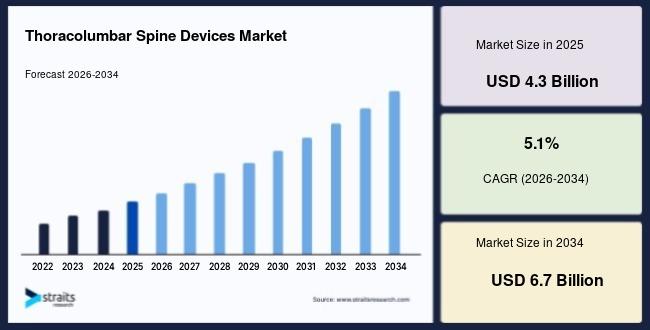
The global thoracolumbar spine devices market size was valued at USD 4.3 billion in 2025 and is projected to grow from USD 4.5 billion in 2026 to USD 6.7 billion by 2034, expanding at a CAGR of 5.1% during the forecast period (2026-2034). The market growth is driven by the rising prevalence of spinal disorders, increasing number of spinal surgeries, growing geriatric population, and continuous advancements in minimally invasive spine treatment technologies.
Thoracolumbar spine devices are specialized medical implants and instruments used to diagnose, stabilize, and treat conditions affecting the thoracic and lumbar regions of the spine. These devices are commonly used for spinal fusion procedures, fracture stabilization, deformity correction, and the treatment of degenerative disc diseases. The increasing demand for advanced surgical procedures and improved patient outcomes is significantly contributing to the growth of the thoracolumbar spine devices market.
For detailed market insights, growth forecasts, and competitive analysis,
visit: https://straitsresearch.com/report/thoracolumbar-spine-devices-market
Market Drivers
Rising Prevalence of Spinal Disorders and Age-Related Conditions
The growing incidence of spinal disorders such as degenerative disc disease, spinal stenosis, scoliosis, and vertebral fractures is a major factor driving the thoracolumbar spine devices market. The rapidly aging global population is more susceptible to these conditions, increasing the demand for effective spinal implants and surgical interventions. As life expectancy rises, healthcare providers are witnessing a greater need for advanced spine treatment solutions.
Technological Advancements in Spine Surgery
Continuous innovations in spinal implants, navigation systems, and minimally invasive surgical techniques are accelerating market growth. Modern thoracolumbar spine devices offer improved precision, enhanced durability, and faster patient recovery. The integration of advanced materials, 3D-printed implants, and robotic-assisted surgery is further transforming the spine care industry.
Increasing Number of Spinal Surgical Procedures
The growing awareness regarding spinal health and the availability of advanced treatment options have resulted in an increasing number of spinal surgeries worldwide. Improved healthcare infrastructure, better diagnostic technologies, and higher healthcare expenditure are encouraging patients to opt for surgical treatment, thereby increasing demand for thoracolumbar spine devices.
Market Challenges
High Cost of Spine Surgical Procedures and Devices
The high cost associated with advanced spinal implants, surgical equipment, and postoperative care remains a significant challenge for market expansion. The financial burden of spine procedures can limit access to treatment, especially in developing regions where healthcare reimbursement policies may be less favorable.
Risk of Surgical Complications and Stringent Regulatory Requirements
Although spinal technologies have improved significantly, procedures involving thoracolumbar devices still carry risks such as infections, implant failures, and revision surgeries. Moreover, manufacturers must comply with strict regulatory standards and clinical evaluation requirements, which can increase product development costs and delay market entry.
Market Segmentation
By Product Type
Based on product type, the thoracolumbar spine devices market is segmented into spinal fusion devices, spinal fixation systems, vertebral compression fracture treatment devices, and motion preservation devices. Spinal fusion devices account for a substantial market share due to their widespread use in treating degenerative spinal conditions and providing long-term spinal stability. Meanwhile, motion preservation devices are expected to witness considerable growth due to increasing demand for procedures that maintain natural spinal movement.
By Surgery Type
Based on surgery type, the market is categorized into open surgery and minimally invasive surgery. Minimally invasive surgery is expected to witness significant growth owing to benefits such as smaller incisions, reduced blood loss, shorter hospital stays, and faster recovery periods. However, open surgeries continue to maintain a considerable share for complex spinal procedures.
By End User
The end-user segment includes hospitals, ambulatory surgical centers, and specialty clinics. Hospitals dominate the market because of the availability of advanced surgical infrastructure, experienced healthcare professionals, and high patient admission rates for spinal procedures. Ambulatory surgical centers are also gaining popularity due to cost-effective treatments and shorter patient recovery times.
Regional Insights
North America
North America holds the largest share of the thoracolumbar spine devices market due to its advanced healthcare infrastructure, high adoption of innovative surgical technologies, and increasing prevalence of spinal disorders. The presence of leading medical device manufacturers and favorable reimbursement policies further supports regional market growth.
Europe
Europe represents a significant market due to increasing geriatric population, rising healthcare expenditure, and growing adoption of minimally invasive spine surgeries. Countries such as Germany, France, and the United Kingdom are major contributors due to their well-established healthcare systems and strong focus on technological innovation.
Asia-Pacific
Asia-Pacific is expected to register the fastest growth during the forecast period due to expanding healthcare infrastructure, increasing awareness about spinal treatment options, and rising healthcare investments. Countries including China, India, and Japan are witnessing increased demand for advanced spinal devices due to their large patient populations and improving access to medical services.
Latin America, Middle East, and Africa
The Latin America, Middle East, and Africa region is experiencing gradual growth due to improving healthcare facilities, increasing investments in medical technologies, and growing awareness regarding spinal health. The expansion of private healthcare services and greater access to specialized surgical treatments are expected to support market growth.
Key Players Analysis
The thoracolumbar spine devices market is highly competitive, with companies focusing on product innovation, strategic collaborations, acquisitions, and the development of advanced minimally invasive solutions. Leading manufacturers are investing in research and development to introduce technologically advanced implants, navigation systems, and robotic-assisted surgical technologies to strengthen their global market position.
Key companies operating in the market include:
-
Medtronic plc
-
Johnson & Johnson (DePuy Synthes)
-
Stryker Corporation
-
Zimmer Biomet Holdings Inc.
-
Globus Medical Inc.
-
NuVasive Inc.
-
Orthofix Medical Inc.
-
B. Braun Melsungen AG
-
RTI Surgical Holdings Inc.
-
SeaSpine Holdings Corporation
Conclusion
The global thoracolumbar spine devices market is expected to witness steady growth, increasing from USD 4.3 billion in 2025 to USD 6.7 billion by 2034 at a CAGR of 5.1% during the forecast period (2026-2034). Rising cases of spinal disorders, increasing adoption of minimally invasive procedures, and ongoing technological advancements in spinal implants are driving market expansion. Despite challenges related to high treatment costs and strict regulatory requirements, continuous innovation and expanding healthcare accessibility are expected to create significant opportunities for market participants.
About Us
Straits Research is a leading market research and intelligence organization specializing in research, analytics, and advisory services. The company provides comprehensive market reports, industry insights, and strategic business intelligence across multiple industries, helping organizations identify growth opportunities and make informed business decisions.
Contact Us
Email: sales@straitsresearch.com
Tel: +1 646 905 0080 (U.S.)
Tel: +44 203 695 0070 (U.K.)

 English