


 SPARK Website
AI Audit Tools vs Traditional Auditing: A Complete Comparison for Modern Businesses
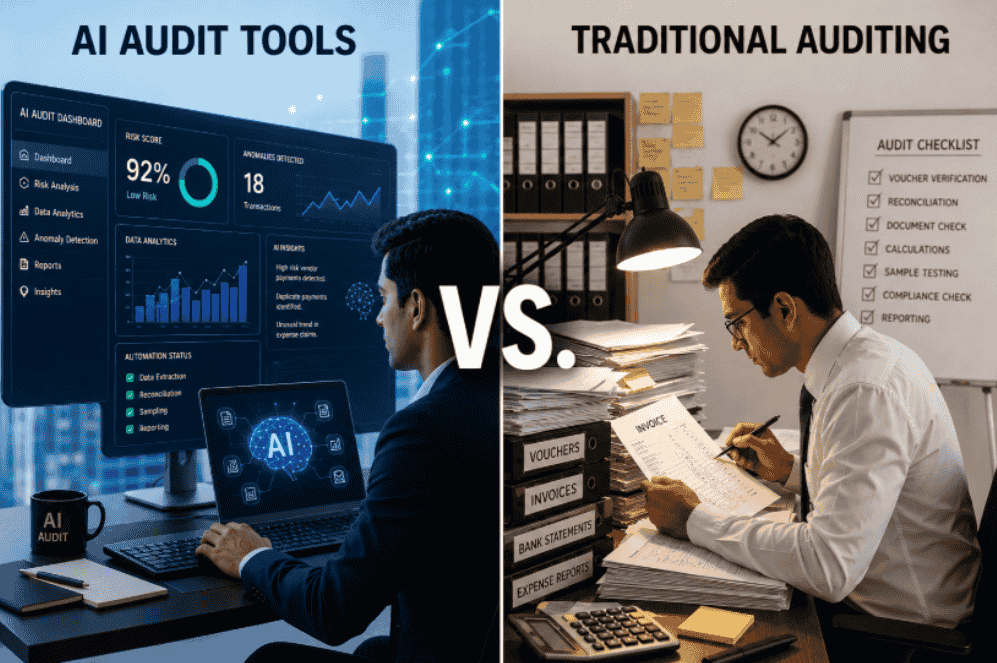
The auditing profession is undergoing a significant transformation as artificial intelligence (AI) becomes increasingly integrated into business operations. Organizations are looking for faster, more accurate, and more efficient ways to manage audits, leading to the growing adoption of AI-powered audit solutions. As a result, the debate surrounding AI audit tools vs traditional auditing has become more relevant than ever.
While traditional auditing has served as the foundation of financial assurance and compliance for decades, AI audit tools are introducing advanced automation, real-time analytics, and enhanced risk detection capabilities. Understanding the differences between these approaches is essential for modern businesses seeking to improve audit quality and operational efficiency.
In this guide, we'll explore AI audit tools vs traditional auditing, examining their benefits, limitations, and the role each plays in today's business environment.
What Are AI Audit Tools?
AI audit tools are software solutions that use artificial intelligence, machine learning, data analytics, and automation to assist auditors in reviewing financial records, compliance data, and business processes.
These tools can:
- Analyze large volumes of data quickly
- Detect anomalies and unusual transactions
- Automate repetitive audit tasks
- Improve risk assessment
- Generate real-time insights
- Enhance audit documentation
Platforms such as AUDITCONFIRM and other modern audit technologies help organizations streamline audit workflows while improving accuracy and transparency.
What Is Traditional Auditing?
Traditional auditing refers to the conventional audit process performed primarily by human auditors. This method relies on:
- Manual data collection
- Sample-based testing
- Spreadsheet analysis
- Physical document reviews
- Professional judgment
- Face-to-face client interactions
Traditional auditing remains widely used because it emphasizes critical thinking, professional skepticism, and regulatory compliance.
AI Audit Tools vs Traditional Auditing: Key Differences
1. Data Analysis Capabilities
One of the biggest distinctions in AI audit tools vs traditional auditing is how data is analyzed.
AI Audit Tools
- Review entire datasets
- Process millions of transactions rapidly
- Identify hidden patterns and anomalies
- Provide predictive insights
Traditional Auditing
- Uses sample-based testing
- Relies on manual reviews
- Requires more time to identify issues
- Limited by human capacity
Winner: AI Audit Tools
2. Audit Efficiency
Efficiency is often the primary reason businesses explore AI-powered auditing solutions.
AI Audit Tools
- Automate repetitive tasks
- Reduce manual workload
- Speed up audit completion
- Generate reports automatically
Traditional Auditing
- Requires extensive manual effort
- Time-consuming documentation processes
- Higher labor requirements
Winner: AI Audit Tools
3. Accuracy and Error Reduction
Human errors can occur during data entry, calculations, and document reviews.
AI Audit Tools
- Consistent data processing
- Reduced manual errors
- Continuous monitoring capabilities
Traditional Auditing
- Subject to human mistakes
- Dependent on auditor experience
Winner: AI Audit Tools
4. Professional Judgment
Technology cannot fully replace human decision-making.
AI Audit Tools
- Analyze data objectively
- Identify risks automatically
Traditional Auditing
- Applies professional skepticism
- Evaluates context and business circumstances
- Handles complex judgment calls
Winner: Traditional Auditing
5. Fraud Detection
Fraud detection is another area where AI audit tools vs traditional auditing reveals major differences.
AI Audit Tools
- Detect suspicious patterns instantly
- Monitor transactions continuously
- Use machine learning to identify emerging risks
Traditional Auditing
- Relies on periodic reviews
- May overlook hidden fraud patterns
Winner: AI Audit Tools
Benefits of AI Audit Tools for Modern Businesses
Organizations adopting AI-powered auditing solutions often experience several advantages.
Increased Efficiency
AI significantly reduces the time required for audit procedures, allowing auditors to focus on strategic tasks.
Better Risk Identification
Advanced analytics help identify unusual transactions and compliance risks before they become major problems.
Enhanced Data Coverage
Unlike sample-based audits, AI can evaluate complete datasets for more comprehensive insights.
Cost Savings
Automation reduces manual labor and improves overall productivity.
Continuous Auditing
Businesses can monitor transactions throughout the year rather than waiting for periodic audit reviews.
Benefits of Traditional Auditing
Despite technological advancements, traditional auditing remains valuable.
Human Expertise
Experienced auditors can interpret complex situations and provide recommendations based on professional judgment.
Regulatory Compliance
Many regulations still require auditor oversight and independent evaluation.
Stakeholder Trust
Human involvement often increases confidence among investors, regulators, and management teams.
Ethical Decision-Making
Auditors can assess circumstances that may not be fully understood by automated systems.
Challenges of AI Audit Tools
When evaluating AI audit tools vs traditional auditing, businesses should consider potential challenges.
Initial Implementation Costs
Deploying AI solutions may require significant investments in software, infrastructure, and training.
Data Quality Dependence
AI systems perform best when working with accurate and complete data.
Technical Expertise Requirements
Organizations may need skilled personnel to manage and optimize AI tools.
Regulatory Considerations
Audit standards continue evolving to address AI-driven auditing practices.
Challenges of Traditional Auditing
Traditional auditing also presents several limitations.
Higher Costs
Manual audits often require larger teams and longer engagement periods.
Limited Data Analysis
Sample testing may not uncover all risks within a dataset.
Time-Consuming Processes
Manual reviews slow down audit completion.
Greater Risk of Human Error
Even experienced auditors can overlook anomalies during extensive reviews.
AI Audit Tools vs Traditional Auditing: Which Is Better?
The answer depends on business needs.
For organizations handling large volumes of transactions, AI audit tools offer significant advantages in speed, scalability, and risk detection.
However, traditional auditing remains essential for:
- Professional judgment
- Regulatory compliance
- Ethical decision-making
- Stakeholder communication
Rather than replacing auditors, AI is increasingly becoming a powerful tool that enhances the audit process.
The Future of Auditing
The future of auditing is likely to involve a hybrid approach that combines the strengths of both AI and traditional methods.
Businesses using platforms like AUDITCONFIRM can leverage automation and analytics while maintaining the expertise and oversight of professional auditors.
This combination delivers:
- Faster audits
- Improved accuracy
- Better fraud detection
- Stronger compliance
- Enhanced business insights
As technology continues to evolve, organizations that successfully integrate AI into their audit strategies will gain a competitive advantage.
Conclusion
The comparison of AI audit tools vs traditional auditing highlights the growing importance of technology in modern audit practices. AI solutions provide unmatched efficiency, data analysis, and fraud detection capabilities, while traditional auditing contributes professional judgment, ethical oversight, and regulatory expertise.
For most organizations, the best approach is not choosing one over the other but combining both methods to create a more effective and reliable audit process. By leveraging innovative platforms such as AUDITCONFIRM alongside experienced auditors, businesses can improve audit quality, reduce risks, and stay prepared for the future of financial assurance.

 عربي
عربي