


 SPARK Website
Automotive Crankcase Ventilation System Market Growth Driven by Emission Regulations
Automotive Crankcase Ventilation System Market
Market Overview
The Automotive Crankcase Ventilation System Market is witnessing steady growth due to rising vehicle production, tightening emission regulations, and increasing demand for fuel-efficient engine technologies. Crankcase ventilation systems play a critical role in internal combustion engines by controlling blow-by gases and redirecting crankcase vapors back into the combustion chamber, helping reduce harmful emissions and improve engine performance. These systems also contribute to lower oil contamination, enhanced engine durability, and compliance with environmental standards.
As governments worldwide continue to enforce stricter emission norms, automotive manufacturers are increasingly integrating advanced crankcase ventilation technologies into passenger and commercial vehicles. Furthermore, technological advancements in engine air management systems are driving the development of highly efficient ventilation solutions that support long-term engine reliability while minimizing hydrocarbon emissions.
Report Link:
https://www.redlinepulse.com/report/automotive-crankcase-ventilation-system-market
Market Size and Forecast
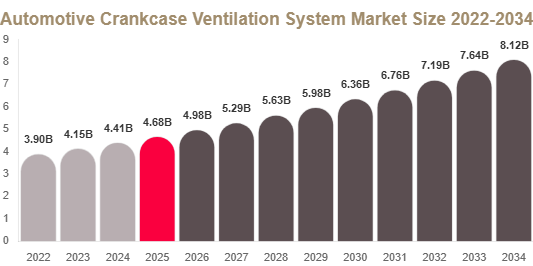
The global Automotive Crankcase Ventilation System Market was valued at USD 4.72 billion in 2025 and is estimated to reach USD 4.98 billion in 2026. The market is projected to reach USD 8.15 billion by 2034, expanding at a CAGR of 6.3% during the forecast period from 2025 to 2034.
Market growth is being supported by increasing automotive production, growing demand for low-emission engines, and continuous innovation in emission control technologies. As automakers focus on improving fuel efficiency and meeting regulatory requirements, advanced crankcase ventilation systems are becoming increasingly important across modern vehicle platforms.
Market Drivers
Stringent Vehicle Emission Regulations Supporting System Adoption
One of the primary drivers of the Automotive Crankcase Ventilation System Market is the implementation of increasingly strict vehicle emission regulations. Regulatory authorities across North America, Europe, and Asia Pacific are enforcing standards designed to reduce harmful emissions from internal combustion engines.
Crankcase ventilation systems help control blow-by gases and prevent their release into the atmosphere, enabling vehicles to comply with environmental regulations while maintaining engine efficiency and durability. Continuous regulatory updates are encouraging manufacturers to invest in advanced filtration, oil separation, and pressure management technologies.
Rising Global Production of Passenger and Commercial Vehicles
Growing production of passenger and commercial vehicles is another major factor supporting market expansion. Every internal combustion engine requires a crankcase ventilation system to ensure proper operation and regulatory compliance.
Increasing vehicle ownership, expansion of logistics fleets, infrastructure development projects, and rising demand for commercial transportation services are generating consistent demand for crankcase ventilation components. The continued dominance of internal combustion engines across many global markets further strengthens growth prospects.
Buy Now Link:
https://www.redlinepulse.com/report/automotive-crankcase-ventilation-system-market/buy-now
Market Challenges
Growing Shift Toward Battery Electric Vehicles
The transition toward battery electric vehicles represents a significant challenge for the Automotive Crankcase Ventilation System Market. Since battery electric vehicles do not use internal combustion engines, they do not require crankcase ventilation systems.
Government incentives, investments in charging infrastructure, and emission reduction initiatives are accelerating electric vehicle adoption worldwide. Although hybrid and conventional vehicles will continue to play an important role in the automotive industry, the long-term shift toward electrification may gradually reduce demand for engine-related components, including crankcase ventilation systems.
Market Opportunities
Expanding Demand for Hybrid Vehicles
Hybrid vehicles present a significant opportunity for market participants. These vehicles continue to utilize internal combustion engines while delivering improved fuel efficiency and reduced emissions.
Hybrid powertrains require advanced crankcase ventilation systems capable of supporting frequent start-stop cycles and variable engine loads. As automakers expand hybrid vehicle portfolios across major regions, demand for sophisticated ventilation technologies is expected to increase steadily.
Growth of Automotive Aftermarket Replacement Demand
The growing automotive aftermarket sector is creating recurring revenue opportunities for manufacturers and suppliers. Ventilation valves, hoses, filters, and oil separators often require maintenance or replacement during a vehicle's lifecycle.
Increasing average vehicle age, rising vehicle ownership, and growing awareness of preventive maintenance are supporting demand for aftermarket crankcase ventilation components. Independent repair facilities and service centers continue to witness increased demand for replacement solutions that enhance engine performance and emission compliance.
Market Segmentation
By Type
The Positive Crankcase Ventilation System segment dominated the market with a share of 71.84% in 2025. These systems are widely used across passenger and commercial vehicles because they effectively reduce emissions while improving engine efficiency and longevity.
The Closed Crankcase Ventilation System segment is expected to record the fastest growth, registering a CAGR of 7.1% through 2034 due to increasing demand for enhanced emission control solutions.
Segments include:
-
Positive Crankcase Ventilation System
-
Closed Crankcase Ventilation System
-
Open Crankcase Ventilation System
By Vehicle Type
Passenger Vehicles accounted for the largest market share of 68.53% in 2025. Strong demand for personal mobility, increasing vehicle ownership, and growing production volumes continue to support segment dominance.
Light Commercial Vehicles are projected to expand at the fastest CAGR of 6.8% during the forecast period due to the growth of logistics, e-commerce, and urban delivery services.
Segments include:
-
Passenger Vehicles
-
Light Commercial Vehicles
-
Heavy Commercial Vehicles
By Sales Channel
OEMs dominated the market with a share of 74.27% in 2025. Automotive manufacturers continue to integrate advanced crankcase ventilation systems during vehicle production to ensure compliance and performance.
The Aftermarket segment is expected to register the fastest CAGR of 6.7% through 2034, supported by rising demand for replacement components and preventive maintenance services.
Segments include:
-
OEM
-
Aftermarket
Regional Analysis
North America
North America accounted for 24.36% of the global Automotive Crankcase Ventilation System Market in 2025 and is projected to grow at a CAGR of 6.9% through 2034, making it the fastest-growing regional market.
The region benefits from stringent emission regulations, advanced automotive manufacturing capabilities, and increasing adoption of turbocharged and downsized engines. The United States remains the dominant market due to strong automotive production and a well-established aftermarket ecosystem.
Europe
Europe held a market share of 22.41% in 2025 and is expected to expand at a CAGR of 6.1% during the forecast period.
The region's emphasis on reducing vehicle emissions and improving fuel efficiency continues to drive adoption of advanced engine management systems. Germany leads the regional market due to its strong automotive manufacturing sector and growing production of premium vehicles equipped with advanced powertrains.
Asia Pacific
Asia Pacific dominated the Automotive Crankcase Ventilation System Market with the largest share of 43.68% in 2025 and is anticipated to grow at a CAGR of 6.5% through 2034.
Large-scale vehicle production, expanding automotive investments, rising consumer demand, and stricter emission standards continue to support regional growth. China remains the leading country market due to its extensive automotive manufacturing capabilities and growing demand for fuel-efficient vehicles.
Middle East & Africa
The Middle East & Africa accounted for 5.84% of global market revenue in 2025 and is projected to grow at a CAGR of 5.8% through 2034.
Growth is supported by expanding logistics operations, infrastructure development projects, and increasing commercial vehicle demand. Saudi Arabia leads the regional market due to significant investments in transportation infrastructure and industrial development.
Latin America
Latin America represented 3.71% of the global market in 2025 and is expected to register a CAGR of 5.9% during the forecast period.
Increasing vehicle ownership, expanding automotive manufacturing activities, and rising demand for aftermarket components continue to support market growth. Brazil dominates the region due to its large vehicle fleet and well-established automotive manufacturing industry.
Key Players
The leading companies operating in the Automotive Crankcase Ventilation System Market include:
-
MANN+HUMMEL Group
-
MAHLE GmbH
-
Cummins Inc.
-
Parker Hannifin Corporation
-
Continental AG
-
Hengst SE
-
Donaldson Company, Inc.
-
Sogefi S.p.A.
Request Sample Link:
https://www.redlinepulse.com/report/automotive-crankcase-ventilation-system-market/request-sample
Conclusion
The Automotive Crankcase Ventilation System Market is poised for sustained growth through 2034, supported by stringent emission regulations, rising vehicle production, and continued advancements in engine air management technologies. While the transition toward battery electric vehicles presents a long-term challenge, opportunities arising from hybrid vehicle adoption and expanding aftermarket demand are expected to support market expansion. With Asia Pacific maintaining market leadership and North America emerging as the fastest-growing region, manufacturers that focus on innovation, emission control performance, and engine efficiency are likely to strengthen their competitive position in the years ahead.

 English