


 SPARK Website
Lubricants Oil Drum Market Growth Opportunities and Future Forecast 2025–2034
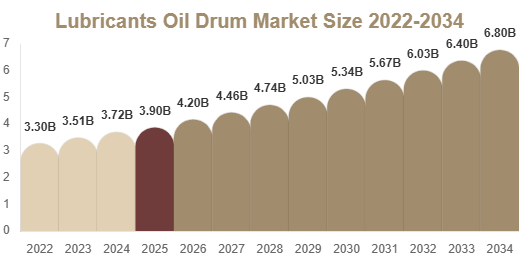
Market Size
The global lubricants oil drum market size is estimated at USD 3.9 billion in 2025, and it is projected to reach USD 4.2 billion in 2026.
By 2034, the market is expected to reach approximately USD 7.1 billion, registering a CAGR of 6.2% during 2025–2034.
Market Size Link: https://packagingmarketinsights.com/report/lubricants-oil-drum-market
Market Overview
The lubricants oil drum market plays a critical role in the industrial packaging sector by providing safe, durable, and efficient storage and transportation solutions for lubricants, oils, and related petroleum-based products. Oil drums are widely utilized across automotive, manufacturing, mining, marine, construction, and energy industries due to their ability to handle large-volume liquid products while maintaining product integrity.
The market is witnessing steady growth as global industrial activities expand and demand for lubricants continues to rise. Manufacturers are focusing on improving drum durability, sustainability, and reusability to meet evolving customer expectations and environmental regulations.
Get Your Sample Report Here: https://packagingmarketinsights.com/report/lubricants-oil-drum-market/request-sample
Market Drivers
Rising Demand from Automotive and Industrial Sectors
The increasing consumption of lubricants in automotive, industrial machinery, heavy equipment, and transportation applications is a major growth driver for the lubricants oil drum market. As industrial production and vehicle usage continue to expand globally, demand for efficient bulk packaging solutions is increasing.
Oil drums remain one of the most preferred packaging formats for bulk lubricant storage and transportation due to their durability and cost-effectiveness.
Growth in Manufacturing Activities
Rapid industrialization and expanding manufacturing operations across emerging economies are contributing significantly to market growth. Industrial machinery requires regular lubrication for efficient operation, creating sustained demand for lubricant packaging solutions.
The increasing movement of industrial oils across regional and international supply chains further supports demand for oil drums.
Increasing Preference for Reusable Packaging
Many industries are adopting reusable and recyclable packaging solutions to reduce operational costs and environmental impact. Reconditioned steel drums and reusable plastic drums are becoming increasingly popular among lubricant manufacturers and distributors.
This trend is encouraging packaging companies to invest in sustainable drum production technologies.
Market Challenges
Fluctuating Raw Material Costs
Volatility in the prices of steel, plastic resins, and other raw materials can impact manufacturing costs and profit margins. Oil drum manufacturers often face challenges in maintaining stable pricing amid changing material costs.
Environmental and Regulatory Compliance
Governments and environmental agencies are implementing stricter regulations regarding industrial packaging waste and recycling practices. Manufacturers must comply with evolving standards while ensuring packaging performance and safety.
The need for sustainable materials and recycling programs increases operational complexity and investment requirements.
Market Segmentation Analysis
By Material Type
Steel Drums
Steel drums account for a significant share of the lubricants oil drum market due to their exceptional strength, durability, and ability to safely store hazardous and non-hazardous liquids. They are widely used for large-volume lubricant transportation and long-term storage applications.
Steel drums also offer excellent resistance to physical damage during handling and transportation.
Plastic Drums
Plastic drums are gaining popularity due to their lightweight structure, corrosion resistance, and cost-efficiency. These drums are commonly used for transporting various lubricant products and industrial oils.
Advancements in high-density polyethylene (HDPE) manufacturing continue to enhance the performance and durability of plastic drums.
Fiber Drums
Fiber drums are used in specialized applications where lightweight and environmentally friendly packaging solutions are preferred. Their recyclability and lower environmental footprint make them attractive for selected industrial uses.
By Capacity
Up to 100 Liters
Oil drums with capacities below 100 liters are commonly used for smaller-scale industrial operations, workshops, and specialized lubricant applications where manageable packaging sizes are required.
100–250 Liters
The 100–250 liters segment represents one of the most widely used capacity categories. These drums provide an optimal balance between storage volume, handling convenience, and transportation efficiency.
Above 250 Liters
Large-capacity drums are extensively utilized in industrial facilities, manufacturing plants, marine operations, and bulk lubricant distribution networks. Their ability to accommodate high-volume storage requirements supports demand in large-scale operations.
By End-Use Industry
Automotive Industry
The automotive sector remains one of the largest consumers of lubricants oil drums. Engine oils, transmission fluids, and industrial lubricants require secure packaging solutions for storage and transportation.
The growth of vehicle production and aftermarket maintenance activities continues to support this segment.
Manufacturing Industry
Manufacturing facilities rely heavily on lubricants to maintain equipment efficiency and reduce operational downtime. Oil drums play an essential role in the storage and distribution of industrial lubricants within manufacturing environments.
Construction Industry
Construction equipment and heavy machinery require significant quantities of lubricants for optimal performance. This creates consistent demand for durable lubricant packaging solutions.
Marine and Energy Industries
Marine vessels, offshore facilities, and energy infrastructure depend on specialized lubricants and oils. Oil drums provide safe and reliable transportation and storage solutions for these critical applications.
Regional Analysis
North America
North America remains a prominent market due to its established industrial base, strong automotive sector, and extensive lubricant consumption. The region also benefits from advanced packaging technologies and recycling initiatives.
Europe
Europe continues to experience stable market growth driven by industrial activities, sustainability regulations, and increasing adoption of reusable packaging solutions.
Manufacturers are focusing on environmentally responsible drum production to comply with regional regulatory requirements.
Asia-Pacific
Asia-Pacific is expected to witness significant growth throughout the forecast period. Rapid industrialization, infrastructure development, increasing vehicle production, and expanding manufacturing activities are major contributors to regional demand.
Emerging economies are creating substantial opportunities for lubricant packaging manufacturers.
Latin America
Growing industrial operations, mining activities, and automotive demand are supporting the expansion of the lubricants oil drum market across Latin America.
Middle East & Africa
The region's oil and gas industry, industrial development projects, and expanding transportation sectors continue to generate demand for lubricant packaging solutions.
Top Players Analysis
The lubricants oil drum market is characterized by the presence of major packaging manufacturers focusing on product innovation, sustainability, capacity expansion, and strategic partnerships to strengthen their competitive positions.
Greif Inc.
Greif Inc. is a leading manufacturer of industrial packaging products, including steel and plastic drums. The company focuses on sustainable packaging solutions, global expansion, and customer-centric innovation.
Mauser Packaging Solutions
Mauser Packaging Solutions is recognized for its extensive portfolio of industrial packaging products. The company emphasizes reconditioning, recycling, and sustainable packaging practices to support circular economy initiatives.
SCHÜTZ GmbH & Co. KGaA
SCHÜTZ is a prominent supplier of industrial packaging systems, offering high-quality drum solutions for lubricant and chemical applications. The company continues to invest in advanced manufacturing technologies.
Time Technoplast Ltd.
Time Technoplast Ltd. maintains a strong presence in the industrial packaging sector through its diverse range of plastic drum products designed for safe liquid storage and transportation.
Balmer Lawrie & Co. Ltd.
Balmer Lawrie is a well-established packaging manufacturer known for its steel drum solutions serving lubricant, chemical, and industrial markets. The company continues to focus on quality enhancement and operational efficiency.
Sicagen India Limited
Sicagen India Limited provides industrial packaging solutions designed to meet evolving customer requirements across various end-use sectors.
Schutz Container Systems
The company offers innovative packaging products emphasizing safety, durability, and sustainability. Its extensive distribution network supports global market reach.
Future Outlook
The lubricants oil drum market is expected to witness steady growth through 2034, driven by increasing lubricant consumption, expanding industrial operations, and rising demand for bulk liquid packaging solutions. Sustainability initiatives, reusable packaging trends, and technological advancements in drum manufacturing are expected to create new growth opportunities for market participants.
Companies focusing on product durability, environmental compliance, and efficient supply chain solutions are likely to gain competitive advantages in the evolving marketplace.
Conclusion
The global lubricants oil drum market continues to play a vital role in industrial packaging and logistics operations. Growing demand from automotive, manufacturing, construction, marine, and energy sectors is supporting long-term market expansion. With the market projected to reach approximately USD 7.1 billion by 2034 at a CAGR of 6.2%, manufacturers are expected to prioritize innovation, sustainability, and operational excellence to capitalize on future growth opportunities.

 عربي
عربي